
Adopting what works and excluding what does not, while systematically targeting ongoing results, could be the personal training motto of six-time Mr. Olympia Dorian Yates. Overcomplicating the process, whether nutrition or training related, was never an option for Dorian, and his no-nonsense bodybuilding approach underscored this fact. Ever analytically sharp and commonsensical he has mastered the art of designing, with pinpoint accuracy, effective training and nutrition programs, his personal bodybuilding journey testimony to his resourcefulness.
With over 25 years' involvement in bodybuilding, many of these within the upper echelons of the iron world as the elite champion, Mr. Olympia, Dorian has seen and heard it all. Concerning nutrition he assimilated all of the knowledge he could get his hands on, and has formulated his own dietary strategies for achieving optimal bodybuilding size and conditioning.
In the following bodybuilding.com exclusive, Dorian shares much of this knowledge and provides valuable advice for those who are either new to the game or are lost in a quagmire of conflicting viewpoints. Also learn how Mr. Olympia prepared for his contests! Presented, as well, are his thoughts on the controversial topic of bodybuilding drugs.

Interview
[ Q ] I am going to start by covering the basics Dorian. Is there a specific protein range that a person should aim for to pack on muscle mass? Is the old gram per pound of bodyweight guideline still a good target?
A gram per pound is a good guideline, or a little bit more. But that should be a minimum. If you can do that then you will be safe. You can even take it up to 1.5 (grams). It all depends on the intensity of your training, but I would say that one gram per pound of body weight is a minimum - between there and 1.5.
| PROTEIN CALCULATOR |
[ Q ] Within bodybuilding, especially at the professional level, you often hear of people consuming up to 600 grams of protein per day. Is this much necessary in your view?
A lot of that will be wasted and it's taxing on the system as well. You can convert amino acids into glucose so your body can turn protein into energy and this could result with excessive protein intake. But it is an expensive way to increase your energy as well as an inefficient energy source. And your body has to eliminate it as well so it will put further stress on your system. At best it's unnecessary.
| RELATED POLL | |||
|
|||
[ Q ] Is there any credence to the belief that excessive protein intake can be damaging to the kidneys?
I'm not a medical expert but I do believe that the kidneys eliminate protein waste, so basically it's making them work harder. Unless you have an existing medical condition it's not much of a problem. Anyone with a kidney disease or disorder is well advised not to adopt a high protein diet, as they can't handle that additional stress. But for healthy kidneys I don't think there is any evidence to suggest it (excessive protein intake) is damaging, it's just making them work harder.
| FORUM THREAD | |||
|
Started By: Brendon_80  |

[ Q ] How would you describe your philosophy on nutrition?
Like everything else it is basically pretty systematic and fairly sensible. If I were to organize somebody's diet I would first of all ensure they were getting enough protein, make sure it is the right quality with first class proteins primarily. Here we are talking about eggs, whether you choose to include the yolks or not.
I would always advise if you were to have several egg whites, include a couple of yolks in there because there are some amino acids in the yolks that are slightly lacking in the whites. So it will provide a better amino acid profile if you include some yolks as well. Other good protein sources are chicken breast, turkey breast, lean beef, fish and other forms of seafood.
| RECOMMENDED EGG WHITE PRODUCT | ||
|
Of course protein supplements. If you are going to take one of these I would recommend taking one that features a combination of proteins - micellar casein and whey, along with maybe egg white protein, rather than just taking one source, like whey protein. That way (with combining) you will get a time release effect with the proteins because they are digested at different rates. Whey protein is taken very quickly into the bloodstream and there is a lot of waste, so it is not ideal on its own in most cases.
| RECOMMENDED MULTIPLE-PROTEINS PRODUCT | ||
|

[ Q ] The casein will ensure the system has a steady supply of protein over a longer period.
Yes, because the casein is more slowly digested, but you have to be aware of what type of casein it is. It has to be micellar casein, which is natural casein; it's not heat damaged. You have cheaper casein like calcium casein that is very hard to be broken down by the body and the quality is not so high.
| RECOMMENDED MICELLAR CASEIN PRODUCT | ||
|

[ Q ] An ideal time to consume micellar casein would be before bed?
Yes, but any time is a good time. And the only time when whey would be useful on its own would be after a workout.
Related Post-Workout Articles:
[ Q ] What else would you consider when organizing a nutrition plan?
First of all I would figure out a guy's protein intake and ensure that was divided properly throughout the day for reasons most people are familiar with: amino acids from protein don't stay in your body all day as they are used within a few hours, so you need to constantly be replacing those so your body is in a positive nitrogen balance all of the time.
| RELATED ARTICLE | |||
|
Author: David Robson  |

So the idea is to keep amino acids circulating in your blood all of the time as muscle repair and other cell repair is an ongoing process. It (muscle repair) doesn't happen two hours after your workout; your body is repairing cells all the time so you want to make sure the balance is positive all the time.
That means not missing meals and going too long between meals. Every two and a half to three hours you are looking at getting a small feeding with enough high quality proteins.
[ Q ] And where do carbohydrates fit into your plan? They are protein sparing, right?
Yes they are protein sparing and they let protein do the job it is supposed to do, which is tissue repair. Whereas if you don't have enough carbohydrates and fats for your energy requirements your body could start using the protein, which is not really what you want. Let's say, for example, we take a 200-pound guy who is having 1.5 grams of protein per pound of bodyweight (300 grams divided over six meals: 50 grams per meal).
He will structure in carbohydrates depending on his metabolism - how fast his body is burning calories; a good place to establish this is in the off-season - but generally it would be double the protein, so two grams of carbohydrates for each gram of protein: 600 grams a day for a our hypothetical bodybuilder.
| CARB CALCULATOR |
If he is putting on body fat then it is too much and you would reduce it, say to 500 (grams) and keep adjusting it like that until you have a level that is giving him enough energy.
[ Q ] And the off-season would be a good period to establish how much is enough?
Yes. And again, the figure I have mentioned is just a ballpark place for somebody to start at. You might find that that is too much, or that the body fat is too high, or, conversely, that they do not have enough energy or are not putting on weight, in which case it is probably too low. But for most people it would be enough I would think.
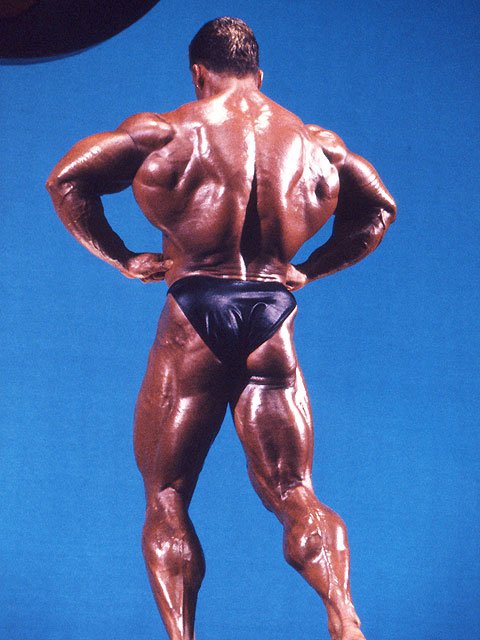
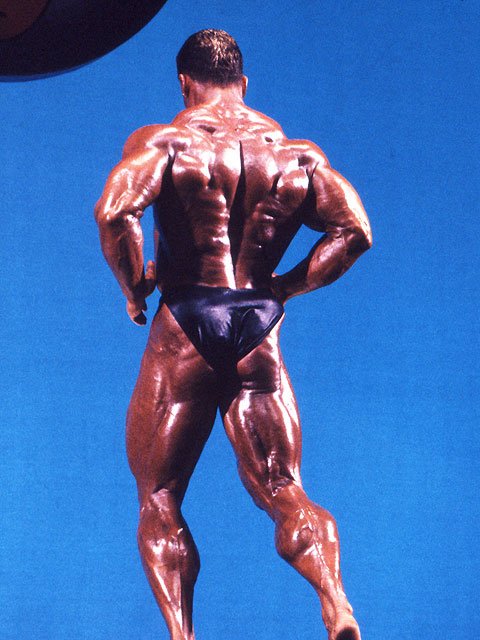
 Click To Enlarge.
 Dorian At The 1994 British Grand Prix.
[ Q ] We will address fats soon. Firstly though I would like to know from your perspective if dropping carbohydrates pre-contest below what the body is normally accustomed to off-season is a smart thing to do? Will this cause muscle degradation?
Not necessarily. Again, you might be using protein for energy. You will definitely need to reduce carbohydrates if you wish to lose weight, but you have to remember you are losing weight partially as a result of taking energy calories - carbohydrates - from your diet and increasing your activity and doing it over an extended period of time. That way you will lose excess weight slowly.
[ Q ] Would complex carbohydrates be the best option during the pre-contest period?
Complex carbohydrates are always best, except, again, after a workout where you could take simple (sugar) carbohydrates to get an insulin spike. But at other times doing this is not very beneficial because insulin is a storage hormone and it's going to shunt everything into the muscle.
Related Insulin Articles:
At that point (after the workout) it is a priority because the muscle is damaged, but if your are sitting on your butt watching TV late at night, and eating sugar then, you will also get the insulin release, but this time it will be more conducive to shunting nutrients to the fat cells.
[ Q ] Where do fats fit into your nutritional equation?
Well, they are essential for some hormone production and nerve health so you do need some fats. I made the mistake in the past of dropping my fats too low when dieting down and I noticed the effects: my skin and hair was healthier if I included fats. And I got just as lean with the additional fats in there.
A good ratio for fats would be about 30 percent of your total daily protein intake, so about 100 grams per day. And obviously you are going to get some of this through your protein sources: beef, chicken, and eggs primarily. And for those who take supplements containing Omega three, six and nine: the essential fatty acids. With fats you are looking at quality rather than quantity. Obviously you don't want a lot of saturated fats.
| FATS CALCULATOR |
[ Q ] So fat intake can be largely taken care of if you include plenty of animal products that contain small amounts of fat?
Yes and also nuts, and to be extra sure, essential omega fatty acid supplementation.
 |
The Bodybuilding.com Store: Essential Fatty Acid Products Sorted By Top Sellers Essential fats must be consumed through ones diet because the body cannot synthesize them. [ EFA Top Sellers! ] |
[ Q ] Is carbohydrate loading something you would do the final week before a contest? And would you recommend others do this?
In the last week I used to do it and it worked fairly well for people I have trained for contests. But it is a little bit different to how some people do it. I wouldn't go zero carbohydrates, I would just cut about 50 percent of them from the previous level, which itself would obviously be lower than in the off-season.
And I would also increase the protein and fat content (during the depletion phase). You are already in a negative calorie balance so if you cut your carbohydrates by 50 percent you are going to go too low in calories and risk losing muscle. So I just increase the fat and protein a little bit more, to replace the carbohydrate calories.
 |
Carbohydrate Loading: In sports, carbohydrate loading, colloquially known as carb-loading, is a strategy employed by endurance athletes such as marathon runners to maximize the storage of glycogen in the muscles. [ wikipedia.org ]
|
|
|
||
[ Q ] How would your training change during this period, and how would you load?
I would do more high volume training to deplete the glycogen. Then I would load for three days before the contest. But, whereas a lot of people increase the carbohydrates as they get nearer to the contest, I would do almost the reverse: I would go very heavy for the first day when I was really depleted, as the body is more efficient at storing at this stage.
But these are all guidelines because it does vary from person to person. For me, though, it would probably be double the carbohydrates I was consuming before the carbohydrate depletion phase (at the beginning of the loading phase).
So let's say we were on 300 grams the last couple of weeks before the depletion phase, then to 150 for depletion, I would be looking at 600 grams plus - at least - at the beginning of loading: double the previous dieting level.
 Click To Enlarge.
 Dorian At The 1994 British Grand Prix.
[ Q ] Some people use the loading phase to eat whatever they wish. Would you advocate against this practice?
I would just stick to the kinds of carbohydrates you are used to. I used to use oatmeal, rice, sweet potatoes and a small amount of different fruits. And, as I said, I would go heaviest on the first day, probably the second day I would maintain this amount (depending on how I was looking in the mirror) and then the third day I would keep the carbohydrates high during the first part of the day, but in the latter part of the day would cut back to eating just protein and fats.
The reason for this is that at that point I'm pretty much - hopefully - fully loaded with carbohydrates. Bringing it down to protein and fats in the evening for half a day tends to have a flushing effect, if you are holding any extra water. And, at this stage, you are not going to lose the water in the muscle because you are not training or anything, so you are not using any of the energy.
[ Q ] At this point would you, in fact, increase your water intake to flush even more water out?
Yes I drink a lot of water all the way through, up until the evening before the show, and then I will pretty much eliminate it. So when I drank a lot of water my body was either using it to bind with the carbohydrates to create glycogen in the muscle, or it was being flushed out.
| RELATED ARTICLE | |||
|
Author: Dr. David Ryan  |

So when I stopped drinking it for a short period of time the body tended to keep flushing it out. And the high protein/low carbohydrate intake has a slight diuretic effect, and that is why people lose weight quickly on this kind of diet.
[ Q ] When would you eliminate sodium when dialling yourself in?
If you eliminate sodium too far out, your body will just release hormones to retain more sodium. You really don't want to eliminate sodium for any longer than 48 hours out (from a contest). You also need sodium to carbohydrate load; it helps to transport the carbohydrates in.
[ Q ] It is all about trying to maintain the perfect balance while manipulating certain nutrients to achieve the desired results.
Your body is always trying to maintain a balance, so if you eliminate sodium your body will sense that and, given that it needs sodium, release a hormone called aldosterone and that will cause your body to hold sodium.
|
What Is Aldosterone? Aldosterone is a hormone that causes the tubules of the kidneys to retain sodium and water. This increases the volume of fluid in the body, and drives blood pressure up. |
|
|
||
So I don't worry about cutting any sodium until about two days before the contest, then I would not use any condiments on my food and would even eliminate the egg whites because they are quite high in sodium. I would have more chicken instead.
[ Q ] Some feel they actually look better the day after the show. Could this be to do with the fact they are too depleted on contest day?
That is because they are going into the contest too depleted in either sodium or carbohydrates or water, or a combination of all three. So people, after the contest, eat a load of carbohydrates and sodium, the muscles become inflated and the blood flow to the muscles is greater so you get more vascular, and you can tend to look better.
But there is, though, a fine line between that and holding water. The last few times I began taking in a little sodium after the pre-judging, I did look a bit fuller so I could have probably been too depleted of sodium at that point. But there is a fine line between that and spilling over. So I was always fairly cautious going into a contest.
I would rather be slightly flat, but very sharp, than fuller and more bloated. To me, that's the look that the guys are going for now (fuller) - you see guys in amateur contests now who are in much better condition than the pros, which to me is not right, because if you are a professional you should be better in every aspect.
| RELATED POLL | |||
|
|||
[ Q ] So the spilling in over is a result of trying to come in too full?
Yes, trying to achieve maximum fullness. I also think you have less separation if you are fuller. If you go to the gym and pump your arms up they are bigger because of the blood volume, the fullness. But the separation is not so defined.
[ Q ] So while it might look impressive in the gym that may not necessarily be the case onstage.
Yes, exactly.
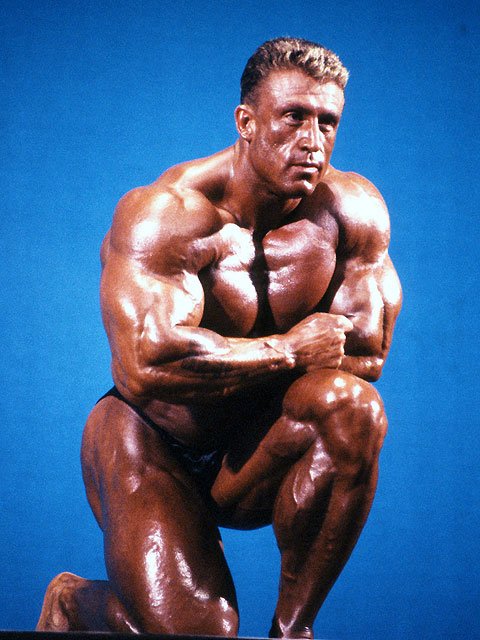 Click To Enlarge.
 Dorian At The 1994 British Grand Prix.
[ Q ] Would you recommend consuming nutrients during training, both off-season and pre-contest?
My workouts never really exceeded 45-50 minutes, and for that period of time you are using stored glycogen for energy anyway. Actually, taking an energy drink that is sugar-based, which nearly all of them are, you risk experiencing almost a reverse effect; you might release insulin, which will bring your blood sugar even lower down than it was originally.
Related Sport Drink Articles:
So the only thing I drank during training was water. I would have a simple carbohydrate and protein drink after training. I don't think it is necessary to drink energy drinks before or during training, as they could have the opposite effect. After training it is good to get that sugar-based/protein mix to shunt everything towards the muscles, which are depleted at that time.
[ Q ] What would be the best kinds of sugar drinks to consume at this time?
A simple sugar that will get the insulin released. Fruit juice wouldn't really do it because it is mostly fructose. So go with dextrose, glucose and similar forms. Combine this with whey or whey isolate or any kind of amino acid product, or creatine if you want to take it at this time.
There is a perfect window of opportunity after training when your body is in need of repair, and that is the quickest way to start the recovery process.
[ Q ] Can taking synthetic insulin in an attempt to store a greater degree of nutrients in the muscles cause the spilling over problem you speak of?
Obviously that is not something I used to do but it would explain the kinds of physiques we are seeing now that look almost a little bit soft and puffy, with large volume. But definitely, yes, you can start retaining water with insulin.
[ Q ] What exactly happens when a pro bodybuilding competitor introduces synthetic insulin into their system pre-contest?
I guess the idea is to use it in the carbohydrate-loading process. It is not something I agree with. I don't know exactly what the guys are all doing but that's my best guess.
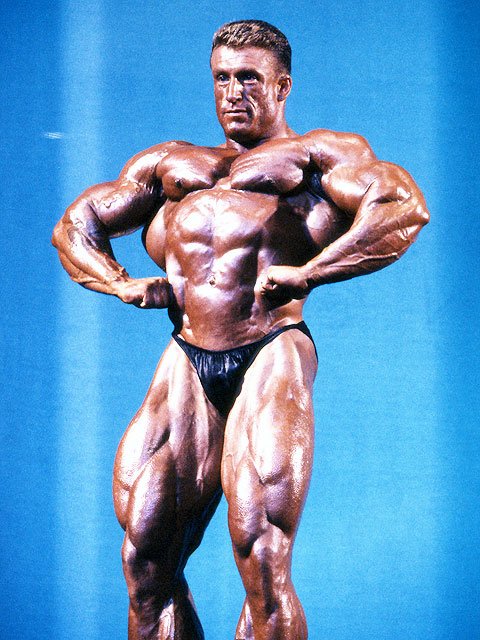 Click To Enlarge.
 Dorian At The 1994 British Grand Prix.
[ Q ] How important are nutritional supplements for bodybuilding success, in both the off-season and pre-contest, and why are they important?
It is very important, but it is supplementation; it is a supplement to something else, which in the bodybuilder's case is food. They are not a quick fix. You can't take creatine and expect to increase strength and muscle volume if you aren't eating enough calories and protein.
So you have to have the base there first, then on top of that they can be beneficial. I always start with the basics and work up. A good quality vitamin and mineral supplement with extra vitamin C, a good protein supplement is almost essential and then you start adding things into that mix. You can now try creatine and glutamine supplementation. Try one thing at a time and get feedback from each product.
[ Q ] People tend to be experimenting with forms of creatine other than monohydrate these days. Is monohydrate still a worthwhile product?
I think the drawback with it is you can retain more water under the skin and there are digestive problems. The newer forms of creatine are transported much more effectively. Kre-Alkalyn, for example, requires much smaller dosages and is faster absorbed. There is also Ethyl Ester creatine.
| RELATED ARTICLE | |||
|
Author: Shannon Clark  |

[ Q ] How effective is supplementation for one who has a good diet?
Some products will give you an instantaneous effect whereas others will help with general processes. A protein supplement, for example, will ensure you have adequate protein of a high quality. I think a lot of people are looking for an easy answer. People will ask, "If I take creatine, will it do this or that?" Well, it can do but it needs to be backed with proper nutrition.
[ Q ] What are your views on bodybuilders who eat excess calories in the off-season and, as a result, become borderline obese in an effort to gain muscle? Sounds strange to me.
Well, any time you lose weight you risk losing muscle mass. So going too heavy in the off-season, and then coming down, your net gains will maybe not be that good. You don't need to restrict yourself - if you are constantly doing this it is not healthy - but just being sensible with your diet and eating enough to gain muscle without so much body fat is the best way to go. Obviously you aren't going to stay in contest shape all year round; it's not a natural state to be in.
[ Q ] From your perspective, is there any truth to the belief that a surplus of calories could contribute to the size necessary to move heavier weights and therefore, indirectly, more muscle as a result?
I really don't think so, but let's say that it did. It is going to be negated anyway when losing all that muscle as a result of having to lose all of that fat. So it is not worth it, even if there was any truth in it, which I don't think there is.
You don't want to be dehydrated with an unhealthy level of body fat. As long as you are properly hydrated and you are not restricting your calories, anything over that is not really going to be any help.
[ Q ] Speaking of hydration, it is pretty well established that bodybuilders need plenty of water both for the assimilation of food and to replace that, which is lost through training. How much water would you recommend a bodybuilder consume through the course of a day?
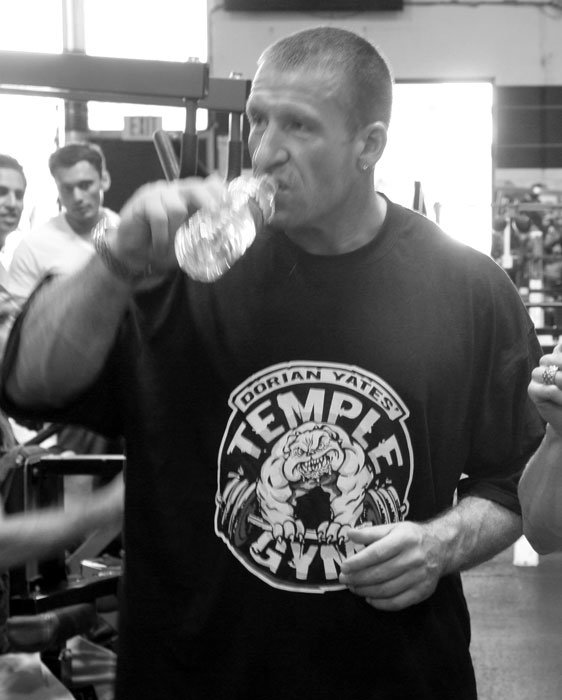
I just drink how much water I feel like drinking. I have heard about these huge amounts people are supposed to be drinking these days, upwards of two-gallons a day. It just seems really excessive to me and perhaps you aren't going to absorb your nutrition as efficiently if you are drinking too much water.
 Click To Enlarge.
 I Just Drink How Much Water I Feel Like Drinking.
So I'm fairly simplistic with this. I just drink as I feel like drinking; I don't really monitor it. It's just common sense; sometimes people want to complicate things too much just for the sake of making themselves look clever when they are not.
[ Q ] Speaking of new supplement products coming on the market as we were before, what are your views on the NO boosters that have become very popular over recent years?
I have one of these products on my European line and it's very effective, but it's a combination of different compounds. The NO products do help with vasodilatation and getting a better pump when you are working out. In my product we have other products that positively affect your concentration and energy levels. If you are optimized mentally, your training is going to be more efficient. So that has got to be helpful.
 |
The Bodybuilding.com Store: NO Products Sorted By Top Sellers Nitric Oxide is a free form gas that is produced in the body and is used by the body to communicate with other cells in the body. [ NO Top Sellers! ] |
[ Q ] What would be the three main supplements you would recommend to a beginning bodybuilder?
If they could only have three then a protein supplement would be number one. Number two would be some kind of vitamin supplement, maybe with extra vitamin C. Vitamin C is quite helpful with the recovery process and is quite underrated because it is cheaper to buy. Number three would probably be creatine or a pre-workout Nitric Oxide formula.
[ Q ] Have you experienced positive result from taking creatine?
To be honest, with the monohydrate I did not get too much out of it, and I tried it a few times. With the Ethyl Ester and the Kre-Alkalyn I did feel more power and put on a couple of pounds so there was a definite effect there. But the monohydrate I didn't seem to react to, so maybe it is an individual thing.
As I'm saying, a protein and vitamin supplement is going to be there as a base that you need all of the time. And if you want to try creatine, try it for a month and see what effect you get. Do not try five different things at the same time.
Try creatine for a month to see what happens, then try Nitric Oxide for a month and see how that works for you. If you are taking too many things at once, you don't really know what is having an effect.
| RELATED POLL | |||
|
|||
[ Q ] This same approach could be applied to nutrition in general?
Yes this is a more analytical way to go. You can try to increase your protein for a month, over the 1.5 grams, to see if there is any benefit to doing this.
[ Q ] Moving onto a different topic. In your view, is growth hormone responsible for the abdominal distension that is sometimes seen, or is it excessive calories prior to the contest as has been thought?
It may be that it's neither of those things because I think that if it were growth hormone it would be internal growth of the organs. And that would mean that if the person stopped the growth hormone they would still have a distended belly. But I have seen many people who have stopped competing where that doesn't happen.
Related Growth Hormone Articles:
And I don't think it is excessive food intake because that's not happening the last two months before a contest, so it doesn't make a lot of sense. I think it could be intestinal water retention from different compounds and so on. But that's a temporary state of affairs.
[ Q ] Could this distension occur during the carbohydrate loading phase where after many weeks of lower carbohydrates these are increased in the final few days?
It could be that or it could be chemically related as well. Oral steroids destroy intestinal bacteria, which is healthy bacteria. But I'm definitely not of the school of thought that it is internal growth as a result of growth hormone, because I haven't experienced that.
[ Q ] Not everybody experiences this distension so if they are all taking the same stuff would it not be the case that they all should have GH gut?
Maybe it is an individual reaction. Some people are allergic to wheat and nuts and milk and some people are not. So it could be a wide variance of reactions.
[ Q ] And it seems to occur more at the pro level.
Yes, maybe it is the insulin loading as well has something to do with it.
[ Q ] Moving back to protein, a lot of people can assimilate the recommended 1.5 grams of protein per pound of bodyweight and grow from this, whereas others might gain fat from such a level. What makes one person more likely to use all of this protein and another not so likely?
Well if you are gaining fat it's fairly simple mathematics: you are taking in more calories than your body is burning. So it's not necessarily from protein, it is total caloric intake. So it could be the fact that somebody added more protein that bumped the calories up. If they added 100 grams of protein, maybe they needed to take away 100 grams of carbohydrate.
 |
600 Exercises: How Many Calories Are You Burning? How many calories are you burning? Use our calculators to find out for over 600 exercises and activities! [ Calculate Your Totals Here! ] |
[ Q ] Would you recommend the high fat diets that are resurging today?
It comes down to individual metabolism. Some people don't react very well to high carbohydrates. I personally do. If I take in very low carbohydrates I can't walk. So obviously I need more carbohydrates. In the off-season I was on 2000 grams of carbohydrates a day and 400-500 grams getting ready for a contest, and my contest condition was better than most, for sure, so my body fat was very low on 400 grams of carbohydrates a day.
Related Low Carb Diet Articles:
And when I went on a high fat/low carbohydrate/high protein diet I had no energy, was very weak and lost muscle size. So for the majority of people I don't think it works. Who can eat just protein and fat all the time anyway? It can't be good for you. There is nothing new about that diet, by the way. It has been around for 100 years or so, just under different names and in different formats. But it boils down to the same thing.
[ Q ] I recall in the early '90s the now-defunct WBF (World Bodybuilding Federation) had their bodybuilders following a high fat diet and most of the competitors came in out of shape.
It was theoretically anabolic, this high fat diet. But the guys were used to taking lots of testosterone and they weren't allowed to take it (the show was drug tested). So no diet would have solved that particular problem.
As I said before, it is a hard diet to be on all the time. But people have got to experiment and find what works best for them. It does vary: the top competitors' tolerance to carbohydrates.
|
The World Bodybuilding Federation: The World Bodybuilding Federation (WBF) was a bodybuilding organization founded in 1990 by Vince McMahon that lasted until 1992. It was a subsidiary of Titan Sports which owned and operated the World Wrestling Federation. [ wikipedia.org ]
|
|
|
||
[ Q ] The Atkins Diet is along these lines as well.
Yes there are 101 diets like this but it is the same thing. There was the old anabolic diet promoted by Dan Duchaine. It is just a diet that has been recycled and sold.
|
Dan Duchaine: Daniel "Dan" Duchaine (1952 - January 12, 2000) was a former American bodybuilder, author, two time convicted felon and philosopher. Nicknamed The Steroid Guru, Duchaine gained worldwide notoriety due to his outspoken opinions on the use of performance enhancing drugs, and made numerous television appearances discussing the subject. [ wikipedia.org ]
|
|
|
||
[ Q ] You mentioned earlier that you consume 400-500 grams of carbohydrates prior to a contest. You clearly had no problem using all of these carbohydrates, whereas a lot of people would become fat from such an excessive amount.
Yes it was because of my fast metabolism and the high degree of muscle mass requires a lot of energy to maintain anyway. And I needed those carbohydrates for training energy, and I was still losing two or three pounds a week.
| RELATED ARTICLE | |||
|
Author: Derek Beast Charlebois  |

[ Q ] Prior to the '80s a lot of the competitors would, it seemed, lose muscle in the off-season and pack it back on as the contest approached. Since then, bodybuilders have tended to use the off-season more productively to pack on as much mass as possible. Is this pushing the envelope the best way to go?
Oh yeah, it is in the off-season where all the gains are made, not before the contest when you are on a calorie restricted diet. That's why I didn't compete too often, because I felt I needed enough time in the gym to train and to try and improve in the off-season phase. Guys who constantly go from one contest to the other without much of an off-season prove to get worse and worse with each contest: they just lose muscle mass.
[ Q ] Staying too low to a low body fat threshold for too long.
Yes, and they are not having a period of time with a high calorie intake. Every time you get ready for a contest you lose a small amount of muscle. So after the contest you need to get that back, so it may take you a month or so just to get back to point A, before you can start building any new muscle. Sometimes these guys don't even have time to get to point A, so they are smaller each contest.
 Click To Enlarge.
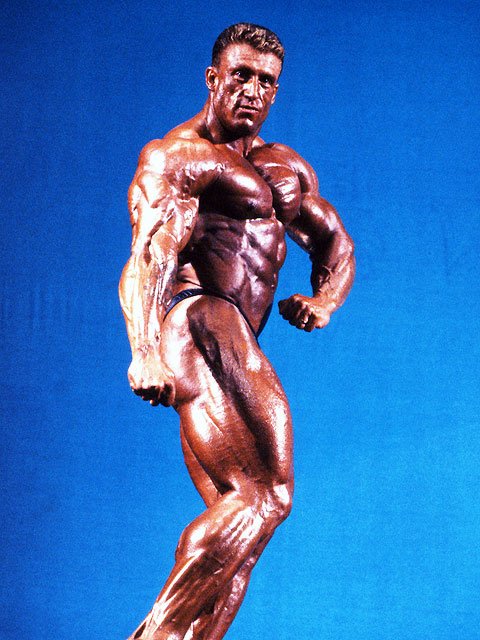
 Dorian At The 1994 British Grand Prix.
[ Q ] How high would you increase your calories in the off-season?
The highest I ever went in the off-season was about 6000 calories. And I generally went below 4000 for a contest.
[ Q ] And you would increase protein along with the carbohydrates in order to increase muscle mass?
No the protein was pretty much the same; so it was just more carbohydrates in the off-season, along with less cardio.
[ Q ] Would you pick a particular date so far out from a contest from which to begin cutting, or would you assess your physique and determine when to begin based on how you looked at that point?
I would gauge it on how I looked. I would start by figuring out where my maintenance calories were at, and then go below that. I would also increase my output at this time with cardio exercise. The first week I would usually experience a pretty rapid weight drop because of water loss.
I might lose five to seven pounds the first week; then it would level off to around two to three pounds a week. And I would constantly monitor it from week to week. So I might have started on 4000-5000 calories and maybe would drop to around 4000 as the contest approached, and would drop down occasionally as my body naturally slowed down.
[ Q ] When preparing for a contest did you cut back on certain nutrients or total calories?
Just carbohydrates, I would have less carbs. Other than that it would be pretty even across the board.
[ Q ] With a reduction in carbohydrates often comes a decrease in energy output. Would you have to consciously train harder to counter low energy levels resulting from low carbohydrate intake?
I would try to train harder, which ultimately was probably a mistake. I didn't really have enough energy there and I was dehydrated and was more open to injuries. So I'm not saying I should have taken it easy, but perhaps not trained to the degree of intensity I was using in the off-season, especially during the last four to six weeks before a contest.
[ Q ] Mentally you were obviously very strong but the body wasn't willing at that point.
Exactly, the mind was actually stronger than the body, so it (the body) had to give. What I would do in the off-season is train to failure or beyond that point sometimes and tried to maintain the weights I used in the off-season, pre-contest, although they would naturally go down slightly, especially in the last four weeks.
But if I could do it again I would train to the point of failure, not beyond, because all I'm trying to do at that point is maintain the muscle, which does not need to go to that point of intensity. You don't have the calories to fuel new muscle growth so there is a certain point where you will risk injury if you overdo it.
[ Q ] So pre-contest you were actually aiming to build more muscle whereas you should have taken your foot off the pedal?
I wanted to maintain it and I thought if I could keep the intensity and the weights the same as in the off-season I would not lose muscle. But that could be detrimental at that point. You are sleeping less because you are not eating so many calories; you are doing more additional exercise, more cardio; you are slightly dehydrated possibly.
All those things increase your risk of injury, so just training to the point of failure is definitely enough to maintain, and if I could do it again I would probably just leave it there.
[ Q ] What are your thoughts on eating prior to sleep at night? Would you do this personally?
Yes I always used to do that, even when I was dieting, although my eating would be more protein and fat based at this point. You are going to be sleeping for eight or nine hours so it is important to make a point of easting something.
I am not of the school of thought where you should not eat after a certain hour at night; I think this is stupid. I used to have some oatmeal with some egg whites a couple of egg yolks, or a protein shake (at night, before bed).
[ Q ] As you just touched on there is a school of thought to where cutting your carbohydrates after a certain period, usually 6:00pm, is best for fat loss.
No, it is 5:55pm! Why six o' clock? Why not 5:55 or 6:04pm? You are not burning as much energy at night so I probably wouldn't eat as many carbohydrates at night as I did for breakfast or after training, but I still have carbohydrates at this time.
Getting ready for a contest I think my last meal was mainly protein or fat, but the meal before that I would have a small amount of carbohydrates. So I would taper off and have less during the evening when I was trying to lose body fat. When I was gaining I was eating carbohydrates all through the day.
 Click To Enlarge.
 Dorian At The 1996 British Grand Prix.
[ Q ] Clearly nutrition and training are the most important bodybuilding aspects one needs to consider. If a young bodybuilding aspirant asked you whether he should add steroids to this mix, what would you say?
I would say no because at the beginning you are going to grow anyway, as you have a lot of potential there. The body is not used to exercise. You need to learn what effects your diet has on your body and how to train properly. You won't learn these things as well if you are taking something that will do the job for you.
And if you are overtraining it will mask this. So you are going to get some results anyway and you need to learn how to train and eat properly and get the most from these things. And you will grow anyway over the first couple of years. Actually, it also seems that steroids work better on someone who has been training over a longer period, maybe because they are able to generate more intensity.
It gets to a point where it's hard to recover, so for a beginner I definitely wouldn't recommend them. I don't recommend them to anyone but for someone who is just starting it would be especially detrimental. It wouldn't be doing them any favors.
[ Q ] So you would recommend focusing on the fundamental aspects of bodybuilding before even considering steroids?
Right. And why use them when you don't need to? You are going to grow anyway. They are not going to work that well for you; you will probably just retain a lot of water and put on bodyweight, but it's not going to be a lot of muscle.
[ Q ] We live in an age where people want progress now and are not willing to wait.
Well, those are the times we are living in. Everything's quicker. Mobile phones are quicker; the Internet's quicker and everybody wants everything now. But you have to think of the long term. Especially young guys: you see a lot of teenagers taking steroids. Some look great for a couple of years but you never see them again. Their bodies just stop reacting.
[ Q ] And they might not have the basics in place before going on them?
Yes, it is not built on a solid foundation.
[ Q ] Given steroids help with protein assimilation and greater muscle growth as a result, surely this is an attractive proposition to those who are beginning bodybuilding?
Yes, but they can get the same results by training and eating properly at least for a couple of years. It might be quicker initially, but you haven't gained any solid muscle so when you stop using the steroids you are going to lose what you think you have built anyway. There is no basic foundation there. And the steroids work better with a good base of muscle in place rather than for somebody who has just begun training. It's not worth it.
 Click To Enlarge.
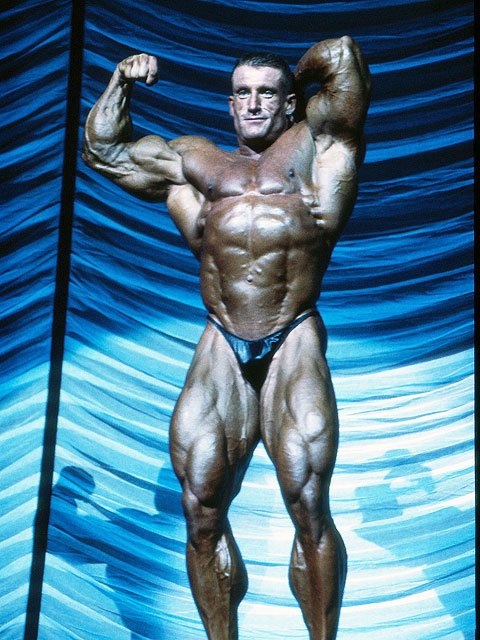
 Dorian At The 1996 British Grand Prix.
[ Q ] Thank you for your openness and insights Dorian. It has, once again, been a pleasure talking with you.
Thank you David. Any time.
| FIVE DAYS OF DORIAN: FEATURED ARTICLE | |||
|
Author: David Robson |

Dorian Yates Website:
Visit Dorian Yates' website, join the members section and gain exclusive access to an around the clock, one of a kind view of gym life in one of the world's most popular training establishments, Temple Gym. Also receive specialized and personalized training and nutrition knowledge from Dorian himself.