
Teleseminar Interview Excerpt: From Dr. John Berardi and Michael Fry
If you're a hard-training combat or grappling athlete, you've simply gotta read this article!
It comes to us from John Berardi and Michael Fry, co-authors of "The Grappler's Guide to Sports Nutrition", a new book detailing exactly how wrestlers and grapplers of all types should be eating and supplementing to optimize their body weight during both training and competition.
And we're not the only ones who like the book: The Brazilian Top team uses and endorses Dr. Berardi and Mike's ideas. Grapplers fighting in Pride, UFC, and Real Pro Wrestling use them. And a host of grappling coaches across the world have embraced their ideas as the best way to prepare for grappling competition.
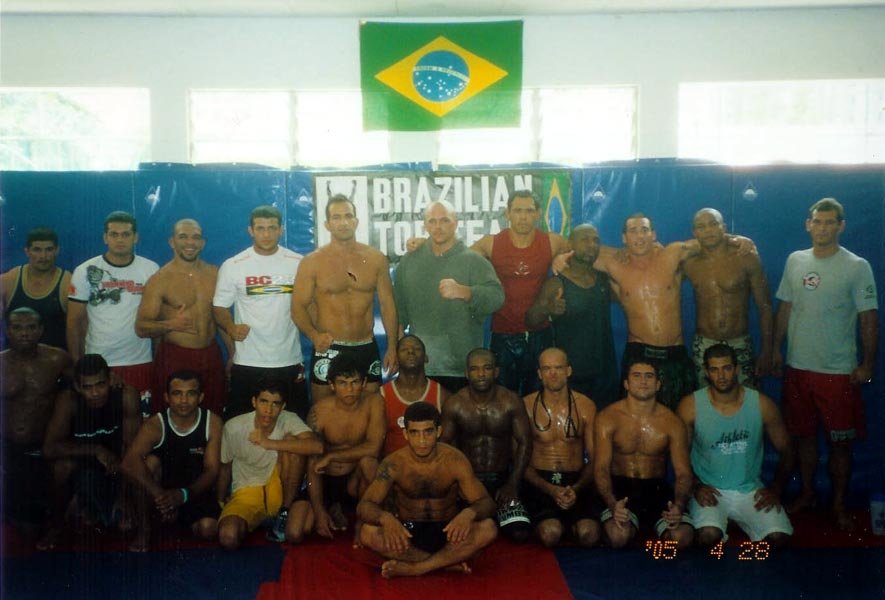
 Click Image To Enlarge.
 Mike Fry With The Brazilian Top Team.
(In the photo above, and in case you couldn't tell, Mike is the bald, pale guy standing up in the middle!) Seriously, though, these guys are no joke!
So, without much further ado, let's get into the teleseminar ... but before doing so, it's important to understand that this article comes as an excerpt from an actual, full-length teleseminar that Dr. Berardi and Mike have recorded and provided for free, in its entirety, at grapplersnutrition.com.
So, if you like what you read below, get on over to their site and download the full, free teleseminar right away! Now, let's get started ...
The Interview Segment
[ Michael Fry ] Tonight we're going to talk about a whole host of topics, from the best foods to eat, to the best methods of weight loss for grapplers and wrestlers. It's going to be a huge, exciting, and useful call. Dr. Berardi?
[Dr. John Berardi] I agree, it's also going to be a fun call! We've got a huge audience listening in on the phone and likely millions more will be listening to this one the web!
So, why not take the bull by the horns and get right down to debunking some of the common and really negative grappling preparation strategies?
Now, you and I both know that there are some "time-approved" methods of cutting weight that grapplers use that aren't what I would call "physiologically approved." In other words, the body doesn't like them at all. And, as a result, grapplers lose strength and power—heck, some have even lost their lives.
[Mike] You're right. So let's get into that right now. The number one topic I want to address is weight loss methods used by grapplers. And the reason I want to bring this up is because a majority of them are based on either excessive exercise or voluntary dehydration.
Now, a recent survey demonstrated that:
- 73% of grapplers used running/jogging to lose weight.
- 59% used other devices such as exercise bikes, ropes for jumping, and climbing ropes.
- 34% used rubber suits or nylon tops as a method of weight loss.
- 14 % used the sauna.
- 8% used throwing up as a means to lose weight.
- 5% used spitting, trying to get rid of excess saliva.
- 2% used diuretics.
The reason I want to bring this up is that nearly every one of these methods is a problem! The exercise used, slow cardio, actually impairs muscle strength and power development. And the other methods dehydrate the body—and without adequate rehydration strategies, huge problems could result.
The worst part is that none of the strategies were centered on the use of proper nutrition!
It's amazing how in other sports, athletes are taught the right nutritional strategies to reach their ideal body weight yet in grappling/wrestling, it's all about the wrong type of exercise, the sauna and sweat.
So, what we're going to try to do here today, as Dr. Berardi has mentioned, is come up with different methods and teach grapplers and parents and coaches that there are alternatives out there for this type of weight loss.
[Dr. B] I wanted to chime in on this one because I really want to emphasize just how crazy those stats are, Mike!
I mean, the real No. 1 controlling factor for an athlete's body composition and body weight is their nutritional intake. Yet, the fact that these athletes are doing the wrong exercise, using rubber suits, saunas, vomiting, spitting, fat burners and diuretics tells us just how far off the mark the grappling community really is.
Seriously, let's start with the exercise. Long, slow, cardio-type exercise causes muscle fibers to become more "slow twitch"—a characteristic of endurance athletes. These fibers contract more slowly and they have lower strength and power capacity.
So, as grappling is based on explosive speed and power, the last thing you want to do is do low-intensity exercise that will ultimately make you slower, less powerful, and weaker! Here's an example of this very thing in action:
I started working with a female national-level bobsled athlete. Before working with me, she was overfat and needed to lose weight for her sport. She was training hard, trying to "train her way into shape," yet the weight wasn't coming off.
So, after going to her original dietitian, she was told to eat less and to do the Stair Master a couple days a week to lose the extra body weight. Well, guess what happened? She lost a bit of weight—yet she also got worse at her sport.
And that's what 73 percent of the wrestlers in the particular survey were doing!
It just pisses me off when I hear this advice! Grappling/wrestling is not an aerobic sport. So, grapplers should not be training aerobically—not at any level.
What's The Difference Between Aerobic And Anaerobic?: Aerobic means "involving or improving oxygen consumption by the body." Aerobic exercise, therefore, enhances respiratory and circulatory efficiency by improving oxygen consumption. Aerobic movements require oxygen to generate force and enlist slow-twitch muscles for activity over sustained periods of time (minutes to hours). Examples of aerobic exercise includes cardio, jogging, cycling and running marathons.
Anaerobic, on the other hand, literally means "without oxygen". Anaerobic exercise, then, does not require oxygen to generate force. Anaerobic movements use fast-twitch muscles for short bursts of intense activity lasting only brief durations of time (ranging typically from a few seconds to up to a minute). Examples of anaerobic exercises includes isometric holds, sprinting and high-intensity weightlifting.
Not to condition, not to drop weight, never! It's just stupid. Especially when grapplers can get into even better condition focusing on interval and power work as well as eating properly!
[Mike] I agree 100%. Let's get into the dehydration part, too!
A lot of people don't understand this, but dehydration by only 3 percent of your body weight can cause you to lose 10 percent of your muscle strength and 8 percent of your speed!
So, unfortunately, while we're out there trying to lose weight, we're actually losing the things that we need the most, which are speed and strength.
[Dr. B] You know, we just talked about one foolish way to lose weight for wrestling and grappling—going out and doing a bunch of exercise that doesn't specifically help you with your sport.
The second foolish way we're talking about now is the dehydration method.
Now Mike mentioned some figures. A 3 percent loss of body water causes a 10 percent loss of strength and an 8 percent loss of speed.
However, even a 1 percent reduction in body water causes a reduction in performance! But, before this gets too numbers-based, let's put this into perspective: Take a 155-pound grappler. For that individual, a 2 percent loss of body water or body mass is about 3 pounds.
So, if any of you are sitting out there thinking "how much weight do I need to lose before I see my performance start to suffer?"—it's 3 lbs for a 155-pound guy. For a 200-pounds grappler, it's 4 pounds.
Drop that small amount of water too quickly, not getting it back before your event, and you're already seeing drops in performance. And most grapplers try to lose much more than this, don't they?
[Mike] Yea, they do. And unfortunately, when you break the numbers down, that's a huge problem! I mean, you can lose four or five pounds at practice without even trying. Even a single practice can put you at that state of dehydration to where your performance is starting to suffer.
[Dr. B] So, truth be told, there are really two primary methods that most grapplers would use to lose weight—and neither is optimal.
First, they go exercise in a way that doesn't actually support their own training for grappling.
And secondly, they lose a bunch of water weight quickly before an event, five, eight pounds, whatever the case may be, through dehydration.
[Mike] People often wonder why we and other experts harp on this dehydration thing, and my answer is that it's because it's that important!
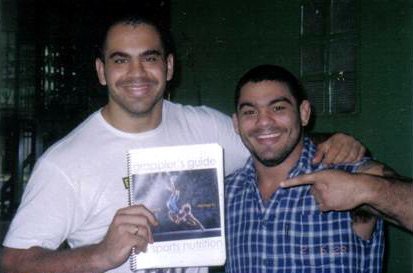 Click Image To Enlarge.
 Pride Fighter And Top Team Member
Paulo Filho Lovin' The Grappler's Guide.
If you take two wrestlers, and put them on a mat together—both dehydrated—and maybe the disadvantages will cancel each other out. However, what if we can put a wrestler on the mat that isn't dehydrated against one who is? All of a sudden, you have a different event.
[Dr. B] That's right—the point is to figure out how to get grapplers into the ring or on the mat without a huge amount of dehydration, with full body strength and power, and with a low body fat percentage.
You see grapplers all the time who try to drop 10 pounds of water for an event when they should have been focusing all along on losing the extra 10 pounds of non-contractile body fat they don't need.
So, again, focusing on water is such a mistake because if you can learn the principles of good nutrition, you can get rid of body fat instead of body water. Coming in at your ideal weight is then a lot easier.
[Mike] Well, that's a fantastic point and that leads us into our next section. The reason for the call is proper nutrition for grapplers. But before we get into the food, I have to sound off about something related to young athletes.
It always drives me nuts when I see 9, 10, 15-year-old kids trying to cut weight while their overweight coaches and parents push them to go out there and run and spit and do everything that they can do to lose weight! All the while the booths at the games and tournaments just breed poor nutrition with concessions full of junk food.
So our young athletes start out with the wrong messages from parents, coaches and their environment. And make no mistake; this is carried throughout their lives.
Truly, for sports and sport nutrition to improve, parents, coaches and even organizers out there need to start learning this stuff so that the next generation of athletes get better information than what the typical North American gets—which is just garbage.
[Dr. B] Yep, young athletes develop a history of poor eating habits and this starts at young ages. And these habits are carried with them into their adult years.
Of course, in a single article or teleseminar it's tough to teach all the principles of good nutrition. We all have lifetimes of experience and education in eating a specific way—the North American diet. And the North American diet isn't so good. None of us are immune. We learn through our parents. We learn through our culture and our media.
Unfortunately, beyond even the fast food and junk food, the sports nutrition messages aren't that good either.
Here's an example: Mike, what do most athletes think they have to eat a lot of?
[Mike] Well, for strength athletes, protein; For other athletes, carbs.
[Dr. B] Right! These are conventional media-type messages: You've got to eat a lot of this or that. Well, here's the problem ... What is a protein?
If you're a young athlete or not educated in nutrition, you've gotta go figure out what a protein is—what that means—or a carb, etc. And even if they do know what carbs are, you find them shoveling down pasta and rice and bagels and stuff like that because they think it's going to give them energy.
That's the problem. The foundation of a good nutrition plan is less about eating lots of any particular food, and it's less about certain foods being "good" or "bad". It's really about 3 things:
- The first is how much you're going to be eating. You've got to figure out how many calories to eat every day to improve your body composition and your performance.
- The second thing is what you're going to be eating. In other words, you've got to focus on making better food selections, getting more of the good foods in ya.
- Finally, it's about when you're going to be eating. That's a concept I call nutrient timing.
I will tell you this - it's not about eating as much carbs as you can. Or eating as much protein as you can. Or about good vs. bad foods. But again, like I said, the real challenge at stake here is that every single one of us on this call, every single one of us in North America, is influenced the most by culture.
We watch the news, we read the papers, and we read websites. But these snippets of information only serve to confuse us. So we need a comprehensive re-education. And I'll tell you how I deal with my athletes. The first thing I do if an elite grappler contacts me is to send him a copy of the Grappler's Guide. But even that's only the first step ...
After they check it out and they begin their "re-education," after they start to learn things like the "10 Habits", after they learn tips for managing body weight, and after they start to learn how to cut weight quickly, safely and effectively, I fly in and do some private teaching with them.
This begins the re-education process. Now they can really talk about fine-tuning their nutrition, with my help, of course.
[Mike] So, to truly get athletes eating right, it's about re-education and learning a new lifestyle—not just focusing on protein or carbs.
[Dr. B] Exactly!
[Mike] Good stuff! Now I have a question. How much different are the needs of the competitive athlete vs. a non-athlete?
[Dr. B] This all plays back, Mike, into the whole idea of the how much to eat, the what to eat and the when to eat it.
First, athletes do need more calories. They need more total energy intake to support their high intensity training. But, we can't simply just tell athletes to go out and eat more calories. Because if we're not telling them what the right foods are to eat, then they'll eat more of the wrong stuff.
By saying eat more, we're prescribing about 1,000 different diets. Athlete No. 1 may be eating a bunch of empty calories. You might say, "Go eat more calories," and all they end up with is more sugar and junk. You take another athlete and you say, "Go eat more calories," and they might triple their protein intake, but not increase their good fat intake or good carbohydrates.
So, obviously, athletes do need more, but they need more of the good stuff.
Another difference is nutrient timing. For the average person who doesn't exercise, their body pretty much responds to food similarly throughout the day. However, if you take someone who's training hard, their exercise changes their ability to tolerate and use certain nutrients.
Let me give you an example:
Okay, let's say I wake up in the morning and I either go to work or go to school. Then, after work or school, I train. Well, the way that my body handles nutrition up until my workout is different from how it handles nutrition during and after my workout.
During and after the workout (some of you may have heard it called the "window of opportunity" or the post-workout window), the body preferentially burns fat and it stores carbohydrates and protein in the muscle.
So you end up with a powerful recovery mechanism built into the exercise period and post-exercise period. Your body just wants great nutrition at this time but also nutrition that's quickly digested and sent to the muscles.
Now, the rest of the day, the same types of things aren't happening. So, throughout most of the day, you want to focus on eating a specific way - namely slower digested foods. But during and after exercise you want to focus on faster digested foods.
So those are two important athlete vs. non-athlete differences.
Athletes typically need more calories and more good nutrition (and that includes vitamins, minerals, everything else) and better nutrient timing.
[Mike] And speaking of nutrient timing, a lot of people wonder about when to time meals before, during and after exercise. How does that work?
[Dr. B] Well, let's start with before exercise. It's likely no surprise that exercise at high intensity can make you feel like dropping your lunch.
However, different people can tolerate different things. Some of my athletes can eat 30 minutes before training and others have to eat 2 hours before. It also has a lot to do with what you're eating. Fast digested stuff can be eaten closer to exercise without as much difficulty.
Yet, in the end, this is a comfort thing, not a "good nutrition" thing per se. The real good nutritional practices focus on what you're eating every meal of every day. To be honest, there is no magical food and no magical time period in which eating will lead to your best workouts.
The key to having consistently good workouts is eating well all the time. And the only thing you can do during the exercise to make sure you don't bonk is to make sure 2 things don't happen:
- First, you need to make sure your blood sugar doesn't crash. That's what makes you feel light-headed and out of energy.
- The second is not eating something that bugs your stomach.
To maintain blood sugar, you need to slowly sip a carbohydrate or carbohydrate/protein drink during exercise. To avoid feeling sick to your stomach, experiment with eating different times prior to exercise. Even if you eat 2 hours prior, you won't bonk as long as you sip the carb or carb/protein drink during training.
[Mike] Great stuff!
A lot of times I see people, especially at tournaments, trying to shove down food to make it to the next match. Or they won't eat at all out of fear. Then they're flat come the end of the day. So I think it's a good point that you brought up, that you just kind of have to feel yourself out and just try and understand what your timeline is for the best plan for you.
Now, you mentioned protein and carbohydrate drinks. There's always the question of how to make them. Any recommendations on the best way to go about doing that?
[Dr. B] There are a few ways to do it. First, when I was a Ph.D. student at the University of Western Ontario, my lab and I developed a product, a recovery drink, called Biotest Surge.
Surge is something we developed that contains protein and carbohydrates in ratios that we found to be good for recovery in both strength/power athletes and aerobic athletes. I suggest finding some and giving it a try. I describe how to use it in the Grappler's Guide book.
However, keep in mind, Surge is awesome but it's no magic bullet. It works great in conjunction with a comprehensive nutrition plan, not instead of one!
[Mike] So, John, let's talk about some guidelines for a great, comprehensive nutrition plan.
[Dr. B] Sure, Mike. I believe all great sports nutrition plans should be based on the "10 Habits" we outline in the book.
I'll talk about the first 5 here.
Habit 1: Eat Often
The first habit is to eat every two to three hours, no matter what. If you're not doing that, you don't have any right to ask me questions about creatine, magic supplements, etc. Eat every two to three hours no matter what—get that down, and then ask about supplements.
Habit 2: Lean Protein
The second habit is to eat lean protein with each feeding. Every time you feed, I'm not just talking about breakfast, lunch and dinner, but every time—you need to have a lean, complete protein source. If you're confused over what's a protein, we cover that in the book.
Habit 3: Fruits and Vegetables
The third habit is to eat fruits and veggies with every feeding. This one is difficult for some to get their heads around so I'll emphasize it again.
I mean every time! So if you're eating every two to three hours, you can see how you're building your meal.
So, the first thing you do when it's time to eat is to grab some lean protein. Then you'll next find fruits and veggies.
Habit 4: Carb Timing
The fourth habit deals with carbohydrate intake. Now if you really want to maximize nutrient timing, the bulk of your non-fruit/veggie carbs should come during and after exercise. So, what might that look like? Do you feel like having some pasta, some bread, some rice or potatoes? Save them for after your training session.
The rest of the day, stick to fruits, veggies, good proteins and good fats.
Habit 5: Dietary Fats
The fifth habit deals with dietary fat. It's important not to avoid dietary fat, as the balance of fat in your diet can improve performance, improve body composition, improve injury healing, and more. Most people don't even think about supplementing with good fats like olive oil, fish oil, and flax seed oil—yet all these things should be in your diet.
So, let's review those first 5 habits really quickly:
- Eat every two to three hours. Are you doing that?
- Each time you eat (every two to three hours), eat some protein.
- Each time you eat (every two to three hours), eat some fruits and veggies.
- If you've just worked out, it's a great time to have some starchy carbohydrates like pasta and things like that. If you haven't, you should probably eat less of them in favor of the fruits and veggies.
- Balance out your fats, supplementing things like olive oil, flax seeds, flax oil, fish oil, etc.
These are the fundamentals. So, what I want every single one of you reading this article to do is to try and achieve these first 5 goals. I'll teach you the next 5 in the Grappler's Guide book!
Make sure you're doing these things before you ever look for recovery drinks, creatine, fat burners, diuretics, etc. Get this stuff together. You'll find that your body will quickly reshape itself with less body fat, more lean mass, and you'll also find that weight control is going to be easier.
You'll be able to train consistently hard and effectively, and your competition performances are going to be stable. If you don't do this and instead obsess about the creatine and the other little things that don't make as much of a difference, you're not going to see the benefits that we're talking about.
I've done this for long enough to know that most people focus on the wrong things, ignoring the important things. I really want to shift your focus toward the most important stuff.
[Mike] I think that's a good point, John, because my email's being pounded with questions about post-workout nutrition drinks and I'm glad that you went over those tips. One thing in regard to that though, is that grapplers, wrestlers in particular, might get scared off with the every 2-3 hour thing because of school or work or whatever. They might think they can't eat all this food. And they might also think it's too much food.
[Dr. B] Right. Well, you know, Mike, it's a great point.
And it leads me back into what I was saying earlier. You've gotta choose the right foods. If you sit down to a lunch of cheese fries, cheese steak hoagies and soda, and then have a dinner like that, and in between eat equally crappy food, eating every 3 hours might not work for ya. But neither will the 3 crappy meals anyway so you're screwed!
The point is to eat the right things every few hours, which includes nutrient-dense foods. I can't get into them all here but in the Grappler's Guide, I list the 21 Super Foods that every grappler should be eating daily.
These foods, and the ideas in the book, will help grapplers boost their metabolic rates so that they'll lose more weight eating every 2-3 hours than they would starving for a week before an event.
Also, with respect to the time constraints on the student athlete, I understand how challenging it can be. But it's possible—in fact, all my high school athletes do it. It just takes some planning, some pre-made meals stowed away in the schoolbags, in the lockers, etc. Eating every three hours is a lifestyle for my athletes and they all find ways.
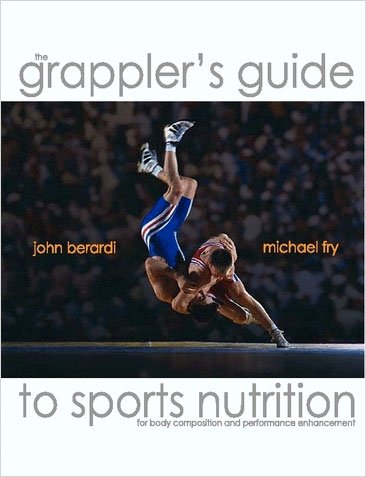 Click Image To Enlarge.
 "The Grappler's Guide To Sports Nutrition"
Available At GrapplersNutrition.com.
One great way is to make their own healthy bars and snacks at home. In my "Gourmet Nutrition" book (which people can pick up along with "The Grappler's Guide" at GrapplersNutrition.com), I outline all sorts of healthy snacks that athletes can prepare at home and bring with them.
[Mike] I want to now move ahead a bit. I want to bring some questions about Saturday morning. We've covered general nutrition but now I'd like to talk prep for competition, making weight, etc.
There are still a lot of guys out there doing some of the harmful, performance reducing, "old school" methods of starvation and dehydration. And, in the book, you've outlined some strategies for making weight that I'd never heard about before. Now, I've been involved in the sport of grappling and wrestling in general for about 25 years and thought I'd seen it all.
Yet you've got some stuff that's crazy effective and safe, too.
[Dr. B] Yep, the material I outline in the book to drop 10-15 lbs, if necessary, safely and effectively leading up to an event is based on my work with both bodybuilders and grapplers. There are certain supplements, foods and water manipulation strategies that really maximize the body's ability to drop weight quickly as well as rehydrate quickly. I won't spill all the info here as I want everyone reading this to pick up the book and to apply these strategies. But they work better than you'd imagine!
[Mike] What about rehydration? For those who don't pick up the book yet continue to do their stupid weight-loss strategies, how can we help them?
[Dr. B] Well, let's say that our athlete is dehydrated and has 2 hours to replenish their water or else suffer performance losses. Studies have shown that you can maximally rehydrate the body by about a liter per hour. So, theoretically, in two hours, you can get 2 liters (4.4 pounds of body water) back.
So, if you only lose 2-4 pounds to make weight, rehydration is fairly easy. If you dehydrate more, you likely won't get it all back. The best way to rehydrate is to sip a rehydration beverage slowly leading up to your event. Your impulse is to gulp. Don't do it. Sip!
Also, the best thing to sip is a rehydration drink containing water, carbohydrate, and some sodium. Pedialyte is a good choice. Gatorade with an extra tsp of sea salt is also a good choice. You can even use the Biotest Surge product mentioned earlier with some extra sea salt.
[Mike] Great stuff!
[Dr. B] The important lesson is this: If you need to make weight and you're four, five days out from an event, you need to make sure you're as close as three pounds away from your competition weight.
This way you won't even consider doing some crazy exercise, you won't have to put a stupid rubber suit on, and you won't have to do much more than a slight dehydration the last three days. And, of course, we teach you how to do that nutritionally in the book. Then, all you have to do is just rehydrate in that next hour, get the two to three pounds of fluid back, and then go kick @$$.
But again, the lesson is this: If you have eight pounds to lose, you blew it, buddy. However, we've still got tricks for that in the book. I want you to learn not to make a habit of being 10-plus pounds over before the event! And how can you learn that? It's in the book.
You have to make sure you're getting rid of body fat rather than water weight. This is definitely possible if you get control over your nutrition. Don't take care of the body fat and you're just hopin' and prayin' that you're not overweight when it's time to weigh in. And that's not a good way to live.
What we're trying to do with this book is to put people in the driver's seat of their weight and body composition.
[Mike] John, this is some great information you're sharing here! I'm pretty confident that everyone reading this will want to pick up the Grappler's Guide right away.
Heck, this info goes beyond grapplers alone. Any athlete who needs to cut weight including jockeys, bodybuilders, gymnasts, etc. would benefit from this. Heck, even parents who are going to a reunion or a wedding and want to look good in a certain dress or suit can benefit!
Even they starve themselves to try to lose weight ... What a mistake! Especially when info like what you've included in the book is out there, Dr. Berardi.
For More Information
This is the end of the interview excerpt. If you wish to learn more, pop on over to GrapplersNutrition.com.