

Muscle Types
There are three different types of muscle tissue in the human body:
- Cardiac Muscle, which is only in the heart.
- Smooth Muscle, which is found in organs & blood vessels.
- Skeletal Muscle, which is found all over the body and is responsible for movement.
All three of these muscle types have distinctly different anatomical structure and function in the body.
We know that muscles get bigger and stronger when put under stress, which is called adaption. This simply means that the muscle is preparing itself in case it's put under the same type of stress again.
An analogy is calluses on your hand, if you rub your hand on a course surface causing enough friction eventually the skin adapts by building up calluses, thus protecting it self from future happenings.
Muscle reacts much the same way, if you train them or put them under enough stress they will adapt to this stress by growing bigger and stronger. So the next time you train them they will be capable of handling this new level of stress. Now obviously that is a very basic explanation, but hang on to your dumbbells! We'll get more in depth!
 Muscle Structure:
-
Inside a muscle there are groups of motor units separated by membranes. Each motor unit consists of a single neuron and all of the muscle fibers it stimulates. In muscles such as the hand where fine motor control is necessary the ratio of nerves to fibers will be much higher than that of a muscle such as the calf.
- Type I
- Type IIa
- Type IIb
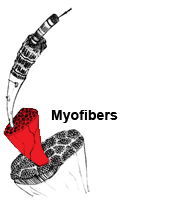
Muscle fiber consists of myofibrils; a myofibril is a small bundle of myofilaments. Myofilaments are mainly comprised of two types of proteins called actin and myosin.
The myofilament is the part of the muscle that actually shortens upon contraction where the actin and myosin filaments slide over each other, which is called the sliding filament theory.
 Back
Back
Basically by the way of chemical bonds and receptor sites located on the myofilaments the actin and myosin attract each other thereby causing a contraction.
A contraction can be held until fatigue sets in, and the strength of a contraction is determined by the number of motor units that are recruited. Inevitably, the more force that is necessary for muscle contraction requires an increased number of motor units to allow the muscle to contract.
Muscle Fibers:
-
Within skeletal muscle there are three types of muscle fibers:
Everyone has their own unique distribution of these fibers, some people are predominately Type I, and some Type IIa, however the "average person" has an even amount of red and white fiber.
Type I muscle fiber often referred to as slow-twitch or red fiber and is highly resistant to fatigue and has a high oxidative capacity, this muscle fiber is responsible for aerobic exercises and activities, such as running.
Type IIa muscle fiber often referred to as fast-twitch or white fiber is an intermediate fiber and they're larger in size and much stronger than Type I fibers.
Type IIb muscle fiber, which are also fast twitch & white fiber, are capable of producing more force than Type IIa, but they're low in oxidative capacity, and fatigue very quickly.
Fast twitch fibers have thicker nerves that give them an increased contractile impulse, which is measured by the number of twitches per second, hence the name fast twitch fiber.
Slow twitch fibers have smaller nerves, thereby twitch much slower, however they have a higher number of mitochondria, which increases their oxidative capacity. Mitochondria are the cells in a muscle that synthesize ATP (Adenosine Triphosphate), often referred to as the cell's "powerhouse".
 |
Mitochondria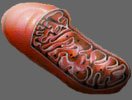 The spherical or elongated organelles in the cytoplasm of nearly all eukaryotic cells, containing genetic material and many enzymes important for cell metabolism, including those responsible for the conversion of food to usable energy. Also called chondriosome. The spherical or elongated organelles in the cytoplasm of nearly all eukaryotic cells, containing genetic material and many enzymes important for cell metabolism, including those responsible for the conversion of food to usable energy. Also called chondriosome. |
|
|
||
Hypertrophy
Okay, so now you have a basic understanding of muscle physiology, let's talk about how we make them grow! The enlargement of a muscle fiber is called hypertrophy. As I mentioned earlier muscle growth or hypertrophy is a result of adaption to a new stress placed upon the muscle.
So, what is the best form of stress? Well, there really is no single best principle that will work for every person. This is where the muscle fiber type distribution that you posses becomes important. If you train using appropriate methods based on your individual body type you will ultimately get faster results.
First I would like to define the 7 Laws (adapted from the writings of Fredrick C. Hatfield) that should be adhered to regardless of the type of training system you employ:

Law I
The Principle Of Individual Differences
-
We must recognize and accept that we are all different based on genetics. We all have different body types, often referred to as the somatotypes: ectomorph, mesomorph & endomorph (most people are a combination of all 3 body types).
- Ectomorph: Thin, light bone structure, difficult to gain mass.
- Mesomorph: Muscular, lean, gains muscle mass relatively easy.
- Endomorph: Heavy, large bone structure, propensity to weight gain.
The somatotypes is a very general classification that can help you determine the best type of training for you, but it's a very basic tool and there is much more involved in one's genetic make-up and musculature. Somatotypes are defined as follows:
| RELATED ARTICLE | ||
|

Law II
The Overcompensation Principle
-
The body overcompensates in defense to the stress placed upon it. A muscle grows bigger and stronger when trained with heavy weights, just as your hand will develop calluses when friction is applied. If you do not change the form of stress the muscles will have no reason to further adapt.
Law III
The Overload Principle
-
Relates to Law II, in that to gain further size & strength, endurance, etc., you must use training that is greater than what the body would normally encounter.
If you train with the same amount of weight and/or repetitions every workout your muscles will not continue to adapt. Thus, you must overload in some way to cause further adaption.
Law IV
The SAID Principle
-
Specific Adaption to Imposed Demands, basically this law states that in order to meet your training objectives, e.g. increase explosiveness, you must you use specific training methods that will increase explosiveness. Or, if your goal is to increase limit strength, you must train with heavy weights.
Law V
The Use/Disuse Principle
-
Very simply put: "use it, or lose it"! If you increase a muscle via weight training you must continue to place the same or more stress upon the muscle or it will inevitably return to its normal size, which is called atrophy.
Law VI
The Specificity Principle
-
This law states that you must progress from foundational training to specific training to meet your final objective, whether it be a competition or improving your game of golf. An example would be to increase your maximum squat you need to use squats in your training rather than leg presses.
Law VII
The GAS Principle
-
General Adaption Syndrome, there are three stages: the alarm stage (intense training), the resistance stage (adaption) and the exhaustion stage (over training).
If one is not careful in their training regimen they will over train according to this law. To avoid over training you must use periods of high intensity training, followed by periods of low intensity training and/or rest.
So, no matter what method of training you utilize, the 7 Laws should be adhered to as closely as possible to facilitate maximum gains and to avoid a state of over training.
Weights & Reps
The two most common questions are "How much weight" and "How many reps?" Unfortunately there is no magic number; it will vary from individual to individual.
An "ectomorph" who is predominantly red fiber will respond better to higher repetition training, whereas a "mesomorph" who is predominantly white fiber will respond better to lower repetitions and heavier weights.
However, no one is any single somatotype, most of us are a combination of all three, so there is no canned program that will yield the best results.
For overall size gains, the goal of a bodybuilder, using a multitude of rep ranges, poundage's and varying intensity will be most beneficial as well as staying in your 55-85 percent maximum range. If your max on bench press were 200lbs, using varying weights of 110lbs up to 170lbs would be your "training zone".
| TRAINING ZONE CALCULATOR |
|
|
That does not mean you should never go above or below those poundage's, it just means that the majority of training you do should be within that range.
Typically, for hypertrophy to take place your reps should be in the 4-8 range. There is no need to ever use a weight that you cannot perform at least 4 reps with, unless your goal is pure strength.
There are a few reasons that I say this, one is that when you train at 90 percent or higher of your maximum weight Type IIb muscle fibers are doing the majority of the work, and this will not do much for hypertrophy.
In fact, even power lifters and Olympic lifters do the majority of their training at around 85% of their max.
Periodization:
-
You may be thinking that 55-85 percent is quite a difference in poundage, well it is. This is where periodization comes into play. Periodization is a concept where you use cycles to break up your training.
Regardless of your ultimate goal you should have a plan, and this plan needs to be broken up into your daily, weekly, and monthly workouts.
So, you may have a week of heavy intense training, then a maintenance week of lighter training, the light week allows the muscles to recuperate, yet because they're still being trained atrophy will not occur from disuse. In order to avoid a state of over training, and continue to grow, we need to recover.
Remember your muscles do not grow in the gym, they grow when at rest. Many factors contribute to over training, including inadequate rest, continued heavy training, and deficiencies in diet & nutrition.
By using periodization to map out your training you will avoid over training and keep your muscles in a state of continued adaption.
Training Cycle Principles:
-
Principles that can be used when planning your training cycles:
- Cycle Training: this is where you break up your training into bulk cycles, strength cycles and cutting cycles; which will help keep your muscles in a responsive state.
- Split Training: this is breaking up your training into separate body parts each workout which allows for shorter and more intense sessions.
- Muscle Confusion: your muscles adapt to stress, and ultimately you can reach a plateau. By constantly varying the exercises, weights, sets and reps you can ensure continued adaption.
- Progressive Overload: continue to increase different parameters in your training, whether it is more weight, increasing sets and reps, etc.
- Eclectic Training: using a variety of methods in your training, combining numerous techniques such as compound and isolation exercises.
Workout Arrangement Principles:
-
Principles that can assist you in arranging each workout:
- Supersets: alternating two opposing muscle groups with little rest in between sets.

|
Super Set Video Guide:
|
- Giant Sets: performing several exercises for a single muscle group with little rest in between sets.
- Muscle Priority: training a weaker body part first in your workout.
- Pre-Exhaustion: this is where you perform an isolation exercise preceding a compound exercise, e.g. leg extensions before squats.
- Pyramiding: beginning with a lighter weight, gradually increasing weight and lowering reps, then work backwards, decreasing weight and increasing reps.
- Stripping: going from a heavy weight, and stripping off weight each set as fatigue sets in.
Exercise Principles:
-
Principles that can be used with each exercise:
- Forced reps: once failure has been reached on a set, your partner assists you in performing additional reps that could not be performed alone.

|
Forced Rep Video Guide
|
- Continuous tension: maintaining slow continuous tension thru out the rep, which will maximize red muscle fiber recruitment.
- Cheating: once failure is reached the weight is swung past your sticking point to complete the movement. (useful when you do not have a spotter)
- Partial reps: as the name implies only part of the full movement is performed, e.g. only curling a barbell half way up, which can be effective due to the varying points of leverage.
|
|
View Partial Reps Video Guide:
|
- Peak contraction: at the completion of a set holding the weight fully contracted for a few seconds.
- Super speed: using a lighter weight, reps are performed explosively yet controlled, called "compensatory acceleration", which can help with white fiber recruitment.
Nutrition
Another very important component of your training and growth is nutrition. Unfortunately, the scope of this article is not diet and nutrition, but I want to emphasize its importance. Since protein is required for anabolism, it's crucial that your protein intake be adequate.
The general rule of thumb for protein requirements is 1 to 1.5 grams of protein per pound of bodyweight. This means that a 200lb bodybuilder should be consuming 200-300 grams of protein per day spread across 5-6 meals each day (33 to 50 grams per meal).
You should consume protein from a variety of sources, including red meat, chicken, eggs, milk, fish, cheese and whey to name a few.
| PROTEIN CALCULATOR |
Many times people will say they just cannot gain weight; well the answer is simple "eat more calories". In order to gain weight, including muscle mass, you must be consuming more calories than you're burning, period.
So, if you feel that you're doing everything correctly in regards to training, and you're not gaining weight, try increasing your calories by 200-300 per day.
I am not saying the answer is that simple, although often times it is, I am just making the point that you cannot gain weight without adequate calories.
For more detailed information on diet and nutrition please see the section on this site where you will find several articles on the subject.