
 Navigation:
- Preface: Introduction
- Anatomy And Physiology Of The Joints
- Anatomy And Physiology Of The Elbow Flexors
- Pre-Lengthening And Pre-Shortening (With Its Video)
- Arm Exercises (Exercise Description, Muscle Intervention)
- General Concepts Of The Curling Exercises Performed At The Cables
- Insider: Biomechanical Aspects Of The "Preacher's Bench Curl"
After reading it all thoroughly and accurately you'll realize how the scientific knowledge is the most powerful weapon for being successful. This knowledge is able to change your mind, your views, and your body (thus your whole life) like no other!

Anatomy And Physiology Of The Joints
The freedom to move part of the upper limb is constituted by 2 parts, one superior and one inferior.
- The superior part is the "Arm."
- The inferior part is the "Forearm."
The arm is constituted by the "Humerus bone" which articulates superiorly with the "Scapula bone," forming with it the "Scapulo-Humeral" joint (one of five joints of the shoulder).
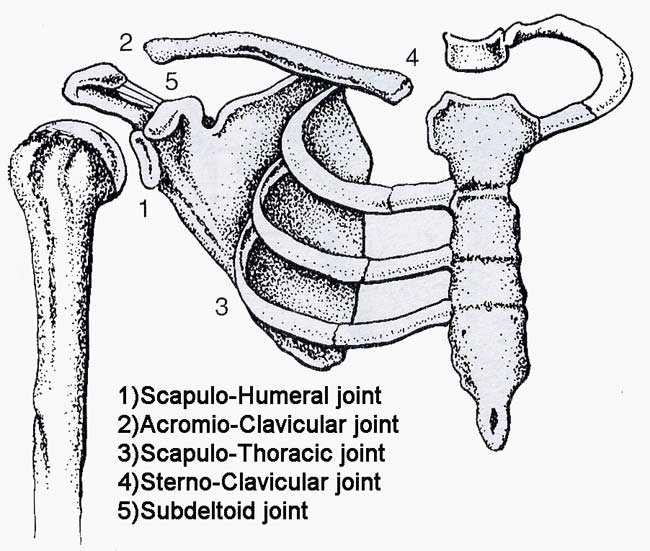
 Click To Enlarge.
 Shoulder Joints Of The Shoulder.
The forearm is constituted by 2 bones:
- Ulna (running medially)
- Radius (running laterally)
The Ulna and Radius articulate superiorly with the Humerus to form the "Elbow" joint. The distal end of the Radius (only) articulates inferiorly with the 3 proximal bones of the Carpus (Triquetral, Semilunar, Scaphoid) to form the Radio-Carpal joint (also known as the "Wrist joint" or "Articulatio Radiocarpea").
The movement analysis occurring at the elbow and shoulder joint levels and the knowledge of the relative muscles that act on them is the first step to understand what kind of movements are required to stimulate the arm muscles when using gym equipment.
Movements Of The Elbow Joint
- Flexion
- Extension
- Supination
- Pronation
To skip the detailed explanation of their meaning click here.
Reference Position:
Reference position is achieved when the longitudinal axis of the arm and forearm are in the same line.
 Click To Enlarge.
 Reference Position.
It's important to note that the reference position of the elbow corresponds to the complete extension of the elbow. Therefore, the absolute range of elbow extension is (for definition) equal to zero. Instead, when talking about extension, (meaning: for the elbow to return to its reference position), we should mention it as "relative extension" since it's always possible from any position of flexion.
Flexion:
Flexion is the movement of the forearm anteriorly toward the anterior aspect of the arm.
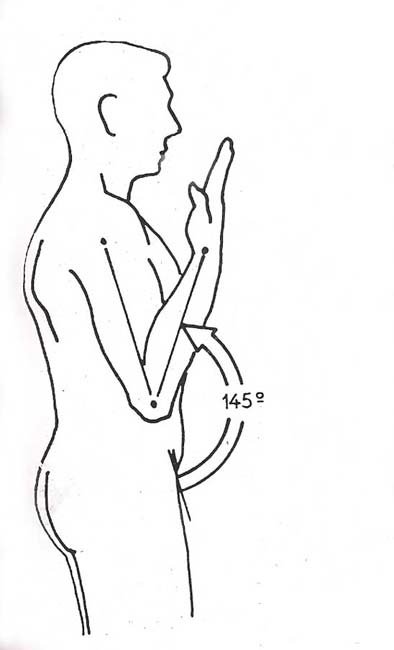 Click To Enlarge.
 Flexion.
Extension:
Extension is the movement of the forearm posteriorly.
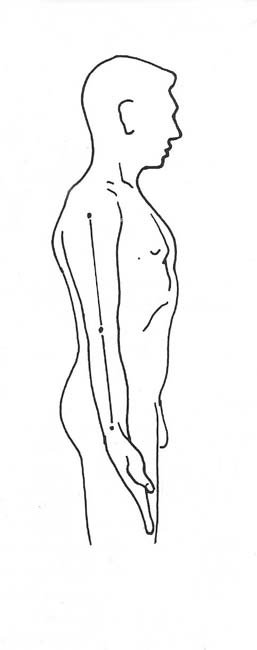 Click To Enlarge.
 Extension.
Supination:
Supination is achieved when the palm of the hand faces upward and the thumb points laterally.
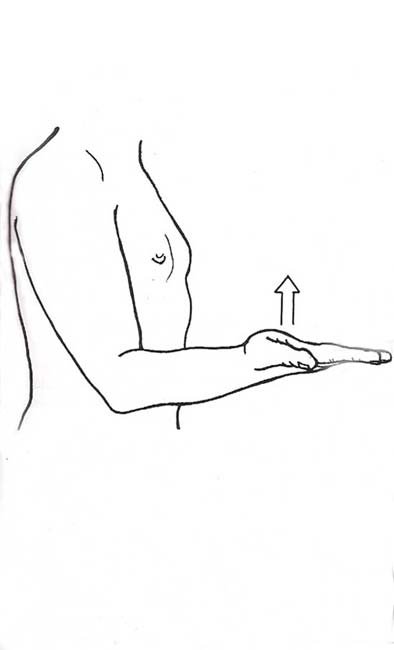 Click To Enlarge.
 Supination.
Pronation:
Pronation is achieved when the palm of the hand faces downward and the thumb points medially.
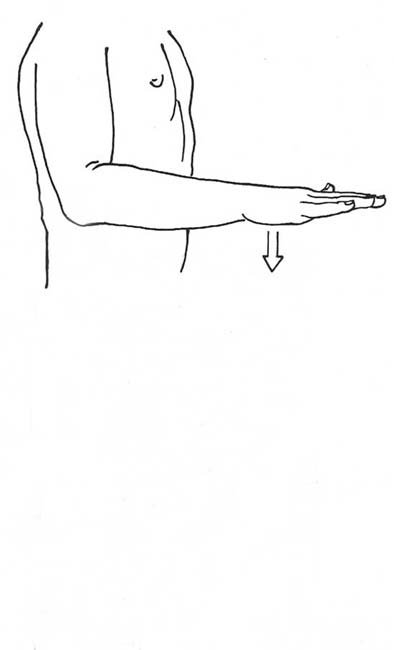 Click To Enlarge.
 Pronation.
Neutral Rotation:
Neutral rotation: is achieved when the palm faces medially and the thumb points upward.
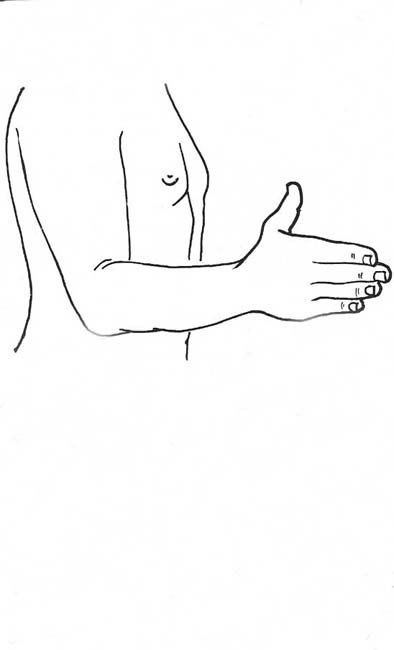 Click To Enlarge.
 Neutral Rotation.
Supination and pronation of the elbow and forearm are the same since it is the radius that rotates around the ulna by means of the "proximal radius-ulnar joint" (one of the three joints that constitute the elbow joint).
Important Note:
If the elbow is extended and the range of pronation of the forearm overexceeds 85° then the rotation of the forearm is compounded with the axial rotation of the arm owing to rotation of the scapulo-humeral joint. As you'll see in the triceps section, the increased range of pronation of the forearm - induced by the compounded intra-rotation of the scapulo-humeral joint - is what happens during the full elbow extension while performing a triceps exercise using a pronated grip on a straight barbell (e.g: "French press", a.k.a: "Triceps barbell extension lying on a flat bench").
Movements Of The Shoulder Joint
- Flexion
- Extension
- Abuction
- Adduction
- Axial rotation of the arm: intra-rotation (or medial rotation) and extra-rotation (or lateral rotation)
- Horizontal flexion
- Horizontal extension
To skip the detailed explanation of their meaning click here.
Reference Position:
Reference position (for evaluating: flexion, extension, abduction, adduction): To evaluate the flexion-extension and adduction-abduction movements the shoulder must be considered in its reference position; that is to say with the upper limb hanging vertically at the side of the trunk.
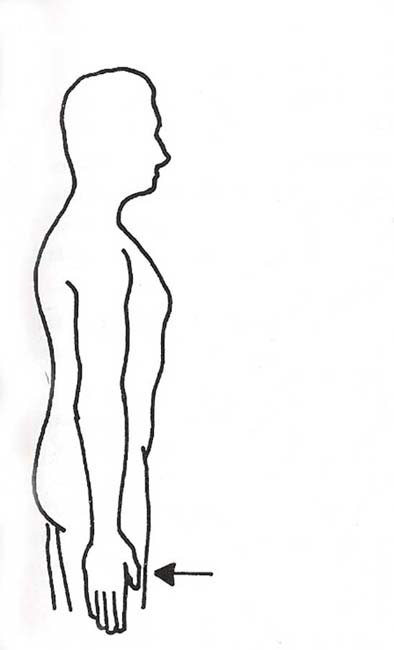 Click To Enlarge.
 Reference Position.
Flexion:
Flexion: movement of the upper limb frontward, on the scapula plane, away from the trunk.
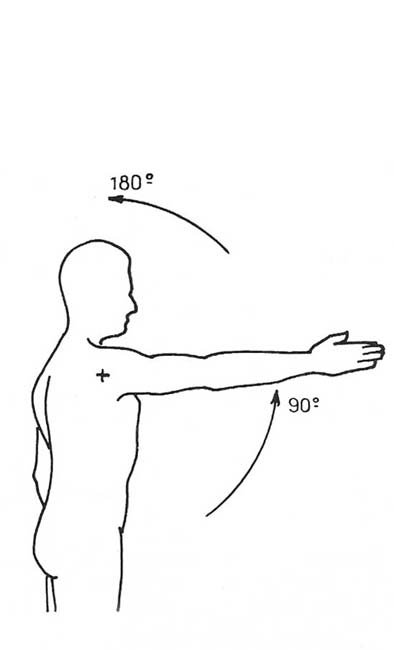 Click To Enlarge.
 Flexion.
Extension:
Extension: movement of the upper limb backward, on the scapula plane, away from the trunk.
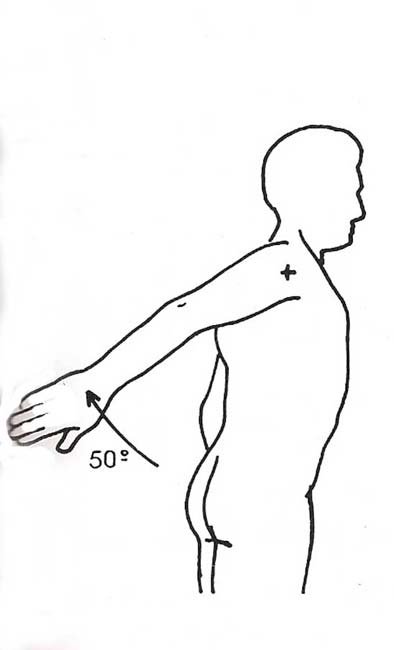 Click To Enlarge.
 Extension.
Abduction:
Abduction: movement of the upper limb laterally away from the trunk.
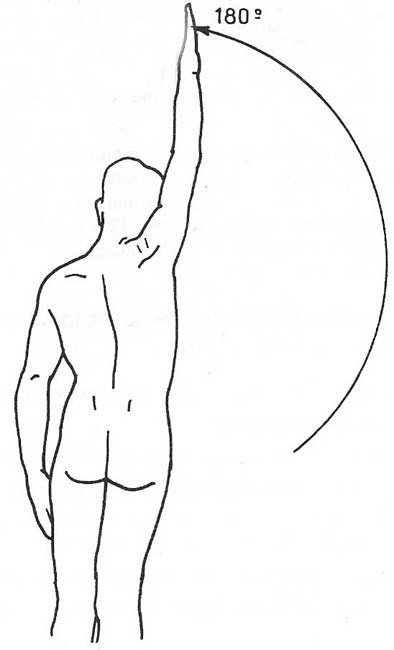 Click To Enlarge.
 Abduction.
Adduction:
Adduction: movement of the upper limb medially toward the trunk.
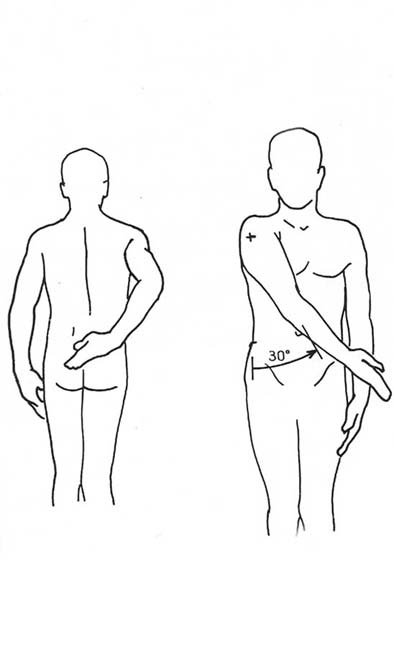 Click To Enlarge.
 Adduction.
Important Note:
The figure "Shoulder adduction" is representing the range of "absolute adduction" - that is the movement of the upper limb medially toward the median sagittal plane starting from the shoulder reference position.
Instead the "relative adduction" is the movement of the upper limb medially toward the median sagittal plane starting from any position of shoulder abduction.
An example of "relative adduction" is represented by the concentric phase (downward phase) of the pulldown at the lat machine.
Reference Position:
Reference position (for evaluating lateral and medial rotation): To evaluate the lateral-medial rotation movements of the arm, the elbow must be flexed at 90° and lying on the sagittal plane. This is called the "true reference position" (0° rotation).
Furthermore, the arm must be internally rotated to 30° with respect to the "true reference position" in order to reach the point of equilibrium between the rotator muscles. This position is called the "physiologic reference position" (30° internal rotation).
If the elbow is not flexed to 90°, the rotatory movements of the arm are compounded with those of pronation and supination of the forearm, leading ultimately - in such case - to the inability of evaluating the exact degrees of motion occurring in reference to the arm.
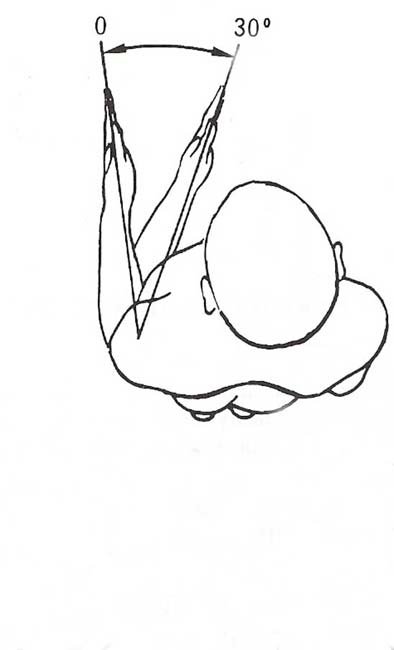 Click To Enlarge.
 Reference Position.
Axial Rotation Of The Arm:
- Lateral rotation or extrarotation
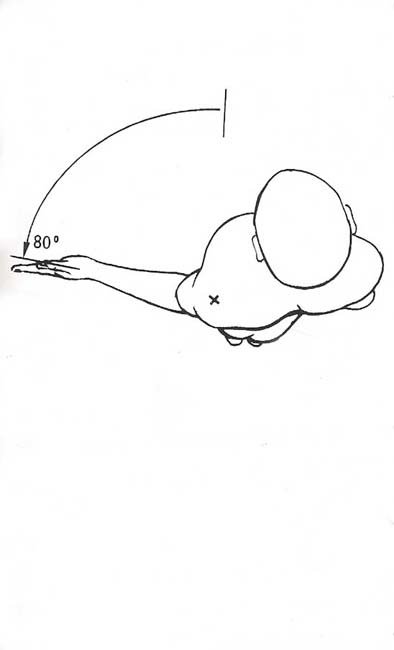 Click To Enlarge.
 Lateral Rotation Or Extrarotation.
- Medial rotation or internal rotation
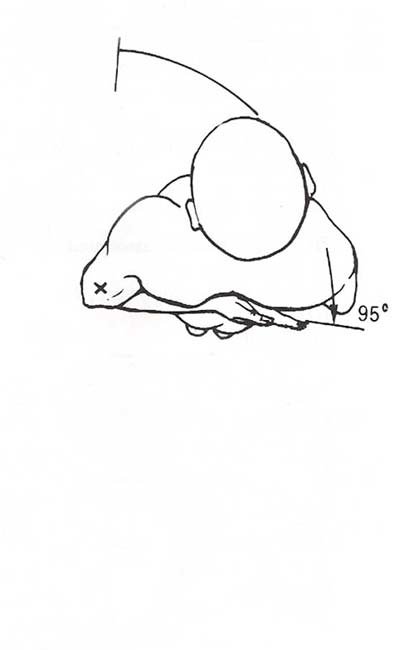 Click To Enlarge.
 Medial Rotation Or Internal Rotation.
Reference Position:
Reference position (for evaluating: horizontal flexion and horizontal extension): To evaluate the horizontal flexion and extension of the shoulder, the upper limb (shoulder) must be abducted to 90° on the frontal plane.
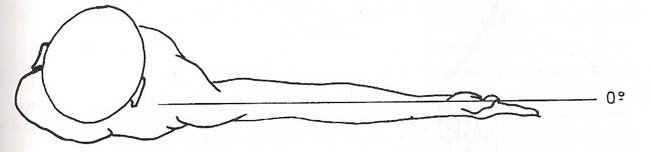 Click To Enlarge.
 Reference Position.
Horizontal Flexion:
Horizontal flexion: the shoulder is abducted at 90° with the elbow extended (movement of the upper limb on the horizontal plane toward the median sagittal plane).
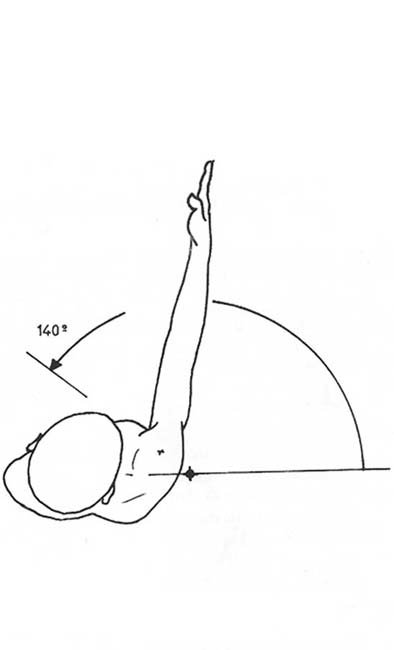 Click To Enlarge.
 Horizontal Flexion.
Horizontal Extension:
Horizontal extension: the shoulder is abducted at 90° with the elbow extended (movement of the upper limb on the horizontal plane away from the median sagittal plane).
 Click To Enlarge.
 Horizontal Extension.
Arm Muscles Involved In The Movements Of The Scapulo-Humeral Joint
Coraco-brachialis
Triceps brachii(long head)
Biceps brachii (long head)
Important Note:
When it comes time to analyze the exercises for arm development: Even though the scapulo-humeral movements represent a secondary importance - more so than at the level of the elbow - for many individuals, their description (scapulo-humeral movements) can't be left without mention because of two main reasons:
- Certain muscles that contribute to arm development act on this joint too.
- As will be described in detail inside the "pre-lengthening and pre-shortening" section; the position of the shoulder affects the "efficiency" and "relative efficiency" of the elbow flexor muscles.
Flexor Muscles Of The Elbow:
Primary Flexor Muscles:
- Biceps brachii
- Brachialis
- Brachio-radialis
Accessory Flexor muscles:
- Extensor carpi
- Radialis longus
- Pronator teres