[ Q ] Born/Grew up in:
- I was born and grew up in Worth, Illinois.
[ Q ] Current Residence:
- I curently reside in Westmont, Illinois.
[ Q ] Measurements:
- BW - 230, Chest - 51, Arms - 19, Thighs - 27, Calves - 17 ?.
[ Q ] When did you start lifting?
- In 1977 at 14 years old.
[ Q ] When was your first contest?
- The 1979 AAU Teenage Mr. Chicagoland when I was 16 years old, I placed 6th in the short class.
[ Q ] What did it feel like winning the Natural Olympia?
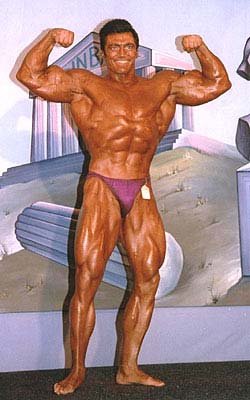
- It was great to win the first Natural Olympia contest in 1998. When the promoter called me in March of that year to ask me to enter it, my first immediate thought was how great it would be to win a contest with that title. Everyone knows that the Mr. Olympia contest is the biggest competition in the world so what better way to promote yourself as a natural bodybuilder than to have the title of Mr. Natural Olympia.
I've always approached bodybuilding from a marketing standpoint. I want to eventually promote bodybuilding to the general public and the titles that I've won as a natural bodybuilder (Natural Mr. Universe and Natural Olympia) will help me do that.
Who cares what federation promotes these shows, if it's the NPC or the AAU or the ABA, it doesn't really matter to me. Believe me, the general public doesn't know or care what organization promotes these shows.
[ Q ] Are you going to get on stage again? If so, when and what show?
- I hope to compete this year at the Natural Olympia and Natural Universe in the fall and, possibly, the Team Universe in August. I have a book coming out at the end of the year (about Natural Bodybuilding, of course) and I have to take the photos for the exercise section of the book in July. I would like to compete again in the Team Universe before I retire from competition.
I competed in the TU 10 years ago, the first year they had it in 1994, and I didn't make the finals so it would be great to return in top condition and do well.
As for the Natural Universe and Natural Olympia, I told Bill Pearl at this year's Arnold Classic that I was using him as a role model since he returned to competition at 41 years old and won the Nabba Pro Universe in 1971 in his best shape ever and I hope to do the same thing at this year's Natural Universe. I just turned 41 in March and I am hoping to achieve my best ever shape this year when I get back onstage.
[ Q ] Let me just say that you have a great physique! How did you build such a great body without the use of steroids?
- I began bodybuilding in the late 1970's and everyone back then used the basic exercises with barbells and dumbbells and lots of weight to build their physiques. The gyms were more hard core than they are now and you really had to bust your butt during your workouts to get massive.
I read an article in a 1978 Muscle Builder Magazine in which Arnold advised young bodybuilders who want to get big to do it with hard and heavy workouts and lots of good food. He said that if you developed your physique with these methods instead of using drugs, you would build your physique from scratch and you wouldn't need drugs to build your body.
I took those words to heart and pushed myself extremely hard with the basic exercises (squats, deadlifts, barbell rows, T-bar rows, standing military presses, power cleans, etc) along with eating top quality food (and A LOT of it!). I weighed 135 pounds when I began training at 14 years old and by the time I was 21, I was 230 pounds, all drug free!
[ Q ] What advice would you give natural competitors who are looking to get huge like yourself?
- The key to getting really massive without drugs is to use the basic exercises with heavy weights. Keep the sets moderate because it doesn't make any sense to do 30-40 sets a bodypart when you are training so heavy and intense. Eat plenty of
- and carbs with at least six meals a day.
Don't rely on these machines at the gym and don't use drugs or prohormones when you are just a kid trying to add some size. The methods I used to get big will work today just liked they worked for me and like they worked for bodybuilders decades before me.
[ Q ] What are your feelings about people who choose to use steroids?
- To each his own, I say. We all have the freedom to put whatever we want into our bodies as long as it doesn't hurt anyone else. Having said that, it's important to consider that steroids are now considered a felony to use or sell. I personally don't believe that steroids are worth the risk. Many of the people using steroids could make great gains if they trained harder and ate better.
Too many people use them as a shortcut to getting bigger and are not willing to put in the time and hard work that it takes to get big. They would rather use drugs to gain 20 pounds in 8 weeks instead of training and eating good for a year to add 10 pounds. The difference is that the guy who gains 20 pounds in 8 weeks is going to lose that weight after he gets off his cycle and the guy who does it naturally is going to keep it because he earned his muscle. You don't earn any muscle by taking steroids.
With all the advances that have been made in the last 20 years in the areas of supplementation, nutrition and training, there is no reason to resort to drugs. When I began training in the '70's, there really were very few supplements that did anything. Now we have great protein powders, meal replacement powders, creatine, glutamine, post-workout 0drinks, etc. A drug-free bodybuilder today can build a very impressive physique without ever considering steroid use.
[ Q ] If you knew for a fact that you could win the IFBB Mr. Olympia if you started using steroids, would you do it? Why or why not?
- That's an interesting question because when I started bodybuilding at 14 years old, my goal was to win the IFBB Mr. Universe title and become a professional bodybuilder. My idols at the time were Arnold Schwarzenegger and Kal Szkalak (1977 Heavyweight Mr. Universe).
When I reached my 20's, I was obsessed with the thought of becoming a professional bodybuilder. I looked up to Rich Gaspari who was the same age as I was. I would see him in the magazines, touring the world doing seminars and exhibitions and competing in the Mr. Olympia each year. That was exactly the life I wanted to lead.
- I thought if I could do a 12 week steroid cycle before the Mr. Olympia each year, that wouldn't be so bad. I read that Arnold and other guys of his era would only use the drugs for a few months before competing each year and they would stay clean the rest of the year.
However, when I started competing, especially on the national level, I realized that the drug usage was much more extensive than that. It was at that point that I decided the risk wasn't worth the reward. I wasn't willing to take the amount of drugs necessary to possibly turn pro and then continue taking the drugs throughout my career as a pro bodybuilder.
I never wanted to put myself in the position of being forced to take drugs in order to keep my physique competitive with the other guys I would be competing against. It was just something I couldn't do. So, to answer your question, I guess I would say no, I wouldn't take the drugs even if it meant I could win the Olympia.
[ Q ] What is the biggest mistake that you see beginning bodybuilders make?
- The biggest mistake I see
- making is what I call "undertraining". Everyone is so concerned with
- but a lot of the young guys I see in the gym training to get big are just not pushing themselves hard enough. Instead of doing exercises such as full barbell squats, deadlifts, barbell rows and incline dumbbell presses, I see them spending the majority of their time on the Hammer Strength machines and doing cable exercises.
The type of training that puts on muscle mass is brutally hard work with barbells and dumbbells. There's no way around this so it makes no sense to waste time and energy doing exercises that are not going to bring results. The training is the first step in the process of building muscle so it is necessary to do it right in order to make gains.
The next step is eating enough of the right foods, plenty of protein, carbs and the essential fats. Young bodybuilders need to learn how to prepare their food so they can be assured of eating the right nutrients for building muscle.
Don't rely on protein bars and fast food because that's not going to get the job done. You have to be disciplined enough to eat six meals a day, every day, in order to build muscle mass. When I was a teen, I had a super fast metabolism and it was very difficult to add muscle mass. It was only when I started eating a lot of the right types of foods was I able to get big. If you talk to all of the really massive bodybuilders, you'll discover the same thing; it takes a lot of good food to get big.
[ Q ] What has been your biggest accomplishment?
- I just finished writing my first book and that was quite an accomplishment for me. I have been writing my own training and nutrition column in IRONMAN Magazine for the last five years so I am used to writing but to write a 28 chapter, 455 page book was something else indeed. It took me almost nine months of concentrated writing to finish it and it was really a relief to wrap it up. It will be published by a company called Human Kinetics and it comes out at the end of 2004 so I am really looking forward to seeing the finished product.
As far as competitions go, there have been several shows that really meant a lot to me. When I won the Teenage Midwest contest at 18 years old, it was a real high because it was the first time I took first place. Another highlight was winning the 1986 NPC Illinois competition as this was the first show in which I won the overall. I trained so hard for that contest, it was like life or death to me to take first place.
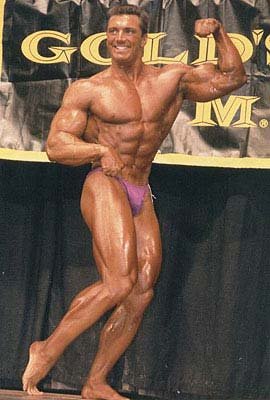 After that, winning the Natural Mr. Universe in 1992 was like a dream come true because I always wanted that title of Mr. Universe. Of course, the Natural Olympia title was awesome also because I traveled to Europe for the first time (the show was held in Greece) and it was great to accomplish my goal of winning the first Natural Olympia. Plus, Tito Raymond and photographer Rick Schaff were along for the trip and it was a great time hanging out with them for the week we were out there. That's how competitive bodybuilding is supposed to be, competing against bodybuilders from all over the world and having fun and enjoying the experience.
[ Q ] What is your training like these days? What type of training has given you the best results?
- My
- these days is still hard and heavy. At the age of 41, after 27 years of intense training, I have to be much more careful in my training than I was ten years ago. I have compressed discs in my lower back so I go to the chiropractor each week to get adjusted in order prevent
- .
I have to be very cautious when performing squats, deadlifts and barbell rows. I still do these exercises because I feel they are necessary to develop the mass I want to build but my lower back cannot handle that type of stress all the time so I have to improvise a lot. I sometimes do squats last after heavy leg presses and leg extensions and I will pause for 2-3 seconds in the bottom position to make the exercise harder. It was a difficult adjustment to make because I was always used to just training heavy and hard on the basic exercises. Now I realize that I can still make gains as long as I continue to train hard during the workout and make adjustments in my training when I need to.
The type of training that has given me the best results is to utilize the basic exercises for a moderate amount of sets (10-14 sets per bodypart depending on the size of the muscle group). I keep a notebook of my training and I try to use more weight or more reps each workout to increase the intensity from week to week. I usually use two workouts for each bodypart so I am using a different routine week to week.
This is necessary to keep the muscles from adapting to the workouts. I always try to feel the muscles being worked even when I am training heavy and this requires a lot of concentration and focus. I don't do a lot of isolation exercises except pre-contest and, even then, I am using them after I do the heavy basics.
[ Q ] What type of diet do you follow?
- I eat six to seven meals per day, approximately 3500 calories in the off season. I used to eat as much as 4500 calories in the off season in the past but that doesn't work for me any more as I have gotten older. Plus, I like to stay a little leaner now as it makes it easier for me to get ripped when I diet for a contest.
I eat approximately 1.25 grams of protein for each pound of bodyweight and slightly more than that in carbs. I don't believe in low carb diets because I lose muscle when I don't eat enough carbs. I question anyone who is natural that eats a low carb and low fat diet and they don't lose any muscle and compete looking hard and ripped. That's just not natural! You can get away with that when you are using drugs but not when you are drug free. I also eat around 60-70 grams of fat during the off season which adds up to around 20% of my total calories. I get most of my fat intake from essential fatty acids such as flaxseed oil.
Pre-contest, I will drop the calories down to around 2800-3000. I eliminate all simple sugars (except for immediately following a workout) and cut back on the carbohydrates while still keeping my protein intake high. I always write down my diet every day, recording the calories, protein, carbs and fats that I eat each day. I do this both in the off season and pre-contest so I know exactly what I am eating. This allows me to gauge my progress more efficiently. Otherwise, it's all guess work.
[ Q ] What supplements are you taking? Which supplements do you feel have worked the best for you?
- I represent the
Muscle Link
- supplement line and I take a lot of their supplements. Protein powders and meal replacement powders are a must in order to get the necessary amount of protein each day. I like Muscle Link's formulation of whey and casein protein instead of just whey. I probably take 3-4 protein drinks a day either from protein powder or MRP's.
I also take a supplement called Recover-X immediately after my workout. This post-workout drink contains 40 grams of whey protein and 60 grams of simple carbs which is just what you need following a heavy and hard workout. I take creatine before and after my training along with glutamine. Glutamine is a great supplement for building muscle mass and I take it 4 times a day. Pre-contest, I'll take BCAA's in an effort to preserve more muscle mass while I am dieting.
[ Q ] What are your thoughts on the current state the industry is in right now? Are you happy with the way it is or do you think things should change? Do you think it is moving in the right or wrong direction?
- Well, the competitions are better produced and the audiences are bigger than ever before so that is a positive trend. However, the professional bodybuilders have gotten so big now that the general public tends to look at them as freaks. The drug use has escalated to an extent that many of the physiques look more like cartoon characters than athletes. This has alienated the sport to only its core audience and away from the general public.
In order to change this trend, the IFBB would need to institute more aggressive drug testing. Of course, if there is a test, there will probably be many ways to beat the test. However, with no testing whatsoever, the bodybuilders are given free rein to take what ever they want to take to win a contest. That is why bodybuilding will probably never make it to the Olympic Games, because of the lack of drug testing in the sport. The only way we could change this image of bodybuilding and steroids is to employ comprehensive drug testing.
Drug testing, however, would change the way the physiques look. In fact, if a test was used which could detect most of the drugs used today, the bodybuilders would look completely different. Another way to accomplish this same goal is to have the judges pick more aesthetic physiques as the champs instead of the most massive bodybuilders. This may be happening to some extent with Dexter Jackson and Darrem Charles winning some pro contests and Richard Jones winning the NPC USA last year.
If no drug testing is instituted, I fear the physiques will continue to get bigger and bigger and bigger. In order for this to happen, the competitors will need to take greater quantities of drugs which will have a negative effect on their physiques as well as their health. I see some changes occurring already as far as more emphasis on the performance aspect of the sport and a preference for more aesthetic bodies.
It will be interesting to see what difference Arnold will make as the new Executive Editor of Muscle and Fitness and Flex Magazines. If we could somehow return to the massive but artistic physiques of Arnold's era, I think the sport could possibly regain some of the general public's attention again. But I still think the sport needs some type of drug testing at all levels in order to be considered a more legitimate sport.
[ Q ] What is your favorite bodybuilding show to attend?
- I love going to the
Arnold Classic
- and the
Olympia
- . The Olympia has better competitors because it is still considered the number one competition in the world. However, the Arnold is a much better produced show.
I saw my first Mr. Olympia way back in 1977 and Arnold and Jim Lorimar had the magic touch to producing competitions even then. I always said that if I could take someone who had never seen a bodybuilding competition before to a contest, I would choose to take them to the Arnold Classic because it is the finest example of a bodybuilding show that there is.
[ Q ] Who are your role models and why?
- Arnold, of course, is a big role model for me as well as millions of others. He was the first bodybuilder I admired when I took up the sport in 1977 and I have continued to be in awe of his success over the last 25 years. I love his mental attitude and his philosophy of staying hungry throughout his life. Whenever I face a dilemma in my life, I often think "How would Arnold handle this?"
Before I began bodybuilding, I admired Bruce Lee. Bruce was a consummate martial artist and he worked so hard on his craft until he perfected it. He had a library of books on every fighting style imaginable and he read them all in an effort to learn some new techniques that he could apply to his style of martial arts. When I began bodybuilding, I remembered Bruce's discipline and work ethic and tried to apply it to my sport.
As I've gotten older, I admire people like Lee Labrada, Jack Lalanne and Bill Pearl. All three of these gentlemen handle their lives with class and professionalism and they continue to promote the fitness lifestyle well after their competitive careers have ended.
Bill Pearl still trains two hours a day, six days a week and he looks incredible for 73 years old. Jack Lalanne is close to 90 years old and he has more energy than most 30 year olds. He is truly a living testament to the benefits of weight training and proper nutrition. Lee Labrada was a very successful professional bodybuilder and now he continues to be a success with his supplement company. I hope to promote the fitness lifestyle to the general public in the same way that Lee, Jack and Bill have.
[ Q ] What do you think about the recent ephedra ban and the possibility of prohormones being banned soon as well?
- I think the government should stay out of regulating the supplement industry. I agree with all supplements being thoroughly tested before being sold as well as guidelines on how to take these supplements being included on the label. After that, it is up to the consumer. I'm sure most, if not all, of the deaths associated with ephedra were from individuals who overdosed on this supplement in an attempt to lose fat quicker. They were looking for a short cut. It's the same with prohormones. Has this supplement killed anyone?
The government is merely jumping on the steroid bandwagon because of the BALCO scandal and the problems associated with professional baseball. It's an election year and they want to make the general public think that they are doing something about this terrible steroid problem.
- The ABA allows props to be used during the evening show but I've never used them. I think it's more important to put together an effective posing routine that is going to show off my physique to its best advantage. Putting together the best poses and choreographing them to music is what a bodybuilding presentation is all about.
I think it's admirable that Arnold and Jim Lorimar allowed this at the recent Arnold Classic as a means of raising the entertainment during the night show but I've yet to see it really work. The Night of the Champions contest thought up this concept many years ago and it didn't really do anything to make the contest more entertaining.
Bodybuilders such as Ed Corney, Mohammed Makkawy, Lee Labrada and Shawn Ray have been performing outstanding posing routines for years and none of these great bodybuilders needed any props to make their routines more effective.
Thanks for taking the time to do this interview. You can learn more about John Hansen at his website http://www.naturalolympia.com.