
Grip training can heavily influence the amount of weight lifted, for all upper-body movements, and develop the forearms to such a degree that one is prompted to take a double take, upon first seeing the forearm-bulging results of grip training first hand.
Certain types of grip training, in and of itself, can provide an ego-boosting experience, as the trainer is able to handle greater gripping poundage's on a weekly basis, provided they consistently train in the correct manner.
Training and aesthetics aside, a strong grip will certainly assist if one becomes involved in a fight, where the power of their grip might determine the outcome. Read on to find out exactly how to develop your grip, and why it is important to do so.

Reasons For Improving Gripping Strength
 Enhance Martial Arts/Wrestling Proficiency.
-
Developing gripping strength will assist when it come to grappling in the context of a martial arts or wrestling fight. It will also add snap, and power, to a punch, giving boxers who practice gripping exercises an additional advantage.
When gripping an adversary, one with weak forearms, and gripping strength, might sustain an injury to the wrist area or worse, end up on the ground with their opponent kicking their face in.
Often, the key to winning a fight is to maintain a vice-like hold on your opponent over a prolonged period, and the key to maintaining such a hold is to develop phenomenal gripping strength.
Develop Respectable Size For Bodybuilding Purposes.
-
Specific gripping exercises, of which there are many (these will be explained later), develop the forearm musculature to a significant degree. Those with the best forearm development are often people who work in a profession that requires a constant gripping of objects (concrete workers for example).
If one's forearms are lagging, specialized grip training could be just the thing they need to break this plateau. Direct forearm work is good, and should be continued, but gripping work stimulates all forearm musculature, as a whole, and provides the additional volume needed to enhance new growth (the forearms, like the calves, need a lot of work to respond).
Enhance One's Weight-Training Program.
-
An improvement in gripping strength generally means an overall improvement in quality, as far as lifting immense poundages in other movements is concerned. For example, bent rowing, a fundamental back movement, will suffer if one's grip is not up to standard. There could always be an argument made for wraps, but these are controversial at best, and are thought to compromise technique.
 |
||||
|
|
 |
||
|
||||

-
So, a strong grip is essential to training progress, as most movements are dependant on correct gripping technique and strength. Chinning, as well, relies on a solid grip, and heavy benches could potentially cause wrist injury in those susceptible (i.e. those with a weak grip).
Day to day activities such as turning doorknobs, opening jars and conducting mechanical repairs, also benefit from a strong grip. The type of wrist action used when doing any of the above is a twisting motion, and there are specific exercises (which will be explained later) that can be done to improve this.
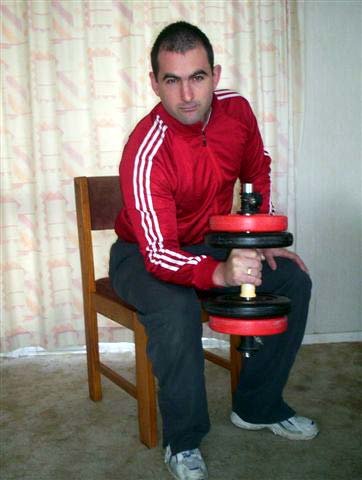
Wrist Twists
 Click To Enlarge.
Types Of Grip-Strength
There are two main types of grip strength: crushing strength and pinching strength.
Crushing Strength
-
This type of grip strength is demonstrated when one crushes a can of drink (strongmen in particular, not your average person). A crushing grip is also used when shaking hands, or, in a fighting context, grabs their opponents wrist. Analogously, a table-vice mechanism, has almost an identical action to that of a crushing grip, in that the stationary side of the vice (the palm) has a component (the fingers) that closes toward it as it crushes.
 |
View The Video Of Mash Monster Windows Media Player (1.6 MB) |
Pinching Strength
-
Holding a heavy plate between the thumb and fingers, as it hangs toward the ground, is a demonstration of pinching strength. Training for pinching strength has little in the way of a real world application (other than targeting a pressure point during a confrontation perhaps), but it will add to thumb and finger strength and help to develop respectable size in both the extensor and flexors of the forearms.
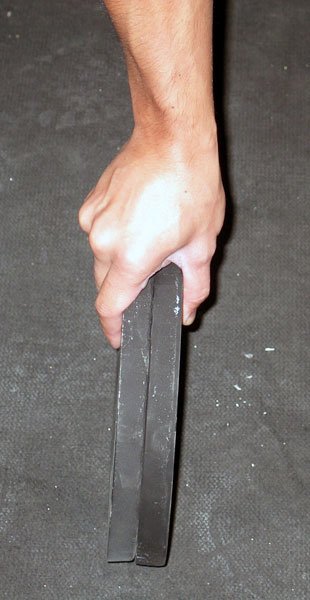
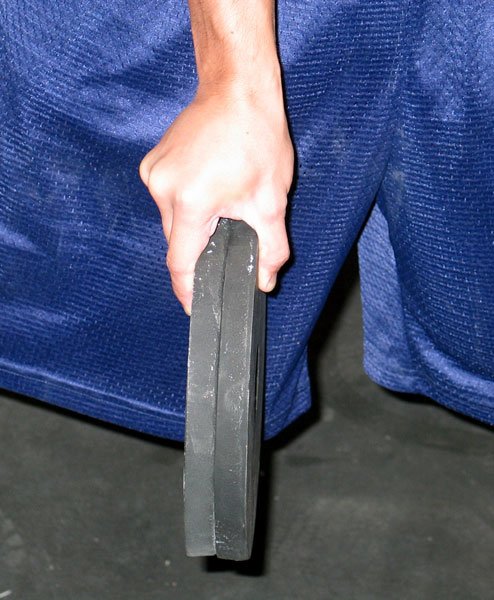 Click To Enlarge.
Pinching grip is generally harder to train for than the crushing grip, given the awkwardness and difficulty of the specific movements needed to target this area.
Holding Grip
-
This type of grip involves the thumb, fingers and palm (almost a cross between the crushing and pinching grips), and is used most often in a real world situation for controlling an object (a steering wheel of a car for example), or person in a confrontation.
In a fighting situation, the holding grip is often used to transition between pinching or crushing, as ones opponent is being controlled.
Types Of Strength Associated With Grip Training.
-
All gripping movements will utilize different types of strength, to varying degrees. Before moving on to the most effective exercises for developing grip, the three main types of strength used in this process will be covered:
- Concentric Strength.
When gripping an object such as a tennis ball, before releasing, one is using concentric strength. Crushing newspaper, as will be explained in detail soon, is another example of this type of strength. In short, concentric strength is vital as far as initially grasping an object is concerned. What distinguishes concentric strength from any other type, is the fact that the muscles of the forearm and wrist shorten in response to the squeezing action. - Isometric Strength.
Isometric strength is used when the same object grasped with concentric strength is held. The muscles in this instance, although contracting, are not changing in length. Using a holding, or crushing, grip while keeping hold of an opponent is an example of isometric strength in action. - Eccentric Strength.
Gradually opening ones, hand while holding a ball, is an example of the type of eccentric strength used to unclasp the hands when striking an opponent with knife-hand. The type of contraction undertaken during an eccentric movement is one of controlled resistance - lowering a barbell during a bench press is a perfect example.
Gripping Exercises
Grip training exercises can be grouped into two types: suspension and crushing/squeezing/tearing exercises.
Suspension Exercises.
-
These involve, as the name suggests, suspending a weight, while gripping it with the wrist. They work primarily the pinching grip. Dangers are inherent in this type of training, as the feet could be crushed if the weight is dropped, or, if the grip gives out during a hanging movement, an injury could occur.
- Grip Hangs.
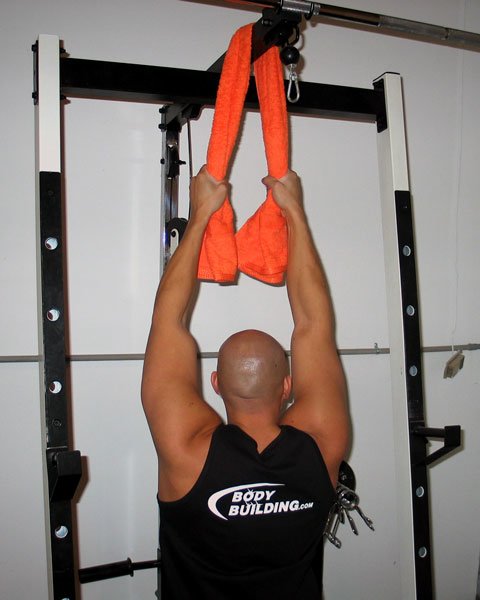
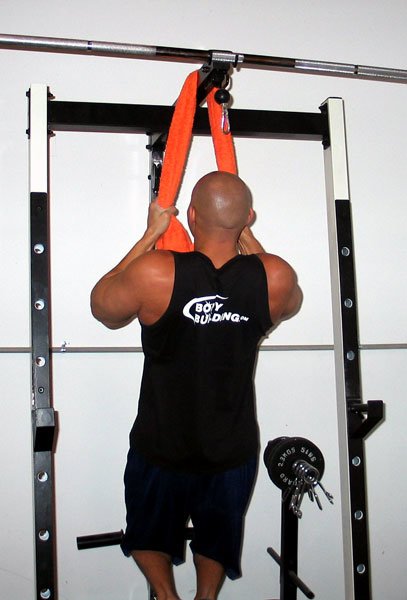
For this exercise, simply hang from a bar with a holding grip for a period of time, which should be increased as grips strengthens.Grips hangs done in this fashion work holding and crushing strength.
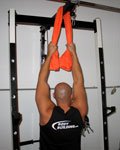
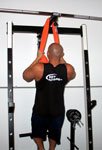
Grip Hangs
Click To Enlarge.
A twist on this movement is to use the fingers (hanging from a beam as opposed to a bar) to increase pinching grip.
- Towel Grip Dumbbell Curls
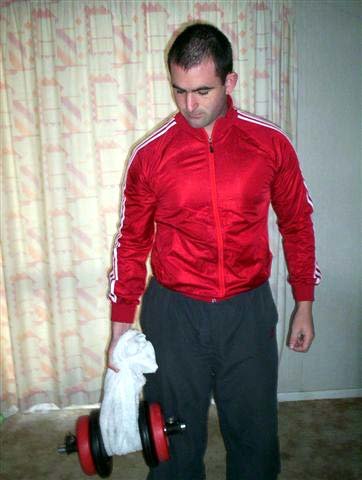
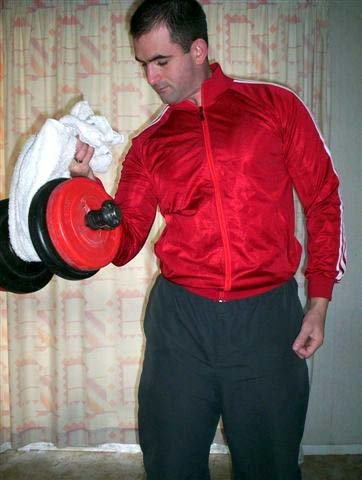
Wrap towel around the bar of a dumbbell, and grip both ends of the towel. Perform a curl in this fashion to work isometric crushing strength, and develop spectacular forearms.A good practice to get into, is to incorporate this movement into a biceps routine (between regular dumbbell curls for example) to really target total arm development.
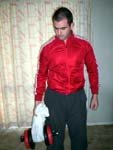
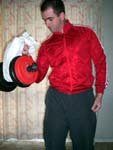
Towel Grip Dumbbell Curls
Click To Enlarge.
Three sets of 12-15 repetitions for this movement. The normal strength-training rules concerning building up slowly before increasing weight apply, as they do with all remaining exercises in this article.
- Towel-Grip & Plate-Grip Farmers Walk.
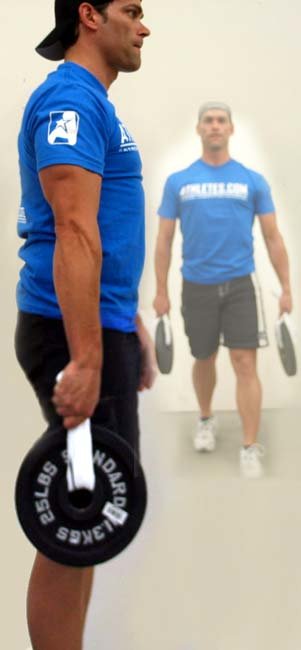
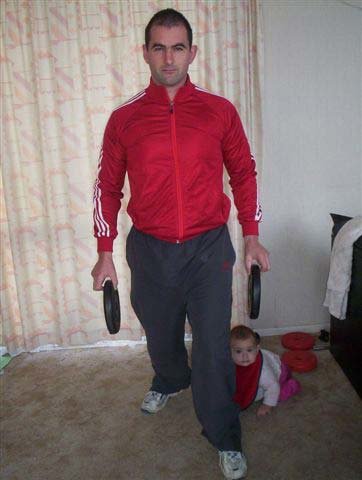
These movements respectively develop isometric crushing and pinching strength. For both these movements, find a suitable area where one can walk 100 meters unobstructed.For the towel walk, attach a towel to a dumbbell or any other suitable weight (a brick, or sandbag etc.), grasp hold of this weight and walk the designated distance until the grip gives out - the weight therefore needs to be suitably heavy so one does not have to walk a considerable distance. This movement really works all muscles of the forearm.


Towel Grip & Pinch Grip Farmers Walk
Click To Enlarge.
The plate-grip farmers walk adopts the same principal in terms of walking distance, but instead substitutes a plate (5 pounds in each hand to begin with), to work isometric pinching strength. Three sets for each type of walking should be sufficient. A 90-second hold should be a realistic target.
- Static Barbell Hold
This movement increases crushing and holding strength. It is a very simple exercise that involves taking a barbell from a rack and holding it for up to 90 seconds.To specifically develop various types of holding/crushing grips, use both the bar and a rolled-up towel to add different degrees of stimulus: the towel with make the grip wider and emphasize more of the pinching type strength. Three sets of 90-seconds for this movement.

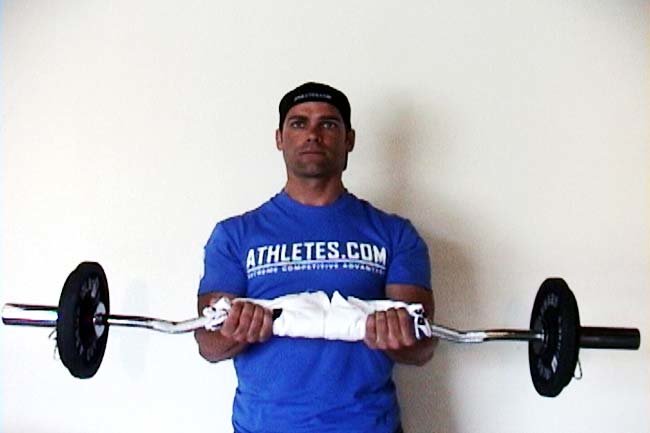
Static Barbell Hold, With & Without Towel
Click To Enlarge.
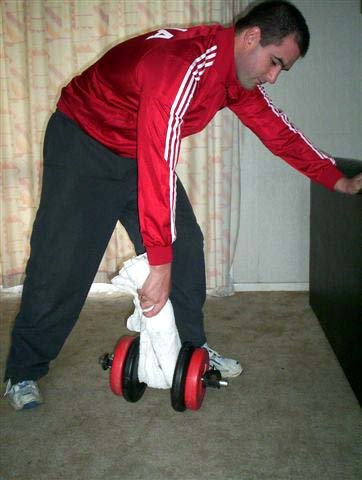
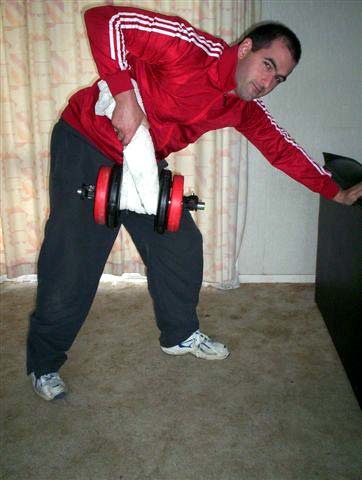
- One-Arm Dumbbell Rows With Towel
Attach a towel to a dumbbell and perform rows while holding the towel. Again, different thicknesses of towel will target different aspects of grip.
One-Arm Dumbbell Rows With Towel
Click To Enlarge.
This movement can be incorporated into a back workout to help build crushing/holding strength.
MPEG (316 kb)
Window Media (247 kb)
Video Of Static Barbell Hold With Towel:
MPEG (568 kb)
Window Media (404 kb)
Crushing/Squeezing/Tearing Exercises
These movements help to build vice-like strength in the hands, while establishing significant size in the forearms. The following exercises utilize the thumb, fingers and palm, which make them total grip strengthening movements.
- Rubber Ball Squeeze
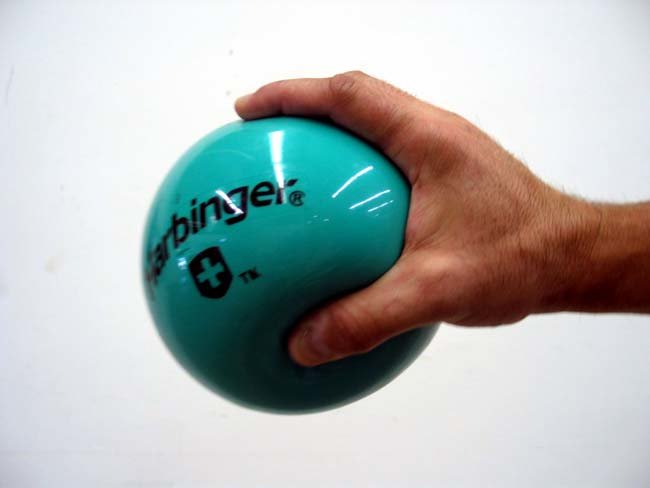
Using a rubber ball (or tennis ball), simply squeeze and hold for up to 90 seconds. Train both hands with three sets each. This movement heavily targets the forearm flexors.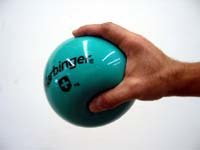
Rubber Ball Squeeze
Click To Enlarge.
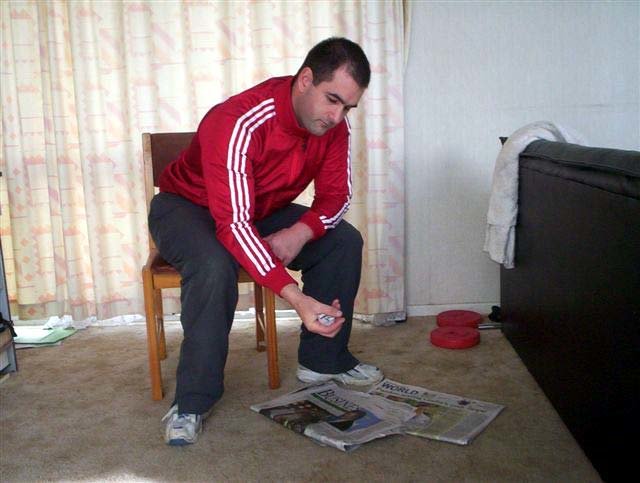
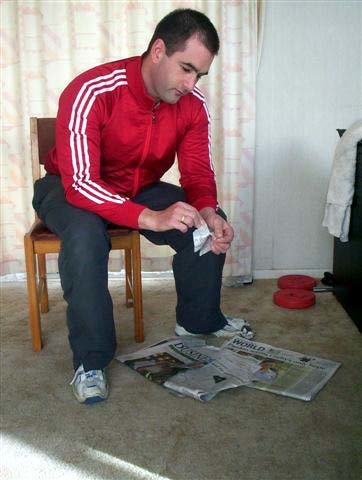
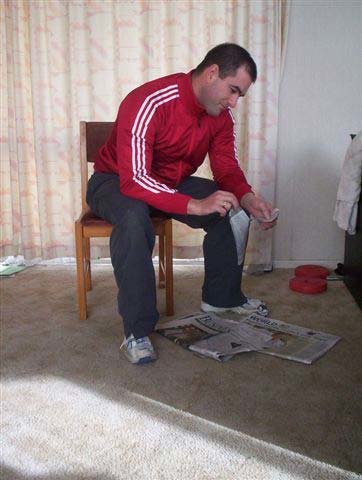
- Newspaper Balls
These would have to be one of the simplest, yet most effective, ways of developing crushing strength. Take one newspaper and tear each page into smaller pieces. Roll each piece into the smallest possible ball, one hand at a time, until the entire newspaper has been used.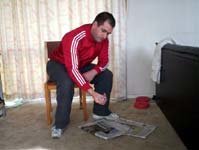
Newspaper Balls
Click To Enlarge.
Of course, it pays to begin with a few pages and progress to the entire paper, over a period of weeks.
- Newspaper Tearing
This exercise is an extension of the traditional strongman phonebook and card-deck tearing feats. In fact it can be used as a build-up to either of these displays. It is a simple movement, which can be done at almost any time, anywhere.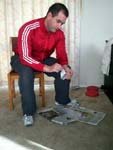
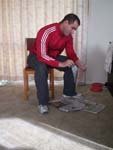
Newspaper Tearing
Click To Enlarge.
Take two pieces of newspaper, lay them on top of each other, the fold them in halves five times. Then begin by tearing these halves into halves, and even quarters. Begin with a few sheets and progress to a entire newspaper.
Other Grip Strengthening Exercises
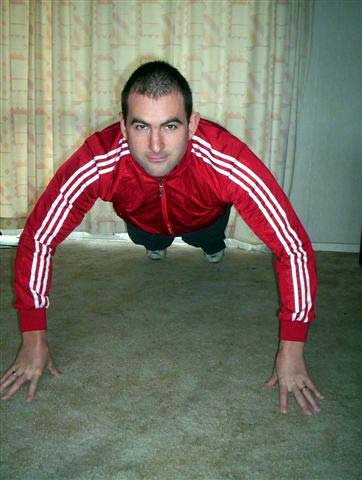
- Fingertip Push-Ups
This movement is one of the most effective for strengthening the fingers, which translates to an improvement in grip strength.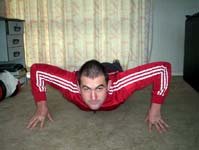
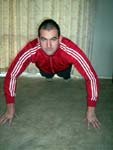
Fingertip Push-Ups
Click To Enlarge.
It does not target holding, crushing or pinching grip directly, but is an excellent movement nonetheless. Three sets of as many repetitions possible should do the trick.
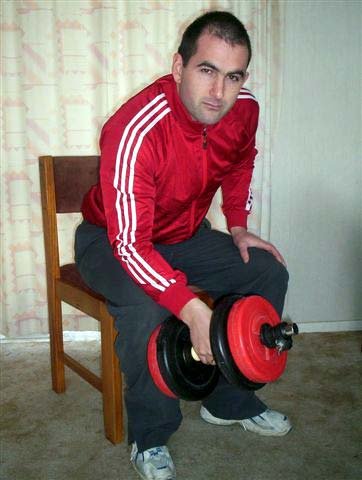
- Wrist Twists
These are great for daily activities like turning door knobs, opening jar lids and using tools such as a screwdriver. To perform this movement, take a moderately weighted dumbbell and sit on the end of a bench.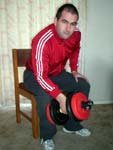
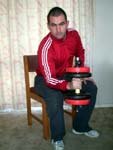
Wrist Twists
Click To Enlarge.
Feet should be shoulder-width apart and forearms are to be placed on thighs. Wrists should be slightly off the edge of your knees. Grasping the dumbbells, slowly rotate the hands back and forth making sure that the forearms are stabilized. Three sets of 12-15 repetitions should do it.
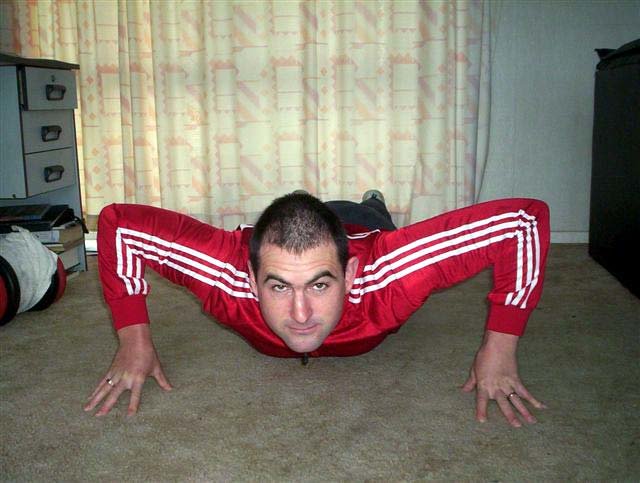
A Grip Strength Program
The following program is designed to build total grip strength. Certain exercises are omitted (Towel dumbbell rows and curls can be done during back and biceps training respectively). Training days can be shifted to suit current training program, if necessary.
Don't be overwhelmed by the workload. Given the relatively non-taxing nature (in terms of stressing the entire body) of grip work, regular training sessions (back/biceps etc) can be easily worked around. The Friday and Saturday sessions can be done in front of the TV or in a similar, relaxed, setting.
- Grip hangs (holding grip): three sets of 90-second hangs.
- Towel grip farmers walk: three sets of 90-second holding.
- Static barbell hold: three sets of 90-second holding.
 Click Here For A Printable Log Of Monday (Crushing Strength).
 - Grips hangs with fingers: three sets of 90-second hangs.
- Plate grip farmers walk: three sets of 90-second holding.
- Finger tip press-ups: three sets of as many as possible (this movement, although not strictly a pinching movement, does strengthen the fingers which are required for pinching work). Click Here For A Printable Log Of Thursday (Pinching Strength).
- Newspaper balls: begin with a few sheets, and progress to an entire paper of over subsequent weeks. Alternate hands.
- Wrist twists: three sets of 12-15 with a light dumbbell - progress to a heavier one as strength develops.
- Newspaper tearing: Begin with a few sheets and progress to an entire paper.
- Rubber-ball squeeze: three sets of 30-40 squeezes with each hand.
Monday (Crushing Strength):
Thursday (Pinching Strength):
Friday:
Saturday:
Conclusion
There are many grip training exercises available. The ones featured in this article are what I consider to be the best and most efficacious, in terms of both developing phenomenal strength, and filling out the forearms. Some of the movements featured are obscure, and used primarily as an aid to martial artists. However, they work equally as well for both strength athletes, and the general population.
Developing grip strength will enhance not only the ability to handle heavy objects, but assist with injury prevention due to increased wrist/hand strength, enhance quality of training due to an increased ability to handle weights without the grip giving out, develop massive size in the forearms, and help with day activities such as opening jars. Developing gripping strength can be a lot fun, and is certainly worth committing to.
References
- About.(2004). Getting a Martial Grip: Improving Your Gripping Strength. [Online]
- Jones, M.(2004). Killer Grip Strength for the Martial Arts. Blitz, Martial Arts Magazine. May, 2004.