
Are you having trouble building your calves? These techniques will help you develop your calves to the very fullest, including the hard-to-reach inner and outer areas.
Technique #1 - Ski-Jump Calf Raises
Your calf machine must be bolted down solidly to take full advantage of this technique as you'll be pushing against the machine at an angle.
Set your shoulders in the calf-raise machine as you normally would. Now place your feet back about a foot back from there (don't use a calf-raise block for this technique as the block may slip out) so your body is at an angle. You will look somewhat like a ski jumper when you are in this position. Push up and forward into the calf raise from this position.
This angle increases the tension in the stretch position and works the calves at a very unique angle not found in any other calf movements. This technique is excellent for any sport requiring explosive forward movement, e.g. track, football, soccer, volleyball, etc., as the body position employed with this technique mimics that movement very closely.
It's also especially useful if you find you're running out of resistance on the calf machine you're using. Since you'll be pushing forward against the machine as well as the weight, the resistance will be greater.
Note: Be sure your shoes have good grip and that you are not on a slippery surface when you use this technique. Your feet could slide out.
Technique #2 - Using Weight Plates To Hit the Inner and Outer Calves
This technique will work on any variation of the calf raise exercise from regular calf machine raises to dumbbell calf raises to Smith Machine calf raises. It will not only work the inner and outer calves but it will also help you develop incredible ankle strength and stability.
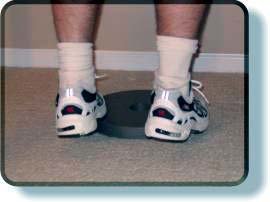 Use one 25-pound plate to hit the inner calves. |
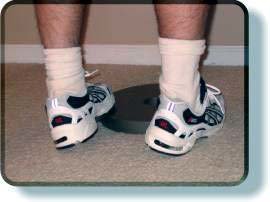 Roll your feet down to the outsides to work the ankles fully. |
Instead of using a calf block or the regular footplate of the machine, you will be using one or two 25-pound weight plates (depending on which area of your calves you want to hit) placed on the floor. These will be what you'll be setting your feet on for the exercise.
To work the inner calves, place one 25-pound plate on the floor. Stand so that only the front inner quarters of your feet are on the plate. The sides of your feet will be half off so your ankles slope down and away. When you execute the calf raise, raise the sides of your feet and come up onto the big toe side each foot. Try to force your heels in together as you come up for a little extra inner-calf tension. Roll back down and out to complete the movement.
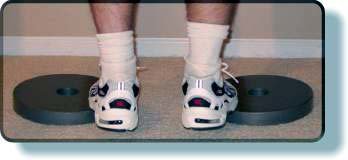
Use two 25-pound plates to hit the outer calves. Opposite to the previous example,
roll your feet down to the inside to work the outer ankles.
To work the outer calves, use two plates with about six inches of separation between them. Place the outer front quarters of your feet on the sides of the plates. Your feet will be tilted down and in. Roll up and do a calf raise then return to the start position. Make sure you hit both positions in order to keep the ankles and calves balanced.
Technique #3 - High Incline Calf Walking
For this one, you will need a treadmill with an incline. It's really quite simple but produces an incredible, muscle- building pump in even the most stubborn of calves. It is one of the most effective techniques you can use for getting past calf-development plateaus.
Set the treadmill to the highest incline setting it's got and set the machine to a fairly slow speed. You aren't trying to do cardio here; you're trying to force blood into the calves.
Walk for five to ten minutes steadily, focusing on pushing up with the calves every time you step (like a mini-calf raise). Keep your body in a straight upright position to keep the resistance on your calves.
This is an excellent way to enhance blood circulation in the calves. After you finish your set, stretch your calves hard once they are fully pumped to expand the fascia. For more information on stretching for muscle growth, check out the following article:
Technique #4 - Calf Raises On A Dumbbell
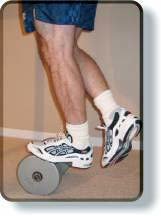
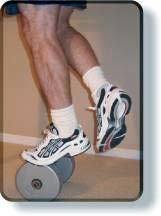
When doing one-legged calf raises, stand on a dumbbell handle (preferably one with round plates so it rolls). This tendency to roll will make you work to stabilize yourself as you're doing the calf raise, increasing the effectiveness of the exercise. Be sure to hang onto something solid as you're doing this exercise as you don't want to slip off.
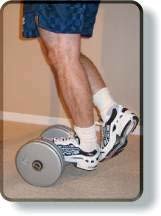
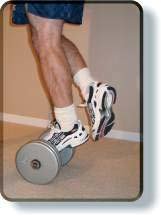
The tendency for the dumbbell to roll will allow you to roll your foot over the top of the handle, giving you full extension of the calf at the top. As you come up, roll the dumbbell slightly backward. Roll it slightly forward as you come down to get a better stretch.
It is also possible to do this technique on the actual dumbbell plates themselves rather than the handle (make sure you are hanging on with both hands if you do this version as it is extremely unstable).
Use a larger dumbbell (e.g. 85 pounder) if you can, though a smaller one will still work. The reason for the larger dumbbell is to be sure the plates are wide enough to stand on comfortably (a single dumbbell plate can dig into your foot quite painfully).
Technique #5 - Add Sets
An Add Set is just the opposite of a Drop Set. Instead of dropping the weight over the course of an extended set, you will actually increase it, hence the "add."
This is a very effective technique, especially for the calves, which recover from work extremely quickly. Calves need to be really overloaded to get them to grow and this technique fits the bill.
Start with a moderate weight for your first round-something you can get about 12 to 15 reps with. Do the set, step off the machine, shake your calves out then add 10 to 20 pounds (or more) onto the machine. Step back on and do as many reps as you can. Step off, add more weight to the machine and do it again. Repeat this procedure 3 to 5 times or until you can't more than 5 or so reps with the weight. Your calves should be fully worked by then!
You can learn more intensity techniques for all your bodyparts in the article "Intensity Techniques That Will 'Kill' You AND Make You Stronger."
Conclusion
If you are having trouble building your calves and they just don't seem to be responding to anything, give these five calf-training techniques a try. They may be just what you need to spur your calves to new levels of development!