
Football training is about performance... running faster, jumping higher, hitting harder ... in fact, most coaches push the performance aspect of training to the nth degree.
Bodybuilding of any kind is looked upon with scorn and ridicule. Yet many players are undersized and need to put on quality muscle mass. Plus, let's face it, we football players are just as concerned with how big our guns look in our jersey as with our rushing yards.
Can a football training program that focuses solely on performance lead to increases in mass? Or, do you need to forget performance and start oiling up and posing in front of a crowd?

Is Bodybuilding Evil?
Bodybuilding methods have been thoroughly vilified by strength coaches over the years ... and with good reason. So many young football players get their training information from magazines like Flex or Muscle & Fitness.
These magazines feature huge, drugged-up bodybuilders and the programs they supposedly follow. The programs are as fake as the drug-induced muscle. The volume is off the charts, with little attention paid to athletic skill or flexibility.
This, combined with the younger football player's drive to want to do bench, curls and abs (the beach muscles), has given coaches headaches for years.
One of the main problems with the typical bodybuilding style football workout is that many sets are taken to failure. There is even an entire training system devoted to taking one main set to failure (H.I.T). The belief is that only those last few reps are worthwhile, so all sets must be taken to absolute failure.
This is faulty logic for many reasons.
- Sets can never really be taken to absolute failure: Fatigue effects from different types of muscular work are specific, thus an athlete who is too tired to repeat the same exercise, say, a bench press, may still be able to perform another in good form, i.e. push-ups.
- It is completely unnecessary for you to become completely exhausted in a workout; strength gains are greater when you are not tired.
- Pushing to exhaustion will burn out your central nervous system and force you to cut volume in future training sessions.
 |
The Central Nervous System: The central nervous system (CNS) is the part of the nervous system that functions to coordinate the activity of all parts of the bodies of bilaterian animals - that is, all animals more advanced than sponges or jellyfish. In vertebrates, the central nervous system is enclosed in the meninges. It contains the majority of the nervous system and consists of the brain and the spinal cord. Together with the peripheral nervous system it has a fundamental role in the control of behavior. The CNS is contained within the dorsal cavity, with the brain in the cranial cavity and the spinal cord in the spinal cavity. The brain is protected by the skull, while the spinal cord is protected by the vertebrae. |
|
|
||
Using The Rep Method Properly
Powerlifters have used higher rep bodybuilding schemes for quite some time. This would seem counter-intuitive because the powerlifter is concerned with strength. But, most powerlifters need a certain amount of mass to gain better leverages (the bigger your chest and back, the less distance the bar needs to be pushed in the bench, thus increasing the amount of weight used).
Also, the bigger lifters need to keep large amounts of muscle mass to "fit" into their weight classes. Strongman competitors also do quite a bit of rep work because of the sheer mass that's required to lift giant boulders, flip humongous tires, and drag around anchors.
So, how have powerlifters figured out how to use higher rep schemes without losing strength or burning out their CNS?
Leave A Few "In The Tank"
The answer is actually pretty simple. They began to cycle exercises often, sometimes every session, and they learned to leave a few reps "in the tank." This simply means that if you are capable of doing 9 reps, you do 8. The last rep is hard, but you aren't straining so much that you are fatiguing the CNS.
The best way to gauge this is to pick a weight and start doing reps. On your last rep it should be hard, but not impossible and you might be able to do another rep, but you leave it alone.
Advantages To Using The Rep Method
There are several advantages to using higher reps for some of your football exercises:
- Higher reps can induce substrate uptake so that nutrients are partitioned into the lean "compartments" of the body and away from the fat ones.
- Induce metabolite build-up and ion transport.
- Bring blood and nutrients to the muscles, which can aid in growth and recovery, and add lean body mass. The higher reps are great for those who need to put on weight to play their position.
Can you gain significant size by only using low reps in your football training program? Yes, to a point.
Even if you concentrated on reps of 4 and below and ate a diet consisting of high-quality protein and calories, you would gain. But, if you wish to accelerate the process and get even bigger, then the Rep Method will work wonders for you.
That being said, you MUST combine this with the Max Effort (heavy) training or you risk becoming big and weak ... and there is nothing sadder than a big, weak football player. So how do you add the rep method to your program in an intelligent manner?
Volume, Density And The Rule Of 24
When it comes to gauging volume for muscle gains, especially when training for football, I like to use the "rule of 24" as my base. Basically, the rule of 24 means that the product of your sets and reps will come out to 24 total. For example, 3 sets of 8 reps.
You can use the rule as a basic guide, it's not a hard and fast rule. Sometimes you may come in under 24 reps, and you will often do way more than 24. But, this should be your aim, especially in the beginning.
You can get to 24 reps in several ways:
- 3 sets of 8 reps
- 8 sets of 3 reps
- 4 sets of 6 reps
- 6 sets of 4 reps
- 5 sets of 5 reps (yes, it's 25 but the idea is the same)
- 2 sets of 12 reps
- 12 sets of 2 reps
Mix it up. Remember, this is the rep portion of the program, so, while 12 sets of doubles is fine, it's not the idea. 12 sets of 2 reps would be great for a heavy day but not so great for a rep session. I've found that the best results come from 3-5 sets of 5-8 reps.
Timed Sets
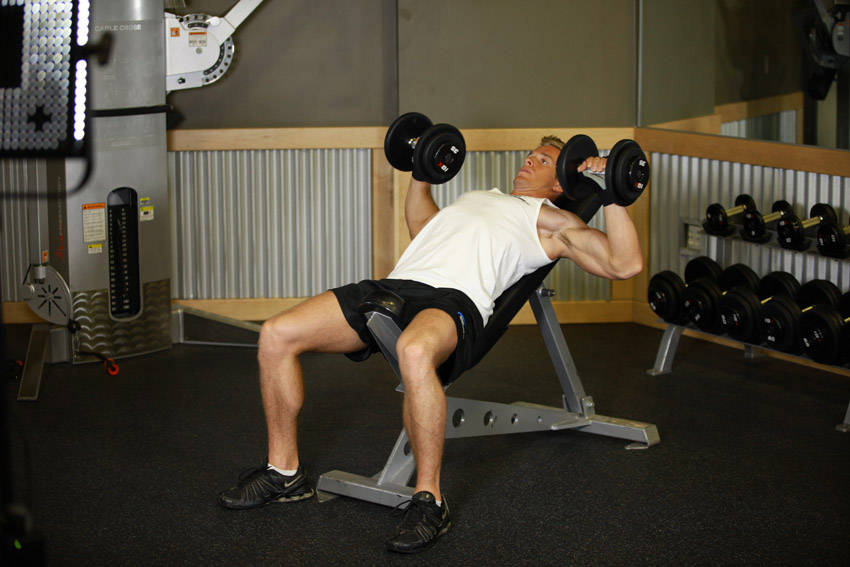
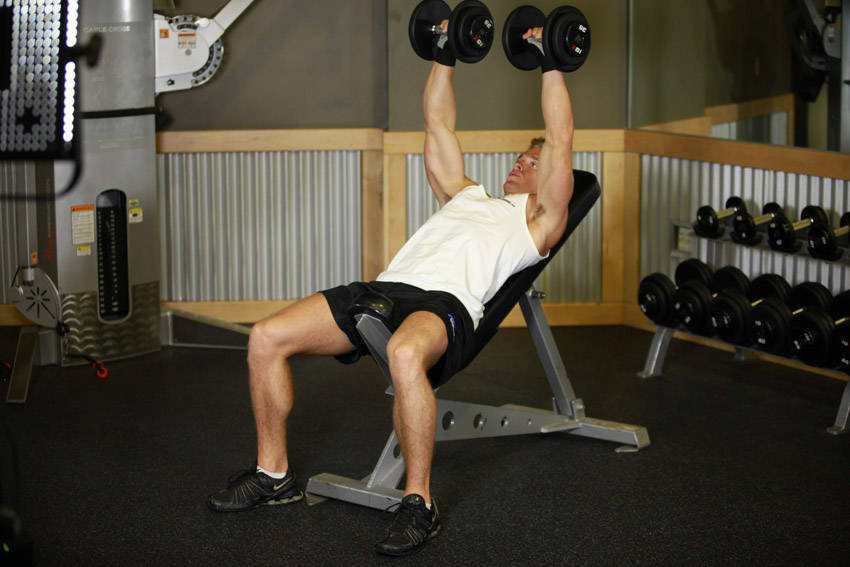
This is a wicked twist on both high rep and density-focused training. Take an exercise like the Dumbbell Incline Press. Pick a fairly heavy weight, something you might be able to do for 8. Then sent a timer for 2 minutes and start pressing!
You will not press continually because you will need to rest along the way, but, you keep the rest periods to a minimum as you try to cram as many reps as possible into this 2-minute period!
 |
 |
Your set may look like this: 8, rest, 5, 4, 5, 3, 1, 1, 1. Then, you rest for 3 minutes and go again. Two of these blocks is plenty! Next time around you try to beat your total. It's simple and brutally effective!
Key Points
- Use higher-reps for muscle building and recovery.
- High rep sets are used for accessory and supplemental exercises, NOT, for your main strength exercises.
- Use the rule of 24 as your base.
- Use some of the more extreme methods like timed sets to break plateaus and gain new muscle.
Steven Morris is a Personal Trainer and Strength Coach in the Philadelphia and South Jersey areas and owner of Explosive Football Training. He has been lifting weights for over 15 years and has been helping people achieve their fitness and strength goals for over a decade.
You can learn more about his methods and download Free Training Reports at http://www.explosivefootballtrainingprogram.com/, and http://www.explosivefootballtraining.com/.