
If you want to perform like the pros, you need to train like the pros. Here Coach Barnes explains exactly how he trains the San Francisco 49ers.
There are literally thousands of ways to train for football. The higher the level the more seriously training is taken. What I tell the '49er players is that it is their responsibility to make sure they are in the best possible condition to either defend their spot on the roster or take one.
Football is not a contact sport. Football is a collision sport. Basketball and soccer are contact sports meaning that contact with the opponent can occur but to collide is to break the rules of the game. Contrastingly, the objective of football is to physically collide with the opponent giving an advantage to one player or the other.
Preparation for football can be as exhausting as the competition. Several layers of training, all integral to the success of the athlete, need to be addressed. They are weight training, conditioning, agility and plyometrics. Nutrition is also critical because without the proper diet peak levels of intense training and competition cannot be reached.

 |
Nutrition & Football! Although body types in football differ greatly from position-to-position nutritional needs remain basically the same. At the 49ers we have a Food First approach. We advocate a high-carbohydrate, moderate-protein, low-fat diet. [ Click here to learn more. ] |
No matter what level of competition the game has some common components such as the need for strength, power, speed, conditioning and agility. Here is an in-depth look on training specifically for football.
Weight Training
There are many benefits of training with weights for football. For some positions weight training is the vehicle to a greater muscle mass. For other positions where refined motor skills are more important such as receiver and quarterback, weight training offers muscle coordination, increased force generation and injury prevention.
Weight training can be approached in many different ways including the technical Olympic lifts at the core of the program and the unsophisticated, 1-set-to-failure lifts on machines. The program that is best for you will be one you are motivated to perform and one you feel best fits your needs.
If you were to examine the biomechanics of football you would soon find that speed, power and strength are necessary for optimal performance. Combining speed and power in a weight-training program may sound difficult but the Olympic movements, the clean and jerk and snatch lifts, actually train the body to perform as a kinetic chain generating high power outputs and speed. Many, if not all, of the assistant Olympic lifts like the power clean, low pull and power snatch also lend themselves to speed and power.
 |
Athletes And The Olympic Lifts! But let's get into Olympic lifting, and try to discern whether there's something there for athletes from other sports to benefit from. [ Click here to learn more. ] |
Well, what about powerlifting? Mechanically the term power is inversely related to time. Powerlifting takes a relatively long time to move the resistance from point a to point b. Olympic lifting takes a relatively short time. Even though the mass of the bar is not as great in Olympic lifting the short time component negates and overrides the smaller mass used yielding a higher power output … pretty cool.
A Further Analysis Would Also Find That The Game Is Played In 3 Dimensions:
- Forward and backward
- Left and right
- And up and down
It so happens that training with free weights is also 3 dimensional. Is there a place for machines in a training program for football? Machines are great for some early phases of rehab and some assistant lifts but the core of the program should come from the barbells and dumbbells.
How much weight training is performed does depend on several factors like previous experience, age, position and personal physical needs. I've put together a one-week snapshot of a routine complete with agility, conditioning and plyometric training as an example. Keep in mind that the Olympic lifts are more technical and complicated than any other lifting. If you don't know how to perform the exercise correctly find a good coach who does.
Agility
Agility is the ability to change direction in an efficient and effective manor. Training for agility for football is the most important component when training either in-season or off-season.
How to train for agility will vary from position to position. For instance, an offensive lineman may not move out of a 10-yard diameter the whole game. On the other hand a defensive back may cover 10 yards every play of the game.
In General, Positions On The Football Field Fall In One Of Two Categories:
- Power positions
- Skill positions
Power positions would include the offensive line, defensive line, linebackers, tight ends and full backs. These power positions rely more on mass and strength than the "skill" positions.
The skill positions would include the receivers, defensive backs, quarterbacks and halfbacks.
In order to accommodate for the different distances used by all positions on the field the drills can be lengthened or shortened accordingly.
- The W Pattern Run: Place 5 cones in an elongated W pattern 10 yards apart. Run in straight lines from cone to cone starting and stopping as quickly as possible.
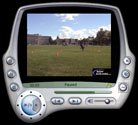 |
View The Video Of The W Pattern Run
Windows Media Player Format (35 KB) |
- Lateral Shuffle Around Cones: Align 12 cones 5 yards apart and 1 yard in front of each other. Laterally shuffle through the cones as quickly as possible, keeping low and not crossing the feet.
- Hoops: Connect a ½ inch PVC pipe to itself to make a large hoop 9 feet in diameter. Arrange two hoops into a figure 8 pattern. Run the drill starting at the bottom of the figure eight and continuing the pattern of the hoops.
- Out 10 back 5: Starting at the goal line run out 10 yards and back pedal 5. Once the 5 yard back pedal is completed sprint out another 10 yards and back 5 again. Repeat this one more time and sprint out past the final 10 yards.
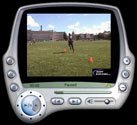 |
View The Video Of Out 10 Back 5
Windows Media Player Format (50 KB) |
- Figure Eight Shuffle: Set up two cones two yards apart. Bend the knees and get in a "ready position." Make 5 tight figure 8 patterns around the cones in one direction. When completed, shuttle the figure eight in the opposite direction.
Conditioning
An unknown author wrote, "Every morning in Africa the fastest lion wakes and knows that it has to outrun the slowest gazelle in order to survive. That same morning the slowest gazelle wakes knows that it has to outrun the fastest lion in order to survive. One thing is for sure, every morning you had better be running." The author who wrote this may have also played football.
As a complement to agility training some basic conditioning should be incorporated into the weekly training. Conditioning the metabolism of the body is simply subjecting the body to the highest levels of metabolic by-products possible (i.e. lactic acid, hydrogen ions, etc.), and becoming more efficient at possessing the by-products.
Running in a straight line is perhaps the most productive manner to tax the cardiovascular system. Running doesn't take a whole lot of skill to perform and can be done anywhere without any elaborate equipment. Baring injury there is no excuse not to run.
As previously stated football is a game of short bursts followed by intermittent rest intervals. Therefore sprint interval training is the most effective manner of conditioning.
The intervals used to train should be less than 20 seconds, which translates to approximately 100 yards being the longest distance. The shortest distances can be as little as 10 yards. Conventionally a one to one work, which is the run to rest ratio is used. For example, run 10 seconds then rest 10 seconds between reps.
It is imperative that each rep is run at full speed and an all out effort is given. The physiological response desired is a high metabolic response yielding high by- products. The adaptation the body makes is to become more efficient at handling the high metabolic by-products with more efficient enzyme activity.