
Used correctly, indoor riding can be a key component of a broad based-cycling training program, particularly during the winter months. Before you complain about indoor cycling as an unexciting alternative to "real" cycling, remember that there are specific benefits worth considering.
The controlled environment of a trainer allows you to isolate and concentrate on specific areas of cycling fitness and technique.
Some cyclists have noted that using a stationary trainer or rollers seems much more difficult, target heart rate being similar, than riding outdoors. Why is that? There is an old saying: an hour on the trainer is worth two on the road.
One possibility is that when you are on the road, you ease up when you are freewheeling down a hill, drafting, or half wheeling in a group. On the trainer, you are at a constant cadence (rpm), which is not your normal style.
Another reason is that the absence of distractions such as traffic lights, changing scenery, traffic and road conditions result in more of a focus on your effort - and pain hurts more if you think about it!
Pros And Cons
Here are a few reasons to consider stationary training.
Saving Time: Avoid the time necessary to get to a road suitable for your workout, and with a planned program get your maximum training benefit in 60 minutes.
More Intense: Minimizes the distractions of road biking, allowing you the concentration and focus to maximize and maintain your heart rate for the session without worrying about cars, potholes, or other road hazards. In fact, using a stationary bike is an optimum tool to determine your maximum heart rate.
Improve Your Pedal Stroke: Spinning with one leg will accentuate flaws in your personal technique and allow you to focus on a smooth and complete pedal cycle.
Promotes Recovery: At the end of a difficult day of riding, consider jumping on the trainer and doing 20 minutes of gentle spinning at 55% max heart rate. Personal testimonials suggest this is superior to massage to clear lactic acid from the muscle and cut down on post training stiffness and soreness.
Avoiding Darkness And Bad Weather
Beat The Boredom Tips
The biggest drawback of stationary cycling is the monotony and boredom of sitting and sweating in one place for an hour.
But cheer up! Here are some some techniques to make it a bit more palatable:
Group Rides: Have a buddy bring his trainer to your place or, if there is one available, have your group meet at a local gym equipped with multiple machines.
Structured Workouts: Have a planned program, and concentrate on sticking to it. A heart rate monitor gives you immediate feedback on your efforts and is a great tool to give you something other than the boredom to concentrate on.
Keep Your Mind Occupied: Use a heart rate monitor, listen to a favorite CD, reading (if you are just lazing along), and watching television, are all ways to keep boredom away.
Use A Fan: The movement of the air is distracting and keeps you cool and more comfortable at the same time.
Drink: It is easy to forget, and with the increased sweating on a stationary bike in a warm room, it is easy to get dehydrated.
Get Good Equipment: Stability of the trainer is key if you plan on sprinting out of the saddle for a little variety during the session.
Remember that having a plan helps fight the boredom, and is a key to making this a positive part of your training program. There are many plans available, but most have common themes.
Equipment Selection
Rollers ///
Rollers consist of three round cylinders mounted on bearings and fixed to a frame. A belt connects one of the rear cylinders to the front cylinder to keep the front wheel spinning at the same speed. Your bike tires rest on the front and rear cylinders.
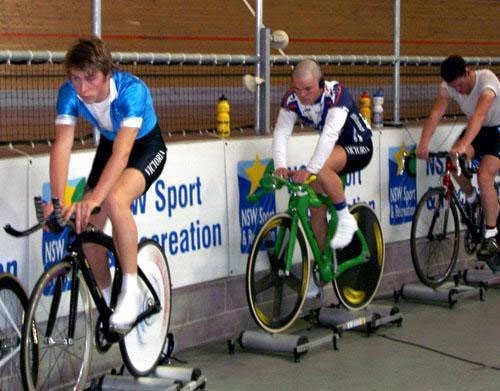
Rollers sharpen your bike-handling skills because you must rely on skillful steering and balance, as the bike is not connected to the device. They teach you to work on smooth, fast spinning to stay in place, but offer little resistance unless you add a fan or magnetic unit for increased resistance.
It may take many attempts to be able to feel relaxed and confident on your rollers. Once past the initial learning stages, the bike-handling skills you obtain will make you a more confident and successful cyclist.
Here are a few tips if you decide that rollers are for you.
Set The Rollers Correctly: Put the bike on the rollers and set the height of the front wheel the same as the rear one. If this is not done you will be riding uphill, your balance will be wrong and you will cause untold damage to the perineum and back.
Set The Length: As the same as the wheelbase on your bike. A plumb line from the front axle of your bike should pass as close as possible to the center of the front roller. A centimeter either way is OK. After you have adjusted this, check the level again.
Placement: It helps to place the rollers in a doorway so you can hold onto the doorframe to get started (an alternative is to have a buddy standing by to give you a hand).
Oh yes, and it helps to make sure you do not position your rollers near the top of some stairs ...
Wind vs. Magnetic Trainers ///
Wind trainers have two fan units with slotted blades that churn the air. Magnetic trainers have powerful magnets and a nonconductive disk that produce resistance and dissipate energy as heat. Magnetic trainers usually have several resistance settings (low to high).
A wind trainer's greatest advantage for indoor training is that it closely mimics the resistance that you experience on the road by increasing resistance exponentially. For example, if you were to increase your speed on the wind load simulator from 15 to 30 kph, you would need to increase your power output by a factor of about eight times to reach that speed.
The disadvantages of wind trainers are the noise generated by the fans and the lack of resistance adjustment.
With magnetic resistance units, resistance increases in direct proportion to speed, which is less realistic than wind load simulators, but they do provide enough drag to elevate your heart rate.
The better designed magnetic units incorporate a small precisely weighted flywheel that creates a slight "coasting" sensation and helps you pedal through the dead spots in your pedal stroke for a more realistic road feel.
The advantages of magnetic trainers over the wind trainer include reduced noise levels and the ability to vary resistance.
Product Availability ///
There are various brands of wind/magnetic trainers available on the South Africa market. The important thing to remember is to steer away from a trainer that requires you to remove the front wheel of your bicycle. These trainers are extremely hard on the bicycle's frame and may cause severe damage.
Rather opt for the A-frame types. The back wheel of the bicycle simply clips into a locking device and you are ready to go within a minute or two. Just remember to raise your bicycle's front wheel - I use an old telephone directory under the wheel - otherwise you might find that your arms bear most of your weight.
I have been using a Minoura MagTurbo for a couple of years without any problems. I travel a lot and have found them to be the lightest on the market without compromising durability and stability.
Expect to pay anything from $250 - $750 for a quality indoor trainer.
Training Plan
A heart rate monitor is an almost prerequisite for indoor training.
My advice is to structure your (weekly) training plan as follows:
Two days at 65-72% as recovery days; a day or two at 73-85% to build your aerobic base, and one or two interval sessions at 85%-plus.
The following is my favorite workout:
With the cadence at 85-95, start in your small chainring/lowest sprocket combination and drop a gear every 5 min. When you get to your second highest gear, change to your big chainring/highest sprocket combination for 5 min.
Move back up the cassette in your big chainring in 5 min intervals until you get to the third last sprocket on the cassette, then drop into your small chainring and cool down in the next 3 sprockets.
Spinning
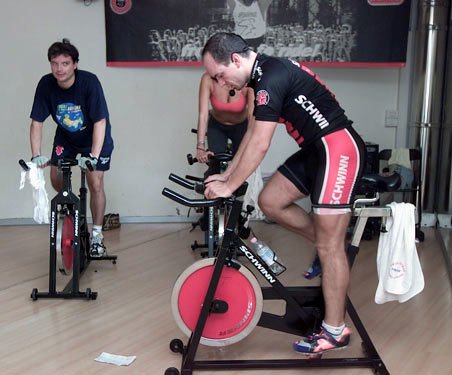
You are pedaling in the Tour de France. The crowd is cheering as you push yourself up the Col D'Sestriere. Your thighs are burning. Your breath is coming in gasps. Will you make it? "You've reached the top!" a voice commands. "Back off that tension!" You reach down and loosen the tension on your spin bike, and come back to reality ...
Spinning is one of the newest and hottest exercise fads. Instead of merely tooling along on your stationary bicycle as you thumb through a magazine or watch a re-run of Lexx on DSTV, you burn up the imaginary road with a roomful of other exercisers, with the lights turned off and the music loud.
An exercise instructor, who barks out commands throughout the 40 to 60-minute session, leads classes, spinning. And like most other exercise classes, spinning starts out with a warm-up and stretching. Then comes the ride, alternating intervals of "hill climbing" (increased tension on the bike) and "sprinting" (less tension). The classes conclude with a cool-down and stretching.
Enthusiasts say what they like about spinning, is that each rider determines the amount of tension on the bike. You can make it as tough or easy a ride as you want to - only you know for sure.
That's it! Do not let this winter get you down or force you into starting all over with your training regime when summer comes around again.