
You've been strictly dieting for a few weeks and have followed your weight lifting program and cardio routine to a 'T'. But, that dreaded plateau has just kicked in. Try as you might, that fat is not coming off anymore, despite the fact you are still sticking with the program.
Now what?
One option is to further reduce your calorie intake. While this does work in theory, for those of you who are already only consuming minimal levels, taking things any lower will risk being able to get proper nutrition. Something else needs to be done.
You could also add more cardio to your program; instead of going at it for thirty minutes, bump it up to an hour. Again, this works in theory but who really has time for this much cardio a week? You have a life to live and probably would prefer not to have to sacrifice it to obtain your fat loss goals.
Sprinting
So, the next option you should starting giving some serious thought to is sprinting.
Sprinting is quick, yet intense in nature. It's not for the weak because it will take a lot out of you—make no mistake about it. If you are looking for a walk in the park, you'd better just free up some more time in your schedule because you'll need it to use option two above.
For those that are willing to push themselves though and kick it up a notch, sprinting is a great way to go.
What To Consider
Before you make the decision to sprint, there are a few things you should consider.
The biggest one being how much total leg work you are doing in the week. If you are already hitting legs three times a week (on a full body program for instance), adding another two to three sessions of sprints on your off days is not going to be a good move.
You'll be hammering your legs five to six days a week, which, hopefully I don't have to tell you, will leave you either overtrained, injured, or a combination of both in record time.
To remedy this scenario, you need to consider doing the sprints on the same days (yes, it will be a killer day you'll hate), or reduce back on the lifting to squeeze in the sprint session.
You should be hitting the legs no more than three times, maybe four MAX, a week—particularly when you're on a diet. For some, this will still be way too much (and this is also highly dependent on how severe the diet is too).
Secondly, the other thing you must consider is what your current shape is. You should already feel comfortable doing your cardio at a decent intensity and be able to carry this on for a good thirty minutes. If you can't, sprinting may just be too intense for you.
In this case, spend a bit of time building up that base, then move up to the sprints.
Forming Your Sprint Program
When getting ready to do your sprints, there are a few ways you can do it.
Specific Time Period:
One, which is probably the most common, is to sprint for a specific period of time or distance, then rest (or work at a very low intensity) to recover. This is usually set up in about a 1:2 or a 1:3 ratio, being work to rest.
Varying Schedule:
Another method of doing your sprints, however, is on a varying schedule, where for each sprint, you'll cover a different distance.
This is a good option for athletes in particular who sometimes perform bursts of all out effort for 10 seconds or less, and at other times, need to go hard for a bit longer.
For this type of program, follow this protocol:
- 1st grouping of sprints: 100 meters X 4
- 2nd group: 200 meters X 4
- 3rd group: 300 meters X 4
- 4th group: 400 meters X 4
 Click Here For A Printable Log Of This Protocol.
If you try this and it's just a bit too much to handle, as you work up the distances, decrease the amount of repetitions so you end up going 100m X 4, 200m X 3, 300m X 2, and 400m X 1.
Note that for each given distance in the sequence, you will be running slightly slower since it will take you slightly longer to cover.
By the time you reach the 400 meter drills, you'll also be feeling fatigue playing a role so this needs to be taken into consideration.
If you are an athlete or just someone who prefers long distances, feel free to reverse the protocol and start with the 400 meter distance, just realize that usually, max effort will be for shorter distances and should be done when you are fresh.
Speaking in terms of sport specific training, however, if you were someone who needed to improve slightly longer duration bouts of intense activity, then the reverse protocol would make more sense.
Between each sprint, you should be aiming to rest for only 30-60 seconds, only taking more if you absolutely need it.
Also, be sure to do a proper warm-up and cool-down before and after this session because injury risk is high given the nature of the intensity.
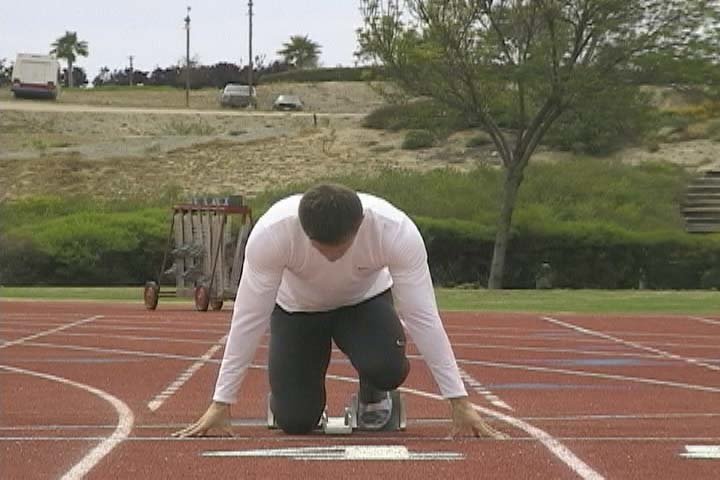
 Click To Enlarge.
 Between Each Sprint, You Should Be Aiming To Rest
For Only 30-60 Seconds.
Conclusion
So, next time you're either looking for a change to your current program or are stalled in the game of fat loss, give this sprint scenario some consideration.