

For many lifters, flexibility training died the day they graduated from elementary P.E. class. Former athletes and service members probably remember long sessions of pre-exercise static stretching, then they probably dropped the routine as soon as they could. Today, few of us perform any flexibility work in the gym. Guess what, you busted barbell jockeys? It's time to limber up and get flexible!
There are many types of flexibility training: static, dynamic, ballistic, trigger point, and beyond. None of them is inherently better than the others—each has its place and appropriate use. Regardless of the chosen method, proper flexibility training can greatly improve performance, mobility, and longevity.
Flex It!
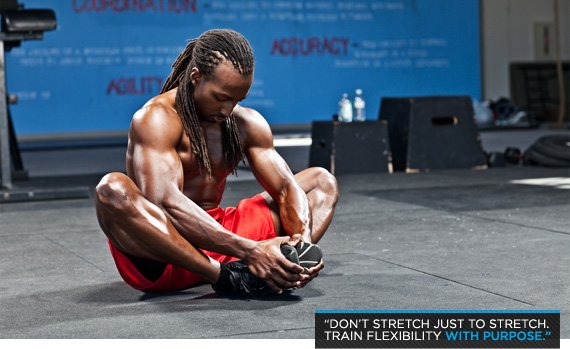
Don't stretch just to stretch. Don't even stretch to reduce your chance of injury. Instead, stretch to increase mobility, which is followed by an increase in recovery. In other words, train flexibility with a purpose, just as you would any other fitness attribute.
Yes, stretching is primarily about increasing tissue length, but consider it as part of the entire package of human movement. If a stretch isn't improving your range of motion, power output, or your recovery, then it's a waste of time. In most cases, your mobility work should show an immediate, measureable improvement. If you aren't sure, stretch one side at a time and compare the feeling and range of motion.
Various experts contend that pre-workout flexibility training is unnecessary, arguing that your workout will deliver the needed mobility improvements, particularly your warm-up sets. This approach might work for people who don't already have mobility restrictions, but that's basically … well … no one! The overwhelming majority of us need corrective work prior to training because our muscles are short and tight from hours of keyboard-clacking and deskwork.
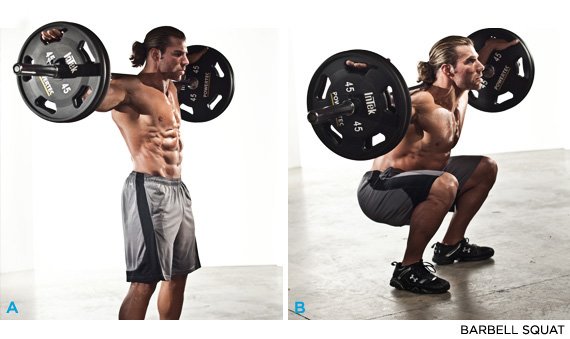
To illustrate the point, hop out of your chair and attempt a butt-to-ground bodyweight squat. You'll probably meet resistance before you hit parallel, since you're most likely compensating for poor thoracic spine mobility, tight hip flexors, and a weak posterior chain. Mind you, that's just with body weight.
If you can't take a light barbell and squat all the way down with it, you're broken. But you can be fixed! Ten minutes of goal-oriented corrective work before training can radically improve your performance and prevent injuries down the road.
Pre-Workout Flexibility Routine
Prior to training, assess what movements you're about to perform. Let's say you've got a squat workout lined up. In our bodyweight example above, what resistances did you feel? Any point of resistance, anywhere in the body, should be corrected. You may need to correct "butt wink," which is a result of poor hamstring extensibility. Your shoulders may be so tight you can't put your hands on the barbell.
You may not be able to correctly position your knees, or your tight calves may limit ankle mobility. Any of these can ruin your technique, and good technique is the key to performance and injury prevention.
Pre-workout Myofascial Release: 6 minutes
Traditional static stretching works on tissue length, while this type of training works on muscle tone. Your muscles should be soft and pliable, but some of your muscles may feel like metal rods. Myofascial release and its cousins focus on stimulating the golgi tendon organ, a receptor that regulates tissue tension and can cause the muscles in question to relax. Soft tissue therapy is one of the most effective techniques for correcting tight musculature and breaking up tissue adhesions.
Prior to training, spend a couple minutes rolling out your most problematic areas. You can mash with a barbell, use a foam roll, lacrosse ball, or even a rolling pin, so long as you work your hot spots. Probable candidates include your thoracic spine, IT bands, calves, and glutes. Roll your worst offenders for at least 30 seconds. Put pressure on the especially tight areas until any pain dissipates.
Corrective Hip Mobility: 12 minutes (optional, recommended)
You may have heard that static stretching is inappropriate before a workout, since certain studies suggest it can reduce the power output of involved muscles. While true, there's a major limitation to this concept: Without stretching, our tissues are often so tight that proper movement cannot be achieved. Therefore, we're left with a choice: We can avoid static stretching and not perform correct squats, cleans, and pulls; or we can hammer our tissues that need corrective work and perform the best movements with improved mobility.
We aren't going to stretch the main muscle groups we're preparing to train. Instead, we'll work their antagonists and the smaller groups that limit mobility. Our squats are no good if we're not moving correctly. We're going to start with an anterior hip stretch (kneeling hip flexor). This will open up your anterior chain and allow you to fully extend your hips. Brace your back leg against a wall with the knee fully flexed.
Follow this with a hip capsule stretch. If desired, use a heavy band for lateral mobilization. Finish off the pre-workout routine with an external rotation stretch. You can use a band for posterior mobilization. Hit each position for 1-2 minutes on each leg.
Optional Hip Mobility Routine 1-2 minutes per stretch
Dynamic Flexibility and Muscle Activation: 4 minutes
Dynamic flexibility is the mainstay of your pre-workout flexibility program. Dynamic stretching involves the use of movement to reach your peak range of motion, with the movement and muscle contractions also acting as a specific warm-up.
- Knee Hug: While walking forward, hug your left knee into your chest, then step and repeat on the right leg, continuing with alternate legs. This is an excellent way to loosen up the glutes and hips.
- Walking Straight-Leg Kicks: Walking straight-leg kicks stretch the calves, plus the lower back and hamstrings. Hold your hands straight out in front of you. Step forward with your right foot and then kick your left leg straight up to meet your left palm. Alternate kicks as you walk.
- Glute Bridge: This movement will actively stretch the anterior hip while promoting glute and hamstring activation. It works great before leg training.
- Side-to-Side Leg Swing: Perform these side to side, leaning forward into a post to improve range of motion. The goal is to activate and dynamically stretch the abductors and adductors.
Post-Workout Flexibility Routine
Prior to training, we did some quick corrective work to improve mobility. After training, we want to improve circulation, recovery, and ease some of those tighter tissues that we just smashed. Take your time and work the full length of any tissues needing work. Roll all the way around your femur. Roll your calves and glutes.
In time, you can make tremendous strides in correcting movement, posture, length, and tone of a muscle with soft tissue work. You can also perform this on your off days, or in your spare time.
Post-Workout Myofascial Release: 1 minute each
- Quads
- Hamstrings
- Calves
- Piriformis
Static Stretching: 3-5 minutes
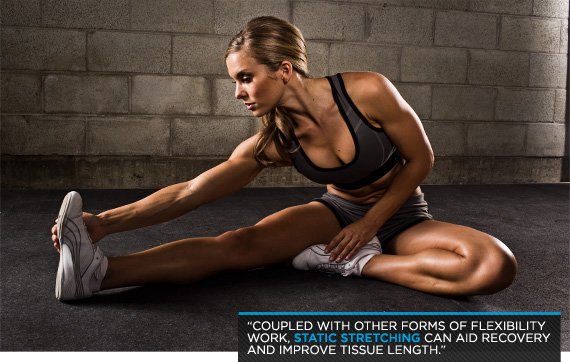
When coupled with other forms of flexibility work, static stretching can aid in recovery and improve tissue length. You will want to work each stretch for 20-30 seconds. Since you just trained legs, work on stretches involving calves, hamstrings, quads, and glutes.
- Seated Hamstring-and-Calf Stretch
- Supine Quad Stretch
- Ankle-On-Knee Stretch