
In the dark corner of my local gym, I recently spied a guy doing sit-ups ... while wearing a weight belt. The sight was like a swift punch to the crotch! While it's not the worst gym offense, or even an incredibly rare event, I realized that many trainees don't know what a lifting belt does, when to wear one, and why someone should.
Wearing a belt during sit-ups, for example, is actually contrary to the function of the belt. The whole point of a weight belt is to prevent spinal flexion; the whole point of doing a sit-up is to flex your spine by contracting your abs. See the problem here? I've also seen people belt up for biceps curls, lat pull-downs, and leg extensions. Clearly, some instruction on this common accessory is needed.
Belt-ology in Action
Most people think that weight belts support the back and can help prevent injury. That's generally true, but a better understanding of the mechanics will change how many people use their equipment. Even some weight belt manufacturers don't understand how a belt is supposed to work, which is revealed when they make the back of the belt wider than the front.
To talk about belts, we first have to talk about breathing. Most people are taught to inhale on the eccentric (negative) part of an exercise and to exhale during the concentric (positive). While you should definitely breathe, this isn't the method that works best when you need to produce a large amount of force. In the everyday world when you need to move something heavy—a couch or an Atlas stone—you take a big breath, push or pull while holding your breath, and only exhale after completing the movement.
We use this technique—known as the Valsalva Maneuver—when we're performing certain exercises at near-maximal effort. Holding your breath against a closed glottis while increasing you thoracic abdominal pressure braces you, and allows you to lift more weight. You'd never see a powerlifter squatting 600 pounds while slowly breathing out.
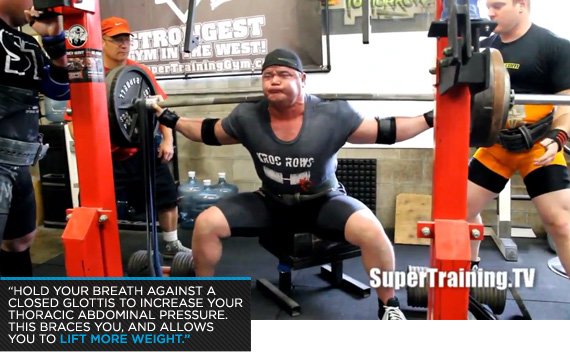
When you inhale, pressure increases in your thoracic cavity; this pressure is further increased when you flex your abs. In this regard, the muscles of your abdomen serve chiefly to apply pressure to the anterior side of your spine, attempting to balance the forces produced by the extensors on the backside. In other words, this pressure keeps you from being crushed by the weight when you squat.
The back muscles apply force, position and support to the spine from the back while the abdominal wall and increased abdominal pressure from a deep breath support it from the front. A weight belt's main function is to add support from the front by increasing abdominal pressure.
Belt It Real Good
In a nutshell, a lifting belt provides a wall for your abs to push against. The added force with limited space means increased anterior pressure for the spine, helping to stabilize it. This gives you a more rigid torso with better transmission of force from the hips to the bar, plus a more stable foundation for overhead lifts. The width in the back of the belt has absolutely nothing to do with a belt's function, as many people think.
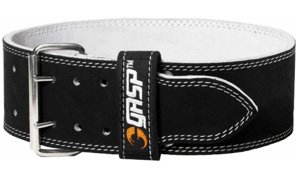
Ideally, a belt between three-and-four-inches wide, all the way around, is sufficient. If it's much smaller than that, it won't provide much support. If it's much larger than that, it may not fit well between your ribs and hips. The material should be firm, typically leather/suede or something that won't stretch.
To Belt Or Not To Belt
There is no need to wear a belt all the time. There is a lot of discussion in the fitness community about whether you should wear a belt at all. Some people believe you should only rely on your own abilities to stabilize heavy loads. I don't intend to delve into that debate here, but I will say two things: first, under a heavy load, a belt can help reduce your odds of getting an orthopedic injury. Second, a belt will definitely aid in lifting performance.
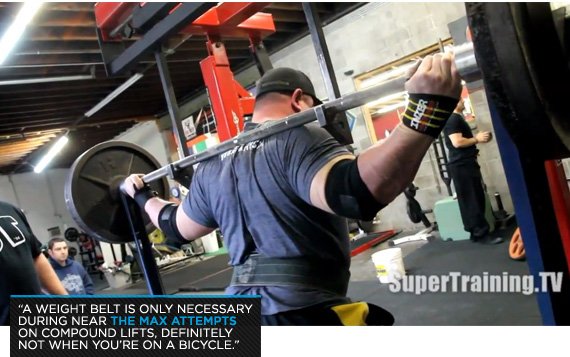
In my opinion, a weight belt is only necessary during near the max attempts on compound lifts, definitely not when you're on a bicycle. You shouldn't wear a belt with loads that you can easily support—below 90% of your one rep max on big, barbell lifts.
Wear It Right
When wearing the belt, it should be positioned and tightened correctly. Many times I've seen lifters move the belt to a more comfortable position under their gut, even though that is contrary to what they've learned about belt usage. Obviously, the belt shouldn't be too loose, although many make the mistake of making it too tight. A belt so tight that you can't properly contract your abdominal wall will actually work against you. Take a breath (hold it), place the belt in position and brace the abdominal wall. Draw the belt just tight enough to slightly restrict your braced abdominal position to achieve maximum benefit.