
While there are a number of different Olympic athletes that will draw attention both from the skills they present as well as their physique. Gymnasts in particular catch the eye.
Armed with poise and a high amount of muscle mass, gymnasts are well-rounded athletes and are physically able to use the strength they possess to do a wide variety of movements.
I recently sat down with Gina Paulhus, who competed with the USA Gymnastics Junior Olympic program for 10 years and now designs conditioning and nutritional plans for gymnasts. She combines her fitness knowledge to prescribe programs for non-gymnasts through her Website, www.homeexercisecoach.com.
Here are some of the things she had to say.
Q. When looking at a male gymnast's body, one thing that jumps out at you immediately is the size of the athlete's upper body. What type of training enables these athletes to experience so much muscular hypertrophy?
Gymnasts have amazing upper bodies. While they certainly have great muscular development, their size isn't quite as big in-person at it seems on television. The vast majority of male gymnasts weigh less than 150 lbs.
Their leanness, which primarily is the result of their 30-plus hours of training per week, makes the muscle size they do have appear even larger. However, if you see them out and about in a T-shirt they will look "small" compared to the average bodybuilder.
In terms of weight training, is the focus with it more on lifting weights, or do most top-level gymnasts incorporate a greater variety of bodyweight or plyometric types of movements?
Most high school gymnasts train with only bodyweight exercises and plyometric type movements, although for the upper body this still represents substantial load (a 120-pound. high school gymnast doing a handstand push-up is pushing his entire weight; same for chin-ups).
By adding explosive movements with bodyweight training, and occasionally ankle and wrist weights, plates up to 45 pounds, or a weighed vest, or doing 1-legged or 1-arm movements to increase intensity, a greater training effect is achieved and the movements tend to correlate to sport-specific strength.
Typically as a gymnast enters college, they experience some formal weight training, but again the movements are geared toward maximizing sport-specific strength, because unnecessary muscle bulk non-essential for the skills will only weigh an athlete down.
However, work in the weight room usually is helpful for the more mature college-age athletes so that they can develop the necessary strength to continue to perform gymnastics with a bigger, more mature body. Rehabilitation and injury prevention work may be done in the weight room as well.
Apart from training in the gym (on event specific equipment), and then training in the weight room, what other types of activities are gymnasts, both male and female, typically involved in?
Aside from practice of skills, drills for skills and body positions, and routines, there is a lot of physical preparation that goes into gymnastics. Sometimes cardio training is added for fat loss, to help with tolerance during long practices, or to improve stamina during floor routines.
The cardio may be slower and steady such as a 30-minute jog, but more often involves interval work where there is a sprint followed by an easier recovery phase, or circuits with stations of exercises for all parts of the body with little to no rest in between.
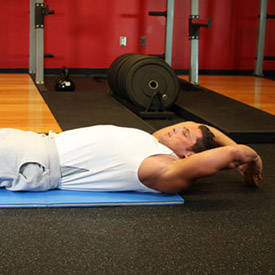
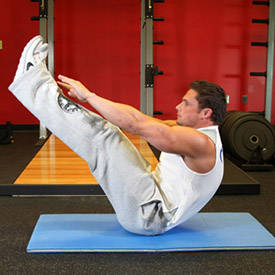
Jacknife Sit-Up
All gymnastics programs include lots of core conditioning including leg lifts, crunches, V-ups, handstand press work and planks.
All exercises are performed with the proper body form and tightness. To develop proper form the focus is more on how well the exercise is performed more than just cranking out sloppy reps. There is also a lot of time spent on flexibility—usually an active flexibility/mobility routine is performed toward the beginning of a practice, and longer stretches are held for 30 seconds or longer at the end of practice.
When looking at the diet of male gymnasts at this caliber, what type of plan are most following?
The male gymnasts are expected to have a certain strength-to-weight ratio in order to safely be able to perform the skills and remain aesthetically pleasing. Their body fat percentage is much more important than their weight.
You will see some longer, leaner male gymnasts who aren't as heavy and some thickly muscled ones who are heavier. All of the successful Olympic-caliber gymnasts will have little to no excess body fat. Due to the long training hours and intense physical requirements, there is usually some leeway with diet because so much energy is being used up during training.
Also, male gymnasts typically are gearing up for the Olympics during a time when their body is optimized to be at its physical peak without too much fuss, the 20s.
Although gymnasts have a concern for nutrition and try to consume plenty of fruits, vegetables and protein, they are not overly strict with their diets.
They have been filmed consuming foods such as french fries, pastas and submarine sandwiches although those types of foods are probably not the mainstays of their diets. Most gymnasts try to stay away from sugar knowing the deleterious effects on energy levels and body fat composition.
If someone was going to try and recreate a program to follow in the weight room to develop a body similar to that of a gymnast, what would you recommend?
The first thing you have to realize is that gymnasts' bodies are a 'side effect' of their training more than an actual goal of the training. There have been gymnasts who happen to be able to develop the skills even though they don't 'look' strong enough. The gymnasts' muscles hypertrophy more or less as needed to aid their skill development and routine performance.
That being said, in the weight room you'd want to start with lots of core work: ab work, especially exercises which require stabilization and 'supermans' (lie facedown, lift arms and legs as high as you can; hold for 2 seconds, lower and repeat).
Then you'll want to do lots of jumping, rebounding and plyometric work. The majority of your exercise to get the 'gymnast look' would be lots of upper body conditioning.
After developing a good base of strength with chest press, overhead shoulder press, bent-over rows, and lat pull-downs, move on to bodyweight training with a significant portion of your bodyweight.
These exercise include chin-ups and pull-ups and handstand push-ups (use a spotter if you're new at this).
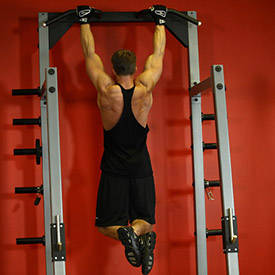
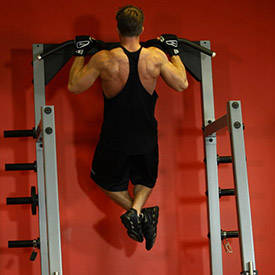
Pullups
To further develop a gymnast-like physique you might move toward walking on your hands, learning basic back and front flips, or supporting yourself and learning basic skills on the rings. It makes sense to find an adult class or an open gym at a gymnastics school if you progress to this stage.
In terms of proportion of time spent developing each muscle group, is it fairly equal for upper and lower body? Or is there significantly more time devoted to upper body training?
The lower body gets trained pretty well simply practicing the events, although some time is still spent developing leg strength and explosiveness.
The upper body is usually the more challenging aspect to develop as the human body was not designed to walk around and 'jump' off its hands like gymnasts do. The shoulders are asked to function almost like hips do when you stand. That is why gymnasts are famous for their enormous shoulders.
Gymnasts have adapted to the needs of their sport. Because upper body strength and control is more challenging and less natural for most athletes to develop, more time is generally spent on it during physical preparation.
In terms of making it to this level of the sport, how much do you believe is training and how much is natural skill?
Almost any dedicated, reasonably athletic individual can make it far in the sport with the proper training, but the training usually needs to begin early in life, at around age 5, if they wish to obtain a college scholarship.
To make it to the Olympics, you need to have the right training and talent. There's no way around it. Proper training can make a good gymnast, but without that extra gift of talent, even the most dedicated athlete won't make the Olympics. It's simply too competitive at that level.
In the past, only a handful of gymnastics clubs and NCAA programs in the United States produced Olympic-caliber gymnasts. Today, great gymnasts come from all over the country, which is nice because gymnasts often used to have to move away from home to have the greatest shot to make the Olympics.
Talent alone won't cut it, though. This sport is too hard. The average male gymnast puts in nearly to 20 years of work training 25-plus hours per week to make the Olympics—even if they are super-talented. You have to love the sport to put in this much work for that long.
In addition to that, what would you say is the most important physical trait that will determine how well a junior level gymnast will succeed?
Strength-to-size ratio and explosiveness are the top qualities to look for in a junior level gymnast. That quick-twitch muscle is essential. Although gymnasts tend to be on the short side, on some events such as the pommel horse it can be of benefit to have long arms, for example.
Taller performers look more graceful as long as they are strong enough to handle the extra bodyweight. Tendon attachment and length of muscle bellies is important. It's something that a top level coach can pick out. A good coach can spot a talented kid right away. The kid might not be the most graceful, refined or flexible, but those are traits that can be developed over time.
If a certain amount of base strength or explosiveness and ease of movement and spatial awareness just isn't there, it's not likely to be developed enough to ever have a hope of being Olympic-caliber.
However, many gymnasts earn a gymnastics scholarship for their efforts. Aside from collegiate education, gymnastics is a great sport that teaches important life lessons and serves as physical preparation for any number of sports. Plus, it's plain old fun!
From a coach's standpoint, the most enjoyable children to work with and the ones who are most likely to stick with the sport may not be the most talented ones, but rather the ones who always come in with a great attitude ready to work hard and who trust and listen to their coaches. Kids who simply love the sport are a joy to work with and that can take them a long way.
In a typical training week, how much rest are gymnasts typically getting?
Most gymnasts practice twice per day for at least three hours per session. Usually the morning workout includes more basics and conditioning and the afternoon or evening workout includes more skills, drills and routines, and a more thorough flexibility session.
Sometimes there will be separate workouts for cardio or weight training, which can sometimes mean a third training session in the same day. Most gymnasts only get one day off from physical activity a week.
There is generally no formal rest week scheduled in, but gymnasts will occasionally miss training time due to travel for competitions, vacations here and there, or time off due to injury. The year is usually planned out designed for the athlete to 'peak' during the most important competitions of the year, and following those competitions, training is sometimes reduced to allow the body to recuperate and for injuries to heal.
More conditioning and strength training is usually done in the 'off-season' during which there are few or no competitions, and more routines are performed during the competitive season to ensure the ability to safely execute the routines and earn a high score.
Skills are developed using aids that assist in learning and are easier on the body than the competitive surfaces such as loose-foam pits, tumble-tracks and trampolines, and moved to regular matting with spotters and eventually minimal matting with no spotters as competition approaches.
Gymnasts train every body part every day, which isn't optimal for hypertrophy, and is one of the reasons why their muscles don't grow in size as much as a bodybuilder training for size would.
The muscles adapt to the demands of the sport and develop the ability to withstand the high volume and frequency of training. Gymnasts do not typically go all out to failure like a weightlifter would, at least not on a regular basis. Most do not do hard conditioning consecutive days in a row.
They usually have 'harder' days interspersed with 'easier' days in the week. They usually taper conditioning work before major competitions so their muscles are fresh, doing something like half the usual volume (otherwise they would not maintain enough conditioning to get through the routines).
If you are training to failure going after that gymnastics body, give yourself days of rest, because you won't be spending the amount of time the elite gymnasts do training, and you can push yourself harder and then give yourself a day to recover. This is the more efficient way to train if you are not an elite athlete spending 25-plus hours in the gym.
Gymnasts must train these amounts of hours to develop the technical skill and refinement necessary for their sport. Older gymnasts who have been on the international scene for awhile tend to incorporate more rest because they have already achieved the basic skills necessary to compete on the international level, and can get by with fewer hours, which is easier on their bodies especially as they get older.
In your opinion, what is the most difficult event to training for in the sport of gymnastics?
Most male gymnasts seem to fight with the pommel horse, due to the insane amount of upper body strength and control it takes to master the event, not to mention the technical prowess that takes years and years to develop.
Also, if you do not have the right body type to be a great pommel worker (light, with long arms and a relatively short torso) you will find the event frustrating. Many gymnasts have a particular event that is their own Achilles' heel, but the pommel horse seems to be the one men struggle with the most.
One false move and you're off the horse and it's a big deduction. For the women, the balance beam is similar. It's a mental event that can be scary to train and even scarier to compete, because one false move or second guess and you could take a nasty fall that will devastate your score.
Most gymnasts train all six events, although as their careers progress some choose to specialize in certain events. This is allowed in modern times to improve their competitive results or due to injuries.
Gymnasts who excel at the 'leg' events such as floor and vault tend to struggle on events that require more upper body strength like the rings for men or the uneven bars for women, and vice-versa. The true all-around gymnast is becoming a rare commodity today. It's a challenging feat for a single athlete to have such diverse skills and abilities. That's what makes gymnastics so special!
Conclusion
So, there you have an inside look into the world of gymnastics. There is no question about it, these athletes train long and hard to obtain the level of skill and performance they demonstrate while executing the movements.
While many of you will have no desire to ever get up on the rings and perform, by learning about how they train and the principles they use, you can get your body looking more like the gymnasts you see on television.