Today when an athlete walks into their local gym they will realize that they are no longer in Kansas. The equipment selection available in many gyms today is sometimes overwhelming. Go to most gyms and you will see machine after machine that's whole purpose is to train one muscle group and that's it.
Many of the big name manufacturers have research departments whose only job is to create the "Next Big Thing". Many young lifters today go to the gym unsupervised and attempt to use every piece available for muscles worked that session. When asked why they use machines many answer, "Because they are there and I see other people using them so they must be good".
With so many equipment options available it's no wonder training programs fail to work. I remember when I first started to get into lifting, my father took me to the local health store bought me a can of protein powder and a muscle and fitness magazine.
For many of us this is how we got introduced to supplements and weight training. The problem with muscle magazines today is that many show workouts that no athlete will ever benefit from. Their exercise programs are designed for people who are looking to go to the beach, not step on the field of battle and wage war.
Today's athletes need to get faster and stronger, not bigger and slower. Now don't read this the wrong way, I'm not saying not to read muscle magazines because I read them when I travel, just know what you're reading before you take on programs listed in them.
Back when I first started I can remember going to the gym with a photocopy of the article and trying each workout only to fail to see the gains that I wanted. What happened was, I was looking at the model or bodybuilder and thinking to myself that if I do these exercises and take the same supplements than I will look the same way but I was wrong.
The reason for the "Perfect" lifter doing the exercises is to promote the magazine and the advertisements in it. Many of the lifters seen in the articles don't even do those workouts because they are either too hard or poorly designed. This is why we need to educate today's athletes on sticking to the basics when it comes to training programs for their sport. In this article we hope to do just that.
3 Basic Pieces Of Equipment
We are going to talk about the benefits of 3 pieces of equipment found in most gyms and how the use of them can help you to become a better, more complete athlete.
Barbells
We all have seen them and used them many times. I like using barbells for most of your strength and power exercises. Sticking to the basics these exercises are bench press, squats and deadlifts. When looking at your program design here is how the exercises will benefit you.
- Bench Press: Build mass and strength in the pectorals, front delts and triceps. The bench press is a fundamental compound exercise for the upper body. It produces growth, strength and muscle density, not only for the chest muscles but for the front deltoids and triceps as well.
- Squats: Build mass and strength in the legs, especially the thighs. Full squats are one of the traditional mass-building exercises for the entire lower body but are primarily for developing all four heads of the quadriceps.
- Deadlifts: Work the lower back. Deadlifts are an overall power exercise that involves more muscles than any other exercise in your routine, including the lower back, upper back, and trapezius muscles, the buttocks and the legs.
Dumbbells
Training with dumbbells allows you to select resistance training exercises based on their similarity to actual movements that occurs during sports. Dumbbells require more balance than training with barbells or machines and balance is crucial for optimal performance. Dumbbells also require more muscular control than barbells, thus enhancing kinesthetic awareness.
The best part of training with dumbbells is it allows the athlete to train through a greater range of motion than do barbells on some exercises. Understand that it is sometimes more valuable to trade heavy weights (barbells) for more sport-specific movements.
Here is a list of some dumbbells exercises for wrestlers:
- DB raise to armpit
- DB upright rows
- DB high pull snatch
- DB bent-over rows
- DB squat to push press
- DB lunges
- DB lateral lunges
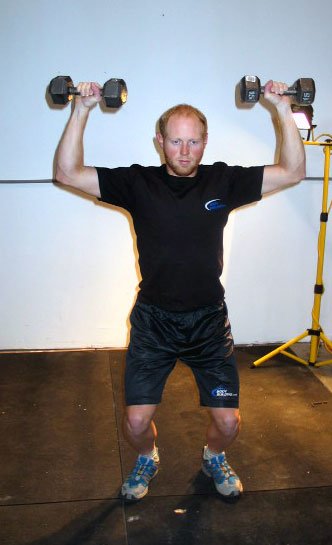
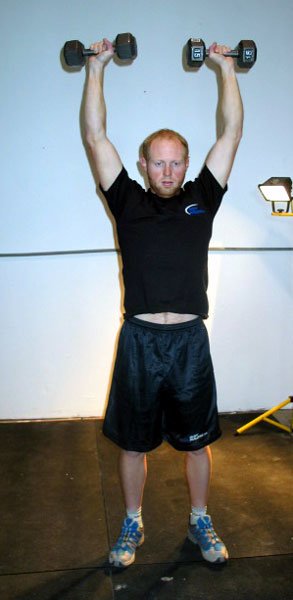
DB Squat To Push Press
 Click To Enlarge.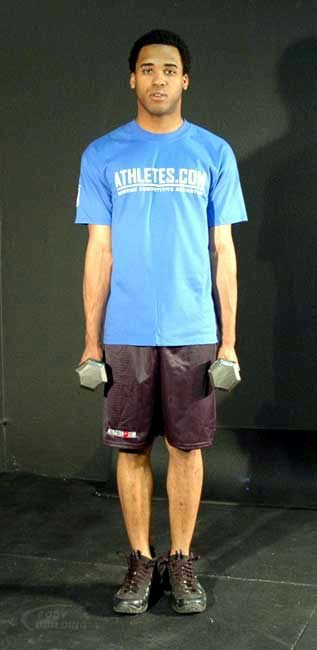
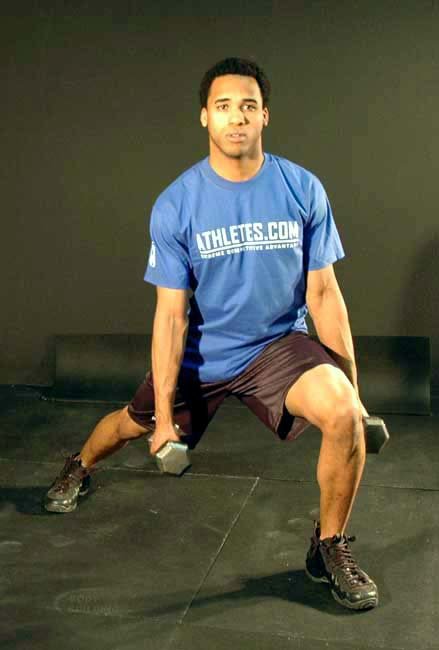

DB Lateral Lunges
Click To Enlarge.Kettlebells
There are four basic categories of physical attributes that you care about that can be increased with kettlebells grip strength, strength endurance, core strength and explosive power.
- Grip Strength: Given the extra-large handle of 'regulation' sized kettlebells and the ballistic nature of many exercises that use them, grip strength improvements are an adjunctive benefit to each and every exercise - as long as you have a heavy kettlebell in your hand, your hand is receiving a training effect. If the thing is moving fast and changing direction in a rapid manner, the effect is increased.
- Strength Endurance: Whether you call it general physical preparation (GPP), strength endurance, work capacity, or simply being 'in shape', the ability to survive (and thrive) high volume training is a must for those of us with weaknesses that must be overcome. Kettlebell training is one of the most efficient methods to increase whole-body strength endurance. For strength endurance, I'd advocate building up to a reasonably high rep count and minimal rest between sets. Start with 5 reps and work up to 20 or more slowly over time—endurance takes much longer to build than strength does, at least for beginners. Give yourself a few months to get your work capacity up, maintain perfect form for each rep, and do this at least twice a week.
- Core Strength: Your 'core' muscles include everything from the top of your legs to the bottom of your chest—erector spine, abs, and the large number of small muscles throughout the middle of your body. My favorite core exercise with kettlebells is passes. Assume a wide stance and circle the 'bell around your body, passing it from hand to hand as you go. Do figure 8's between your legs, and reverse direction often. With a big kettlebell, you can easily work up to 50-100 reps per set. The faster it moves and the more often you quickly reverse the direction of the kettlebell, the more ballistic effect is imparted to your core muscles. It is the ballistic effect that causes rapid gains—deep shock like training effect to the small muscles, tendons and ligaments throughout your core. As with all new exercises, be careful and work up the rep count and ballistic intensity slowly.
- Explosive Power: The Swing, Snatch, and Clean with a kettlebell in each hand, will serve to increase explosive power. It is the explosive lifts that cause the greatest forces to be transferred to the hand, core, and posterior chain—this is the gold mine that's not panned out, so spend your time and energy wisely: two-handed swings in your deadlift or squat stance, with as much 'snap and pop' as you can muster while remaining in control of the kettlebells, and in perfect form, should constitute the majority of your training.
Why Use These Tools To Train?
Answer: Overall speed, muscular and aerobic endurance, superior joint strength and flexibility, awesome power and explosiveness. Athletes don't need fancy equipment to get in top shape but what they do need to do is train properly and sometime that's hard enough.
You will notice that nowhere did we mention bicep curls, leg presses, leg extensions or any other isolation exercises. When training athletes it's important to get the most out of your training session, this is why we like to train total body and combination movements. Think sport-specific movements in your program design. You can do fewer exercises and receive greater returns than with old conventional bodybuilding programs that have some people in the gym for over 2 hours.
Remember, on the mat no one cares how big your biceps or how much you can leg press. It's the moment when your opponent stands up and you need to lift and return him to the mat when you will see the need for total body training and combination exercises.
Is Weight Training Safe For My Child?
I think back to the day when my son Keegan was only 18-months old and just able to walk. I was sitting watching TV when I heard his little voice say "Ball Dadda". I looked over and there he was with my 15-pound bowling ball in his arms. The weight of the ball was about 60% of his bodyweight.
At first I was afraid of him hurting himself by dropping it on his foot but the more I looked at him the more I wondered how he got the strength to pick it up.
Much to my wife's dismay I took the ball from him and rolled it across the floor for him to pick up again.
To Keegan this was a game of rolling the ball with daddy. He would walk over to the ball, performed a squat like you would see a strongman do when picking up 300-pound stone boulders and would pick it up and start walking.
I knew then this was the making of a strength machine and to this date he is still as strong as a bull ...
Every year for the past 4 Christmases Keegan has asked for weightlifting equipment as a gift.
For 3 of them I, like many parents and coaches in America, resisted allowing him to weight train due to his age and the concern that lifting prior to puberty was unhealthy and could cause injury to under-developed muscles.
Grapplers Gym
Then I started Grapplers Gym and I wanted to provide information to wrestlers and athletes of all ages and this meant gaining as much information on training for all ages even our K-8 kids. What I learned was that with the proper supervision and program design young athletes as young as 7 can weight train and not cause damage to their bodies.
Much research has been done on this topic and the results show that boys and girls can show a strength increase as a much as 74 percent in only 2 months of training. This is possible because strength development is associated with a variety of neuromuscular factors and does not solely depend on hormone levels (1).
Exercises should consist of 13-15 reps for one set and training should be conducted 2-3 times a week. If the child is in an after-school sports activity then training should only be conducted twice a week. Weight training should be conducted only under strict supervision of a "trained" coach or parent with slow movements and minimal weight until proper form is demonstrated for reps of 15.
We receive emails each week on this question and we will be doing a series of articles on the topic that will cover everything from program design to proper nutrition, cardiovascular training and exercise related games.
So to get back to the original questions "Is weight training safe for my child" well the answer is YES and our goal over the next couple of articles will be to teach you how.
Until next time...
Remember, hard work beats talent, when talent doesn't work hard!
About The Author:
Michael Fry is the owner of Grapplers Gym and www.grapplersgym.com. Grapplers Gym is the home for advanced fitness and conditioning for today's wrestlers. Subscribe to our FREE weekly Newsletter! Each issue is crammed with free training tips, articles, programs, exclusive discounts, strength/conditioning news and many more surprises. Mike can be reached by email at mike@grapplersgym.com.