
Introduction To Team Building
Whether on athletic teams, in corporate America, therapeutic populations, for or at-risk youth, the inclusion of a team building and adventure-based approach to learning and to performance enhancement has gathered increased adoption because of its desirable effects in the workplace, team environment and in individual development.
Adventure programming and team-building activities embrace and encourage adaptation, creativity, risk-taking, the development of problem solving skills and helps individuals of all ages to trust, cooperate, risk, achieve and grow. There are several national curricula throughout the United States; one of the most popular and well known is operated by Project Adventure".
Their projects and activities have been successfully implemented by hundreds of schools, community, therapeutic, corporate and athletic groups both nationally and internationally.
Personal Experience
 I have personally used team building activities with boys and girls and men and women from ages 6 to 65. These types of activities provide a holistic strategy, and action-based learning environment for cultivating specific performance enhancements, including: goal-setting, communication, "in the moment" problem solving, emotional control and intelligence, anxiety management strategies, etc.
I try to challenge people's assumption that team chemistry is a noun, a thing, something you have and that simply exists. Rather, I ask them to envision "team chemistry" as a verb, something you Do, something that is fluid, kinetic and action-based.
Team chemistry is fundamentally a problem of action, of individuals and groups doing and being active in developing the intricate web of connections that exist among any group composed of diverse people, talents, roles and abilities.
Factors To Consider
If you want to include team building activities into your practices you should consider several key variables and tailor the initiatives to your particular group, level and activity. These variables include:
- The age and maturity of the group (age, gender, level, goals, etc.)
- The readiness of the group (safety, conflict tolerance, guidance required, etc.)
- The length of time available for the program (per session and number of sessions per year and over what period of time)
- The specific goals of the program for your particular team at a particular point in the season (trust building, communication, cooperation, competition, fun, problem solving, leadership, etc.)
Planning
It is best to plan an entire team building session in a progressive manner with each challenge building on the next and organized around key themes for your team. For example, if you want to foster better communication among group members, then your activities should include initiatives that call for various combinations of players taking a leadership role in giving directions, commands or ideas in both verbal and non-verbal mediums.
If you want to develop team trust, then initiatives should include activities that ask teammates to relinquish control and power to another teammate in a safe, non-threatening manner.
Beyond the thematic focus of the event, your team building session should also include progressions from individual and partner challenges to small group and eventually to full-team initiatives. The complexity should also vary on a continuum from simple (fewer rules, less demanding challenges or shorter times to complete tasks) to more complex (more rules or restrictions, greater demands on the individuals or the group based on length of time to be successful or level of difficulty).
Getting started With The Ice-Breaker
 Like any good practice session, team building should also begin with a proper warm up to prepare athletes for the day's events. Warm up activities can be thought of as simple "ice breaker" type experiences that encourage athletes to transition from physical training, competitive mode to a more relaxed and open spirit of engagement.
Laying The Ground Rules
At that point, the ground rules should be given to your team including the goals for the activity, any team rules you want to encourage (for example, "only positive verbal comments are to be shared," "let's all respect individual differences," or "let‚s foster a safe environment both physically and emotionally").
Let players know that there is a purpose to these games and while they may be having a great time laughing, having fun and enjoying themselves, there is a deeper meaning, if you will, that will be explored and that is embedded in the activities. Let them know that these messages will be addressed at the end of the day.
The Debriefing
One error that many team leaders often commit is to focus almost exclusively on the initiatives themselves and neglect the debriefing session at the end of training with the entire group. At the final debriefing, lessons extracted from the day's activities should be explored. Players' opinions should be drawn out and they should be asked to explain what they saw, heard, learned and felt during the team building actives and what potential applications could be derived for the team or for the season. In many ways, the debriefing sessions are as important, if not more so, than the activities themselves.
With experience, team leaders will increase their skills in both the art and science of leading activities and in discussing their use, value and application for the team in the weeks and months ahead.
Ongoing Follow-Up
Finally, it is essential that coaches follow up the event by highlighting the themes unveiled and revealed in the team building sessions in subsequent practice sessions e.g. on the court, field, pool, arena, etc. as part of a traditional practice). In other words, the lessons should be revisited throughout the year and not simply left at the site of the team building activities.
Example Ice-Breakers
As the name implies, they are generally low-organized, simple types of challenges that facilitate the breaking down of barriers, alleviate the ego concerns that athletes might have, and generally establish a safe, fun, engaging atmosphere of active participation.
Remember, the primary goals of teambuilding are to provide activities which serve as critical learning experiences for athletes which are then coupled with group and individual reflection on the lessons learned from the activities.
These are games in which inhibitions are lessened, or activities for individuals to get to know one another, have fun and take some. As the saying goes, "you never get a second chance to make a first impression." This is certainly applicable to successful team building.
Start with a bang. Make the activity an attention grabber that leads and motivates the group into the rest of the day's activities. Begin with a high-energy initiative that immediately captures the attention of the participants. An exciting beginning can serve as a bridge from the current to the next level of involvement and sets the tone for future challenges. Here is one example for a simple icebreaker. It incorporates competition, problem solving and communication.
Bean Bag Shuffle

Equipment:
One stop watch and a bean bag for each team.
Space:
An open field or gym
Teams:
Divide your group into two or three teams of 6-8 individuals
Set up:
- Provide each team with one small bean bag (you can buy them in a store or make your own).
- Have the teams stand in a circle, any size they choose.
- Set the challenge: the goal of this activity is to see how fast you can pass the bean bag from person to person so that everyone in the group has to have completely handled the bean bag and individually passed it on to another team member (in other words, simply "touching" the bean bag does not count as "holding and passing individually").
- Assign a stop watch coach (make sure it is a trust worthy, competent timekeeper) to each group.
- On the signal, "ready, set, go," teams begin to pass the bean bag around the circle as fast as they think they can but still following all of the rules
- Establish a winner based on time. Record that time.
- Now ask, "Can they do it faster?" Let them try. Continue to record the times for each team.
- Can you do it faster still?
Eventually teams will learn that they can move close together and make an even smaller circle so that it almost looks like a big mob of people. Then, they will learn that they can hand and pass the beanbag much faster, more efficiently, and all in one motion if they change their distance from one another and alter their team's configuration.
Debriefing Lessons:
At first, they'll think that winning is the only goal or that winning is when they simply "beat" another team. Ultimately, you want them to come to see, that what they initially thought was good enough, fast enough and successful enough can actually be made better and faster. It is the same principle we learn in sport.
With planning, motivation and ingenuity, they can learn skills and strategies to keep lowering their previous best time and therefore improve overall "team" performance. That debriefing message can have season-long implications no matter what the age, level or sport you play.
This next icebreaker can serve as an excellent warm-up activity not only for the team building session but also for the cardiovascular system and musculoskeletal structure depending how active and competitive your athletes are.
The Human Dragon
Equipment:
None needed
Space:
An open field or gym, free from obstacles
Teams:
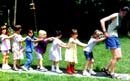
Divide your team into 4 teams of 6-8 individuals. You can have odd numbers or vary the length of the "dragon" depending on the skill, size and ability of your athletes.
Set-Up:
- Each team designates the "head" person and the "tail " section of the Human Dragon
- All other team members fill in behind the head of the dragon by holding on to the person in front of them at the waist
- At this point, your four dragon teams should form one long line with all team members connected by holding onto each other's waist in a single-file, one-in-front-of-the-other line
- The goal of the activity is to have the head of each dragon attempt to tag the tail of any other dragon team
- Only heads of the dragon can do the tagging as all other team members must remain connected (with two hands) to their teammates
- Players attempt to avoid having their team's tail be tagged and skillfully (did I mention, humorously?) attempt to shield their tail from other dragons on the prowl
- Each time a tag occurs, the tagging team receives one point and the tail of the team that was tagged becomes the new dragon head, therefore creating a new tail
- If one person is a tail for too long, switch the tail and periodic time intervals
- The game continues on for a specified time (as competitiveness and interest allows)
- If the any of the dragon people in the middle release their grip on the person in front of them, teams are asked to "self-report," count a point against themselves and switch the tail of the dragon. In other words, releasing your grip results in a loss of one point for your team
- Dragons should call out their score every time they gain or lose a point
Learning:
This game is great for communication, competition, honesty, cooperation and protection of teammates. By moving as a team to "protect" their tail, the team's success is more likely enhanced.
In this simple but fun initiative, the following concepts can be emphasized and developed:
- Collective effort
- Competition between groups
- Cooperation within groups
- Speed of performance
Decide what's best for your particular group at this particular point in your training cycle and alter the activity to meet those demands.
Here's one more good Ice-Breaker ...
The Hula Circle
Equipment:
One hula hoop for each team and a stopwatch . Teams:
Divide your group into the number of teams you desire with 8-15 individuals per team.
Set-Up:
Each team is asked to stand in a circle by clasping hands with the person on either side of them. That grip cannot be broken. Place a hula-hoop on the forearm of the "Team Captain" and have him/her re-grasp the hands of his/her teammate to complete the hand-in-hand closed circle.
The Challenge:
On a "ready, set, go" command, teams begin to "pass" the hula-hoop around the circle without breaking the handgrips. Players bend and twist their bodies through the hoop by climbing through the hoop, ultimately getting it over their head to the other side of their body.
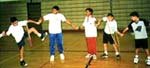 The entire process repeats itself as the hoop travels from teammate to teammate around the circle as fast as possible. Keep in mind the handgrip can never be broken.
If the handgrip is broken the hula-hoop must start back at the beginning again.
Variations:
- How fast can you pass the hoop?
- Who finished first?
- Can you do it even faster?
- Have players stand with their back toward the center circle and try it again.
Learning:
There are so many lessons to be gleaned from this fun and exciting initiative. Players will discover that just because their team may be far in the lead at one point in the contest (or behind), a few small errors (or quick recoveries) on anyone's part can lead to disaster (or can bring them quickly back into the game).
The point is that whether you are winning or losing at any given point in the contest, it is no guarantee of final outcome. Truly, anything is possible. Often in sport, teams get the lead and relax. That loss of focus and competitive fire can be costly.
Secondly, players also learn the importance of not only competing against someone else (as in beating the other team) but also learn the real value of competing against their previous best performance (as in "can we lower our team's best time?").
Eteamz.com Members,