

TOPIC: How Can An Athlete Improve Their Punching Power?
The Question:
Punching power is most necessary for MMA fighters, but that's not to say it isn't also used in the hockey rink, or in the streets.
What are the best techniques to improve punching power?
What kind of routine should you follow? Include specific exercises.
What kind of effect will this have on your athletic conditioning?
Bonus Question: Who is the hardest hitter in regulation MMA fights (Pride, UFC, Etc.)?
Show off your knowledge to the world!
Prizes:
- 1st place - 75 in store credit.
1st Place - perldog007
Punching Power!
For punching power big muscles mean next to nothing. Anybody who has seen Paul Buentello, David Bey or James Hipp fight knows what's up. None of these guys would be flagged as gym rats, but all of them can drop the hammer.
On the flipside, more than one guy with big muscles has actually hurt himself trying to throw a punch. Here is an excerpt from an interview of Guy Grundy by David Robson from Bodybuilding.com:
Franco Colombo's Winning Bodybuilding tells us it takes six months at a gym to learn to throw a knockout punch with either hand. Punching a heavy bag is used for resistance to build the necessary muscles. According to Franco, this time can be significantly abbreviated by using a boxing specific bodybuilding workout.2
I really like that book. A classic work in my view. On that point I have to disagree. To this writer, who was stupid enough to spend a year at a full contact club, six months of striking the heavy bag builds your technique.
Joe Leiderman wrote about this back in 1925:
If you read enough by Coach Davies, you will come across the concept of imperfect training. One dictate of this concept is that weightlifting in a controlled gym on a flat floor, with your belt, wraps, air conditioning, mp3 player, spotter, etc ... may have a reduced carry over in the real world. Likewise in sport or in self-defense, punching the heavy bag will only take you so far.
Unless your opponent is kind enough to swing suspended from the ceiling and not punch back, you will need more than the heavy bag. Traditional tools are the jump rope, speed bag, double ended striking bag, floor mounted speed bag and, finally sparring. There are still a few old school trainers who will insist that you are proficient in the drills before you spar. If you have mastered the basic drills, you are ready to spar if you wish (if your doctor clears you; VERY IMPORTANT!).
Sparring is where it all comes together. Recently retired Admiral Arthur Cebrowski, Director of Force Transformation at the Department of Defense, on the news was heard to say,
This also applies to getting "OWNED" in the ring. When you are getting beat up, your learning receptors are enhanced. Learning uptake is much higher than when you are sitting on the couch watching UFC.
 |
OWN3D? This is an example of "Leetspeak." Leet, usually written as "1337" in Leetspeak, is an online culture and/or attitude, as well as a language code, among the Internet population. The word is derived phonetically from the word "elite", and is a cipher, or cryptic form of spelling replacing letters with numbers, symbols, and other letters that look or sound alike. |
|
|
||
In order to spar, you simply have to be in shape. With a high level of confidence this writer can state that gasping for air and trying to keep the room from spinning can degrade your best MMA moves. Since a sport or street fight can be more demanding than sparring, conditioning is king.
 Strength Training:
After flexibility, technique, skill, and conditioning have been addressed strength becomes a factor. All other things being equal the stronger fighter can throw a harder punch. But when are all other things ever equal?
Strength training can give a significant advantage to the fighter who has addressed all others areas of punching power. Most people think of triceps right away. Old timers would tell you that is a common mistake. There is a reason that karate masters will insist their students build strong midsections.
The midsection takes the force you generate by pushing off the ground with your legs and transfers it to your upper appendages. Much like the transmission of a car transfers the power of the engine to the wheels giving motion to a car.
The article is on an excellent drill called the "Full Contact Twist". I was not aware of this drill in '86-87 when I was paying good American money to get beat up. Same situation in '89-91 when I was involved in too many scuffles doing security work at Union Station in Washington D.C. Had I known about it I would have been using it. If you want some serious punching power I recommend it.
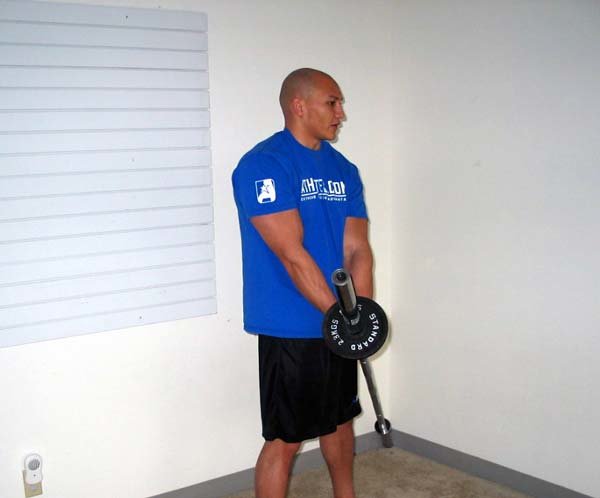
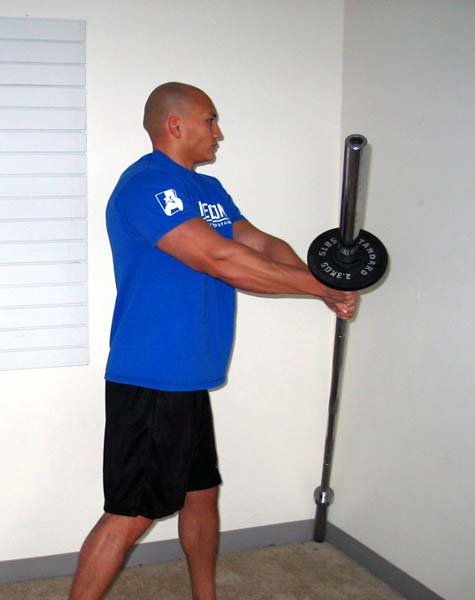
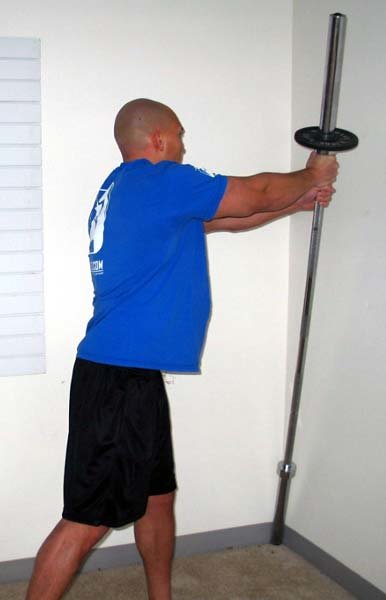
 Click Image To Enlarge.
 Full Contact Twist.
Deadlifts build overall strength. There are some parallels between pulling weight off of the floor and coming off the ground with some power. Fight commentators talked about fighters like Mike Tyson and Tommy Morrison throwing punches from the floor. Most experienced fighters will tell you to be very wary of an opponent with big lats and traps.
Olympic lifts would be good, but can be difficult to learn. I do not own kettlebells, but I do have dumbbells and Mike Mahler's excellent Kettlebell Solution For Size and Strength DVD.
- Swings
- Snatches
- Clean and press
- Clean and jerk
- Squats
- Windmills
- Turkish Get-ups
All good drills for striking.
At this point, it looks like some kettlebells will be arriving at the dog compound in early 2006.
There is a reason that so many hard-@sses in the combat sports come from rural areas where agriculture is a vocation. Ballistic work like throwing hay bales and chopping/splitting wood carry over to fearsome punching power.
Routine:
What Kind Of Routine Should You Follow? Include Specific Exercises.
The first time I put on gloves, my power was a joke. Everybody in my club (dojo) would just walk right in and get some. Within a year, my right hand was universally respected at my club and I could put a palm heel strike with either hand through a one inch concrete block, supported. These are the drills that worked for me then, and some weightlifting drills I have learned since.
My sensei, who weighed maybe 138 poounds and could strike with terrible power, told me to stretch every day if I did nothing else. That is a good place to start. Some people say to stretch before exercise, some say after. I would leave the reader to form their own opinion. In my school, we always stretched before warming up and sparring. It works. Your mileage may vary.
1. Flexibility
- Standing toe touches
- Arm circles
- Shoulder circles
- Shrugs
- Neck circles
- Elbow circles
- Wrist circles
- Knee circles
- Ankle circles
- Hurdler stretch
- Reverse hurdler
- Butterfly stretch
Any other stretches you like to do, try to add one now and then. Spend 20-40 seconds on each stretch, longer if you feel the need.
2. Jump Rope
Arguably the best cardio for a striker. This drill builds endurance and coordination. The muscles that lift you off of the floor will also generate force for punching. If you can jump rope for any length of time, you are potential trouble in a fistfight.
Try to do a little more each day. If you can do ten minutes to start with that is good, if not work up to it. The longer you can jump without exhausting yourself the better.
3. The Drills
- Heavy Bag: Work in 1-minute rounds, taking 1-minute breaks. As your endurance improves, work up the rounds and cut down the breaks until you can wail for three minutes with a 30-second break. UFC fans might want to work up to five minutes. Start with two rounds. Throw combinations, switch leads, and try to throw a flurry of punches for the last ten seconds of each round.
- Speed Bag: This not only improves coordination but, done after the heavy bag, strengthens the arms by holding them up when tired. Again, work in rounds; start with a minute and work up. Start with two rounds. Use a steady rhythm of the classic knuckles, hammer fist and switch hands. Ask somebody or watch "Million Dollar Baby."
- Double-Ended Striking Bags Or Floor-Mounted Speed Bags: Are great for improving coordination and the closest things to reactive devices in most gyms. Try to start with two 1-minute rounds and work up. With this apparatus you are striking the bag and moving out of its way on the rebound. When you can go a round or two without getting hit by the bag, it might be time to start sparring.
4. Strength Drills
If you are not going to train with weights ... daily or 3x per week, depending on how bad you want it. If using weights, you may want to still do these twice a week or more, depending on your recovery ability. Pull ups (lat pulldowns if you cannot do pull ups) complement weight training nicely.
To really get strong, do frequent sets of these exercises throughout the day. Do a number of repetitions that you can handle easily in good form and do them often.
- Crunches
- Leg lifts
- Push-ups (work up to doing them on your knuckles)
- Pull ups
Weight training, 3 times per week. Deadlifts with Barbell, Full contact twist with bar, all others with dumbbells or kettlebells if you have them and know how to use them.
When this gets to be too easy, add weight to the deadlift and full contact twist and add a set to the bell drills. Rest 2-to-3 minutes between sets; this is not the cardio portion of the training. The db/kb exercises are wonderfully explained in the Mahler DVD.
- Deadlifts: 2x5 (80-90% of 5 rep max, start with 80 work up to 90 before adding a set, then go back to two sets of five and add more weight).
- Full Contact twist: 5x5 per side.(start with bare bar, work up in weight)
- Double military press: 2x5.
- Single-arm swings: 10 per side.
- Single-arm snatches: 5 per side.
- Windmills: 5 per side.
- Double front squat: 5 reps.
- Turkish-get-ups: If you can do five per side after all that, Tu esta le Hombre!
 Click Here For A Printable Log Of Routine.
5. Farm Work
If I had the opportunity to split wood and carry it in a wheelbarrow I would definitely substitute that for a weight workout up to once a week. Alternatively, doing sledgehammer strikes on a tire and pushing a loaded wheelbarrow around could be a good replacement for a weight workout. Don't laugh; farm boys tend to grow into hard men.
6. Sparring
Sparring with a competent partner and proper safety equipment (mouthpiece always, cup is good, foul protector even better). Hand wraps, gloves and a safe work area are also important. It is a good idea to have other people around if possible. I have sparred in back yards and parking lots. Working in a ring is much better.
If you have four people, Ironman is a great drill. One person is "it;" they spar the other three for a minute each. Then all three go after "it" for a minute. If you can get through four minutes of being "it," you can probably throw a decent punch. Most punchers would tell you that you need to spar once a week or more to make progress.
Some people like to do bag and rope work before strength training, some after. Pick one. Feel free to swap it out.
Which brings us to our last point of discussion. This writer makes no claims to being an expert on martial arts. I have spent only about 40 hours in the ring (actually little time when you think about it). Unfortunately, doing security work in a violent place and time, I have been in more than 100 altercations, making arrests.
I only had to punch two people making detentions and they went down immediately from body shots. I do not advocate punching to the head in a street fight. But, like I said, I am not an expert. Just a guy who went from not being able to fight his way out of a wet paper bag to being able to land a good punch.
This is a routine that I would use today to build punching power. I hope it helps you find yours.
Conditioning:
What Kind Of Effect Will This Have On Your Athletic Conditioning?
Simply put, these drills will enhance overall athleticism.
Following a routine that puts you in condition to give 110% for three minutes in the squared circle (or five minutes in the octagon) will carry over to other sports. The combination of endurance and explosive strength needed to be a successful puncher would benefit many athletes from cyclists to bull riders.
Bonus Question:
Who Is The Hardest Hitter In Regulation MMA Fights (Pride, UFC, Etc.)?
The hardest hitter is the one who can drop the hammer the hardest in a fight. Fighting straight up, on top, from the guard, stepping in or stepping away is Chuck Liddell. Anybody who can pivot and drop step while backpedaling like Chuck did against Vernon White gets my vote.
| Chuck Lidell Stats | ||||||||||||||||||||||||||
|
There are some hard hitters out there but the way that the Iceman can deliver the goods from any angle makes him the champ.
Thanks for reading, chin down and hands up!
References:
- "Full Circle with Guy Grundy, a Fighter's story" by David Robson
- "Winning Bodybuilding" by Franco Colombo.
- "Secrets of Strength" by Joe Leiderman circa 1925, page 36 [ online ]
- "Full Contact Abs with Pavel Tsatsouline" [ online ]
Honorable Mention - Tarkana
The Power Behind The Punch!
While all the questions were not answered in Tarkana's article, we found the addtional information given valuable enough for a special placement.
People seem to naturally be afraid of large, muscular people, but many times in fights a skinny, lanky stick of a man has knocked out a much larger and more solidly built opponent. The factors behind punching power are speed, flexibility, balance, and then strength. So large, bulky muscles are not what generates much of the power behind a punch (and too much bulk can be counterproductive).
General Fighting Preparation
First things first - There are a few basic things you need to be trained in (and that should probably include a real fighting style as well if you don't want to be dropped in seconds)
Stretching:
For any form of training, lifting, sparring or matches, it is important to stretch well before and after. Stretch everything; roll your neck out, your shoulders, your feet, stretch out your back, quads, hamstrings, arms and everything! You need to be loose for optimal performance.
Cardiovascular Conditioning:
Any athlete knows all too well how hard conditioning is, but is just as necessary. You need to be able to go all out for the full length of the fight, most of which last more than 10 minutes, up to 20.
If you plan to be a striker, quick moving on the feet drains you even quicker than ground or clinch work will. You need to be conditioning at least four days a week.
All these sessions should be moderately intense continuous runs for 20 minutes or more, or burst-moderate (a slightly more intense HIIT style) running for at least 15 minutes. Being able to last through these will give you the cardiovascular and pulmonary capacity needed to last through a long and intense fight.
Strength Training:
A fighter's strength training should be fairly simple, focusing on basic compound lifts needed for raw power and done in a low, strength-building rep range.
Also, frequency is an important factor, and more volume can be slowly built up too, as recovery improves. A routine like the one given below should be done 3-5 days a week. (number of sets will vary with frequency, rotate listed exercises)
- 3 x 4 Bench Press or Incline Bench Press (can be barbell or dumbbell)
- 3 x 5 Squat or 4 x 3 Deadlift
- 3 x 4 Bent-over Row or Weighted Pull-ups
- 3 x 4 SLDL or Romanian Deadlift
- 3 x 4 Military Press or DB Shoulder Press
- 3 x 8 Weighted Twisting Sit-ups
Click Here For A Printable Log Of Strength Training Routine.
Muscular Endurance Training:
For a fight to last, you also can't let your muscles give out quickly. For your strength to keep up through the fight, endurance-type circuits should be done at least 3 days a week. The circuit should include a 100-meter dash, pushups, lunge jumps, chin-ups and bicycles. Perform the circuit 3 or 4 times at first, and work your way up.
Mine Looks As Follows:
- 100m sprint
- 40 pushups
- 30 lunge jumps (each leg)
- 10 chin-ups
- 60 bicycles (each side) All done 5 times
On top of all that, you should be well-trained in whatever fighting style you're training in. Ones that interest me are Hapkido, Ninjutsu and Brazilian Jujitsu (which I plan to start next spring). Right now I wrestle and am just starting judo.
Focusing On The Punch
Now that you are prepared for a fight in general, you really want to focus on that powerful knock-out punch. There are many different types of punches from jabs to uppercuts to roundhouse punches, but all of them are based on the same principles. Remember the 3 factors mentioned above that are independent of strength: speed, flexibility and balance. These skills will be tailored to focus on punching power.
1. Speed:
Many things can be done to increase the speed of a punch. One of the first exercises I recommend is Smith machine bench throws. This is performed like a Smith bench, except a lighter weight is used. Instead of stopping when the bar reaches the top, you throw the bar up through the lift and catch it coming down (duh). These should be done in sets of 8 reps done very quickly.
Just as important as pressing speed is torso rotation. A great way to accomplish this is by executing full contact twists in a rapid fashion with a weight heavy enough to give good resistance. Perform these in sets of 10 to each side.
The last link to chain the force being generated by the whole body is the legs, and a great way to train this is with the push press (not the one in the Bodybuilding.com database, the one football players use). This exercise will help with forward explosion from the legs as well as more pushing force being connected together. These work well in sets of 5-8.
On top of that, speed work on a punching bag can add to speed preparation. Remember, the power travels from the ground through the pushing off of your legs, twisting of your hips, rotation of your shoulder through your arm to your fist. If any of those links fail, those below them will lose their impact on the punch's power.
2. Flexibility:
For your punch to generate as much power as possible, it must have as much distance to speed up over possible and this means the greatest possible range of motion.
You are going to have to get flexible like a gymnast (OK you don't need to be able to do the splits, but it couldn't hurt; ever seen Mortal Combat?). You need to extend the range on your shoulders, back and twist of the hips.
Perform the following stretches, slowly moving them farther in the range for about a minute or two. Repeat the stretches several times and do them every day.
Note: Push your arm behind you against a wall and slowly raise your arm higher (or body lower) and twist away from your arm.
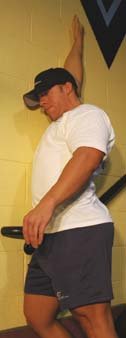
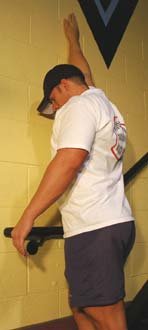 Click Image To Enlarge.
 Wall Stretch.
- Wall stretch: Bend to the side, slowly going farther, and twist backward.
- Side stretch: Bend over backward, literally, going to a bridge.
3. Balance:
There are devices designed to train balance, like boards centered on a pivot that tip easily. The more difficult ones can be useful for improving your balance.
- Balance board:
More training for balance is done with a partner. Simply having them push you as you try to keep your balance is a simple method, or being pushed on a balance board.
Sumo drills are also useful. Improved balance is a useful and important skill.
Putting It All Together:
With all the methods put into effect, you can develop a powerful KO punch. But on top of these, the most important part of training is the actual fighting, making sparring the most valuable form of training by far. Sparring trains your ability to throw punches and your overall fighting ability in general.
Preparing for fights or fighting sports is some of the most intense training of any sport. This type of training will improve your athletic ability in other sports.
Someone who can last through a long fight can stand pretty much anything other sports with far less intensity can dish out. Even the punching training alone will increase explosive power and range of motion, with are valuable athletic traits.
Bonus:
The Hardest MMA Hitters.
The hardest punches thrown in terms of raw power are the big shots taken by the champion Chuck Liddell. His big punches can take out even the strongest constitutions, including Jeremy Horn, who had never been knocked out. Another great puncher, however, is Mike Swick. Though his punches aren't as brutal in a single shot, his flurry of shots have KO'd opponents as fast as 20 seconds
| Mike Swick Stats | ||||||||||||||||||||||||
|