

TOPIC: What Are The Best Techniques To Improve Your Skills For Your Sport?
The Question:
A great athlete does not compete with just one style. They are able to adapt to different scenarios with different skills. Endurance, speed, agility, balance, power, strength, etc.
What are the best techniques to improve endurance, speed, agility, power and strength?
Show off your knowledge to the world!
The Winners:
- Steve_W View Profile
- Goheels View Profile
-
Prizes:
-
1st place - 75 in store credit.
2nd place - 50 in store credit.
To use your credit, e-mail Will @ will@bodybuilding.com for more info.
1st Place - Steve_W
Name one Olympic sport that does not require speed, power, agility or strength. Any serious athlete knows that speed, agility or strength, makes up the foundation of their training regimen. The most successful athletes in the world do not train, or complete with one style. They work hard on improving different fitness factors and components, such as endurance, power, speed, agility, balance and strength.
In order to succeed, an athlete must excel at each of these components. One particular weakness can have some detrimental effects on overall performance, even with great skills elsewhere. So, in order for an athlete to perform at his/her best, they must take into account each particular fitness factor and component.
Techniques
What Are The Best Techniques To Improve Endurance, Speed, Agility, Power And Strength?
As mentioned earlier, these are vital components into overall success at competitive level.
 Muscular Strength & Endurance:
-
Strength is defined as the maximum force exerted by a muscle against a resistance. Not to be confused with POWER, this is something different as I will come to later.
- The cross-sectional area of a muscle
- The muscle length
- Muscle fiber types
- Age
- Sex
- Speed of contraction
- BB Bench Press 3 sets 5-7
- Incline DB Press 4 sets 6-10
- Bent over BB Row 4 sets 6-8
- DB Flies 3x 8-10
- Pull-up 3x max
- Behind Neck Military Press 3x 6-8
- CGBP 3x 6-8
- Barbell Curl 4x 6-10
- Skull Crusher 3x 6-8
- Cable Curl Dropset
- Deadlift 3x6-8
- Good Mornings 3x8-10
- Light Squat 3x 15-20
- DB Lunge 3x-8-10
- BB Shrug 3x6-8
- Wrist Curl 3x6-12
- Rear Laterals 3x8-12
- Calf Raise 3x6-8
- Ab Superset:
 Click Here For A Printable Log Of Tuesday: Lower A.
 - DB Decline Press 4x8-12
- Incline DB Press 3x8-12
- Incline DB Flies 3x12-15
- Cable Row 2x8-10
- DB Bent Over Row 2x10-12
- Lat Pulldown 3x8-10
- Chin Up 3x max
- On Arm DB Ext. 2x10-12
- DB Hammer Curl 3x8-10
- Weighted Bench Dips 3x6-10
- DB Incline Curl 3x8-12
- Overhead Tri Ext. Dropset
- Squat 3x8-12
- Stiff-leg Deadlift 3x6-8
- Calf Raise 3x10-12
- Leg Curl 3x8-12
- DB Lunge 3x8-15
- DB Shoulder Press 3x8-10
- DB Side Laterals 3x10-12
- DB Shrugs 3x8-10
- Back Extensions 3x max
- BB Wrist Curl 3 8-12
- Ab superset:
Factors Affecting Strength:
Training:
-
The best way to improve strength is weight training. You need resistance to increase strength. Weight training is the perfect fit. Progressive overload is necessary for this.
This involves gradually adding more weight within the same repetition range as your strength increases. For muscular strength, I believe lifting in the range of 6-10 reps is the most beneficial.
For muscular endurance, 15-20 reps with shorter rest intervals in between sets and for muscular power, 1-4 reps. Below, is an example of a 4-day strength/endurance program, training each body part twice per week:
Monday: Upper A
Tuesday: Lower A
Thursday AM: Upper B
Fri AM: Lower Body B
Speed:
 Get A Move On!
-
Speed is defined as the ability to put the body or body parts into motion quickly. It is measured as the time taken to complete the specific task, such as a 100-meter dash. This task completion has two parts:
- Reaction Time [RT]: The time taken to initiate a response to a specific stimulus, e.g. the starting gun. This is usually about 0.2 seconds.
- Movement time [MT]: The time taken from the start of a movement until it finishes.
- Genetics: the greater number of white fast-twitch muscle fibers in the muscle, the faster the person will be.
- Distance: as the duration of the exercise increases, speed decreases
- Strength & Power: initial speed improvements seem to be the result of better neural transmission of impulses to the muscle concerned, but you can make improvements to this by developing your strength and power in the correct way relating to your sport.
- Specific Function Of Muscles & Joints: speed, like flexibility and strength is specific to each muscle group and joint. For instance, a person who can throw quickly, need not be able to run quickly.
- The Mechanical Structure Of Joints: i.e. the type of lever and length of the lever arms.
- Lack Of Mobility In The Joints.
- Anaerobic Threshold: i.e. the accumulation of lactic acid and the individual ability to tolerate and disperse it.

"GO" Response Time Measured.
Factors Effecting Speed:
Limitations Of Speed:
Training:
-
Fartlek Training:
-
Fartlek training is an excellent way to work on speed. It is a form of continuous training but with regular bursts of speed; 5-to-10 seconds, every 2 minutes or so during a session, depending on the desired intensity.
These sessions increase the involvement of the anaerobic energy systems, while heavily using the aerobic system.
Reaction Drills:
-
Reaction time is an important sub-component in athletic speed. Reaction time is the delay between sensing the need to move and actually moving. Reacting too late is obviously bad. It can be improved by practicing reaction to common stimuli, such as sight or sound.
Acceleration Sprints:
-
Acceleration sprints are conducted for less than five seconds, with the athletes in a variety of starting positions, e.g. lying, sitting, kneeling, standing - sport depending.
Longer Sprints:
-
Because acceleration work does not allow enough time for maximum sprinting speed to be reached, it is necessary to extend the length of the spring. This can be done in 20-second efforts, in which maximum speed is held for 5 seconds, after 10 seconds of gradual acceleration.
Technique Training:
-
Correct technique is an important part of speed. This requires a gradual build-up to maximal speed after several weeks of learning at submaximal rates. Seniors possessing a long history of working with a poor technique may take longer than juniors to make the appropriate changes.
Power:
-
Easily confused with strength. Strength is acting against a resistance, power is the athlete's ability to generate their own "explosiveness".
- The anaerobic energy supply
- The muscular strength
- The speed of contraction
Partly tied in with speed, power is the ability to put body parts into motion quickly, and to sustain high-intensity efforts, where the energy is supplied anaerobically, i.e. doing sprints.
The Power That You Can Produce Depends On:
The Formula For Power Is Expressed Like This:
-
Work = Force x Distance
Power = Work / Time

Training:
-
Fast-twitch (white) muscle fibers are responsible for power development.
| RELATED ARTICLE | ||
|

-
Ways to improve power should focus on short, sharp explosive movements. The broad bean jump, or vertical jump are good examples of this. Olympic lifting or plyometrics are also an effective way of improving power.
Plyometrics were developed in Eastern Europe for Olympic competitors. Without a doubt, the most performed plyometric drill is the depth jump.
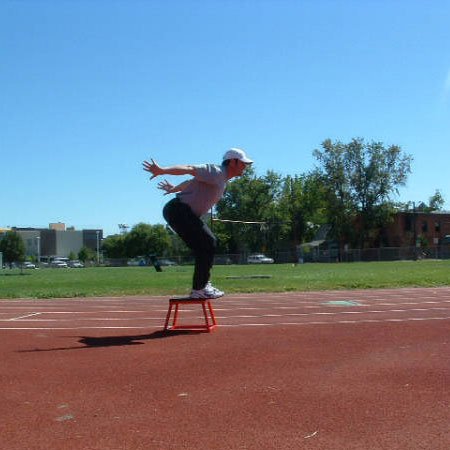
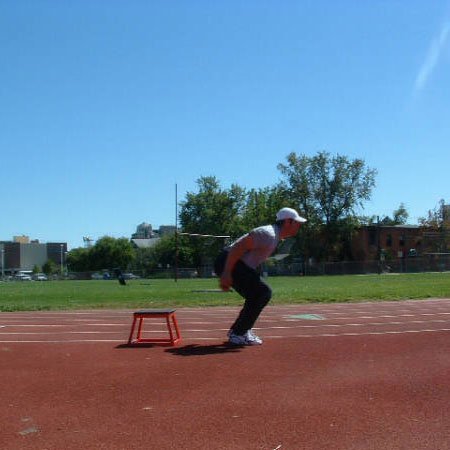
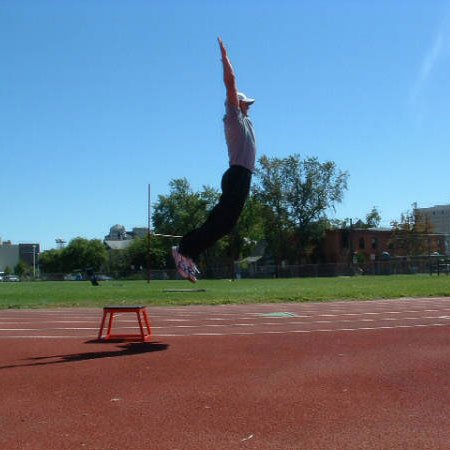
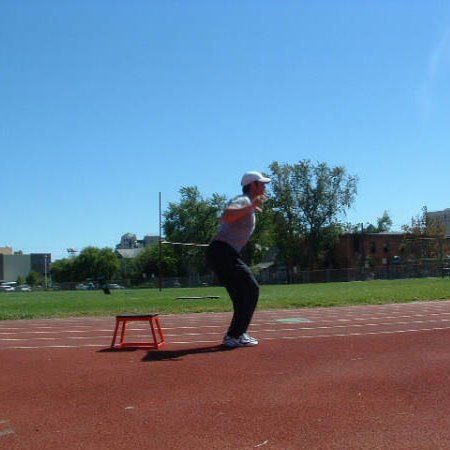
 Click Image To Enlarge.
Depth Jump.
Although it is uncertain if this jump actually improves vertical jumping potential/ability, it has shown to increase leg strength and power when done alone or with a weight training program. A definite must in any athlete seeking power.
| AUTHOR RECOMMENDED ARTICLE | ||
|

Endurance:
Just Keep On Truckin'!
-
This is the capacity to keep performing tasks involving the whole body for extended periods of time, where the energy is produced aerobically. This requires heart/lung efficiency in delivery oxygen to the working muscles, e.g. a long distance runner.
When looking at the chronic effects of long-term endurance training, you will notice cardiac hypertrophy, among other adaptations. In endurance athletes the size of the left ventricular cavity increases. These changes or adaptations occur as the athlete advances in training.
For endurance, the best way an athlete can improve is by consistently increasing the duration and intensity as they progress. This way the body will not adapt and has to keep working hard in order to meet the new training demands.
Agility:
-
Agility is defined as the ability to handle the body quickly and precisely and to change direction accurately while moving quickly. Agility relies on both flexibility and speed.
- Rugby: weaving, dodging
- Basketball: weaving whilst dribbling
- Netball: catching and passing on the run
- Tennis: net play
- The Illinois Agility Run
- Squat thrusts
Agility is vital in such sports as:
Agility can be developed through calisthenics or practices related to the sport being played, e.g. diving practice for volleyball.
Tests for agility include:
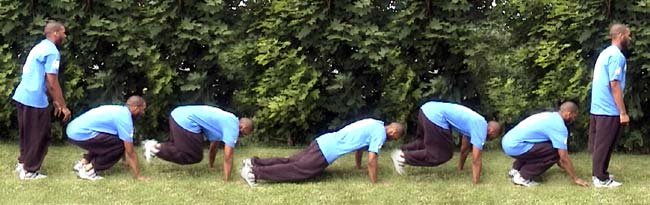 Click Image To Enlarge.
Squat Thrusts.
Windows Media (361 KB)
MPEG (1.8 MB)
- Modified Zeklenka tests
Agility Drills:
These are drills designed to make the athlete quickly and accurately change direction. It can be done by short shuttle runs, or obstacle runs around tires, cones or markers.
So, as you can see, the elements above are an important part of your athletic success. The sooner you understand them, and concentrate on each one of them individually and concisely, the better you will be for it!
2nd Place - Goheels
Building Athleticism
The big four in athletics are endurance, speed, agility and power.
- Endurance - The ability to maintain a set intensity over a long duration of time. This endurance could be either muscular or cardiovascular. An example of this is how well you run a marathon or how many reps of a set weight you can lift.
- Speed - The top speed the athlete can reach. We typically think of this as the 40-yard dash time.
- Agility - The ability to quickly get to top speed or change directions rapidly. Also influenced by power and control of that power. This is typically measured with dot drills
or shuttle runs.
- Power - The maximal ability of a muscle to contract to produce force. This could be measured with one rep maximums and can include things like vertical jump.
To attack any of these four key factors of athletic performance you need to follow these steps.
- Measure current maxes.
- Set long term, measurable goals.
- Set up intermittent goals.
- Plan a method of attack.
- Follow through with the plan.
- Halfway through your plan, assess your new maxes.
- Re-evaluate your plan and goals.
- Continue this process until you get to the desired results.
Measuring Maxes
To better judge how you need to improve you must first know where you are at. There are several ways to determine your maxes in each of these categories.
Endurance:
-
Can be measure with, VO2 max, anaerobic threshold, mile-time, number of pull-ups against body weight, number of dips against body weight,
sit-ups in one minute, resting heart rate, previous ending heart rates for the same intensity and duration in a particular exercise.
| VO2MAX CALCULATOR |
|
|
Speed:
-
Forty time, 100 time.
Agility:
-
Shuttle run time, dot drill time, reaction time, basketball suicides.
Power:
-
1 rep maxes in any lift but particularly squat,
power clean, deadlift, bench.
| 1 RM CALCULATOR |
Enter the amount of weight you can lift (in pounds) and the number of reps you can lift it for.
|
-
The key to seeing progress is to obtain values that can be quantified or have a significant value. By seeing where you are currently at you can start to build a program designed to help you meet your goals.
The Principles Of Improvement:
With the knowledge of these principles you can further see how you need to make your plan.
Principle Of Specificity:
-
The exercises and plans that you use should be specific to your sport for the most dramatic effect.
Principle Of Overload:
-
These exercises must be at intensities, frequencies, or durations that are higher than you are accustomed, to see improvement.
Principle Of Adaptation:
-
The body will adapt to previous exercises and make them easier for you to complete. This improves performance when this occurs.
Principle Of Progression:
-
The amount of load you place on your body must be increased gradually. If you increase too much you increase chance for injury, but if too little then you will not have enough stimuli for growth.
Principle Of Individual Response:
-
Each individual is different and what works best for one individual may be different than what works best for another individual.
Principle Of Tapering:
-
You must scale back work after an extended period of time to allow the body to recover fully to the new loads it has been accustomed too. Remember tendons and ligaments do not recover as fast as muscles and must adapt to these new stresses.
Principle Of Variation:
-
The body will eventually become so accustomed to the continuous stresses placed on it that it will adapt and may not change to increased load. You must vary your workouts to force the body to adapt to new scenarios.
Principle Of Reversibility & Detraining:
-
If you completely stop training you will lose some of the gains that you have made; however, the ability to return to previous levels of fitness is greater.
Principle Of Moderation:
-
It is important to do everything in moderation. Change in calories for food, workout durations and intensities, or anything else must be done in moderation to monitor the effects properly.
Now that you know some of these key principles of training let's look at the individual things you can do to improve each of these four aspects of training.
Ways To Improve Endurance
There are several methods to improve both cardiovascular and muscular endurance.
One of the best methods to improve cardiovascular endurance is to choose an exercise such as: biking, rowing, running, Stairmaster or versa climber to name a few.
Progress In The Following Manner:
- Begin with 3 x 30 minute sessions per week at a heart rate of 60% of maximal heart rate. (MHR = 220 - age).
- After two weeks of this, increase the workout to 40 minutes in length.
- After another two weeks, increase the workout length to 45 minutes.
- After two weeks of this workout, add one more session to a total of four at 40 minutes per session.
- Now that a stable base has been established we can start increasing the intensity. Two weeks after step four, during one session keep your heart rate at 70% of max.
- The week after this do two at 60% of MHR and two at 70% of MHR.
- Two weeks after this change the workouts back to 45 minutes each with 2 at 60% and two at 70%.
- After two weeks of this give yourself a break. Do two sessions this week at 45 minutes at 65% MHR.
- For the next week, do two 45 minutes workouts at 60%, one at 75%, and one 30 minute workout at 80%.
- Increase intensity and duration at desired amounts to achieve your goals.
| HEART RATE CALCULATOR |
-
I really suggest you buy a
heart rate monitor if you want to increase cardiovascular performance. It helps tremendously. So you might be asking why go at these specified percentages. First, heart rate will drop as your body adapts to these exercises. In return, you will have to go faster to keep your heart rate at the specified percentages of maximal heart rate.
 By training your cardiovascular system in this manner you allow your body to adjust gradually, and this in turn helps you from overexertion.
To improve muscular endurance I suggest a weight training regimen that consists of rep ranges of 12-20 and with rest between sets at 30 to 60 seconds. With this type of time and rep constraints improvement on muscular endurance is inevitable. You can increase the weights as you are able to perform more than the needed reps for the set you are doing.
I recommend you lift with an endurance style program for at least 8-to-10 weeks with three lifts per week to see great gains in this aspect. I suggest you do at least one major lift per body group but two for the quads during the week. You can alter reps and sets as you see fit to meet your goals.
| WHAT'S YOUR GOAL | ||
|

Ways To Improve Speed
Speed is difficult to improve. It has a large genetic component; however, with dedication and attention to the specifics of training it can be improved.
Some key ways to increase speed are to lose unnecessary body fat. Any weight you can get rid of that does not reduce your body's ability to produce maximal force for speed is a plus. This mainly means a decrease in fat.
| RELATED ARTICLE | ||
|

You might also think about establishing a program in which you run sets of sprints. These could be sets of 40-yard dashes, 100s, 200s or 400s. By altering the distance and number of sprints per session you will train your body to become faster. It is important to have set times that you have to meet each session to remind yourself of the speed you are trying to achieve. Eventually, your body will adapt to these set times and you will need to lower them.
Other ways to improve speed come from mechanical changes in the movement. For instance, sprinting speed is partly due to stride length and stride frequency. If you can develop ways to improve either of these mechanical factors you will improve your speed. This could include technique work from your coach and watching film of your running style to see what you could do better. This could be applied to any sport to improve performance. Technique has a lot to do with speed and don't forget it.
Also, you could get your body accustomed to going against a larger resistance to improve speed. This can be done either with weighted vests or with parachutes to get wind resistance. These are two great tools that should be incorporated into your training program to improve speed.
Another way to improve speed is to increase power, this will be discussed later.
Ways To Improve Agility
Reaction time is an important component of agility. If you're fast off the blocks in track or off the ball in football you're going to do better. A great way to do this is to set up reaction drills. Here, you need to be creative. Have your coach practice and time your reaction to sound.
Practice by having the coach blow a whistle to signify the start. By conditioning your mind and concentration to this you will be faster. Another drill is the QB pass drill in football. The defensive back looks at the quarterback and looks at his shoulder placement and reacts to it.
Have the coach change where he might throw the ball a couple of times and then have him throw it and let the DB react. You can do this in any sport and by being creative you give yourself an edge.
Another way to improve agility is to practice the techniques that might help you change direction. The proper way to make cuts in football or the proper way to plant your feet in tennis to change direction are important parts of agility. By creating drills that challenge yourself to change directions frequently can help you improve your overall agility.
One key exercise is to section off approximately 15 yards of distance and set up two cones at each end. For one minute run back and forth between these cones and count the number of times you touch them. Do this drill 10 times. Each subsequent week, try and touch these cones more times during this time period.
Ways To Improve Power/Strength
Power and strength are directly relational to the amount of muscle mass you have and the density of your muscle fibers. By including a resistance training regimen to your program you will greatly improve your power and strength capabilities.
For The Greatest Improvements In Maximal Power:
-
Three sets with rep ranges from 1-3 are recommended. This improves the neurological factors that influence maximal power such as firing rate of motor neurons and recruitment of muscle fibers.
For Gains In Muscular Mass That Would Facilitate Later Gains In Power:
-
Three sets with rep ranges from 6-10 are recommended. This improves the muscular density and mass which helps improve the ability to contract maximally.
I suggest at least four days of training per week for power and strength gain for a minimum of at least 10 weeks. You should perform at least 3 different exercises for big muscular groups and at least two different exercises for smaller muscular groups.
Conclusion
Remember, a plan of action is important for success in athletics. By using the ideas I have presented in this article you should be able to create a program that effectively enhances your athletic ability without completely overloading yourself.
Be sure to get adequate nutrition and rest for the absolutely best results you can achieve on any program. It is also important to assess your current status and re-address your goals as you go along. Now go out and improve yourself Mr./ Mrs./ Miss. Athlete.