
Ever wonder if some of the things you do on a daily basis could be making you gain fat?

Nine Sure-Fire Ways To Gain Fat
Some things you may already know but some of them may take you completely by surprise! [ 1. ] Eating then sleeping will make you gain fat.
- Did you know that sumo wrestlers eat then sleep on purpose to gain fat as quickly as possible? Your body doesn't require as many calories during sleep and calories that are eaten right before sleep have a far greater chance of being stored as fat. In fact, it's almost a certainty.
This goes for afternoon naps and also applies to late-night eating. If you eat and then immediately sleep on a regular basis, you will gain fat.
[ 2. ] Skipping meals or not eating for long periods of time will make you gain fat.
- But doesn't skipping meals (most notably
- ) save a lot of calories during the day? Sure, there's a chance that it may. But consider this - skipping meals will slow your
- and you'll get really hungry.
With a metabolism that's been slowed by not eating (particularly true of skipping breakfast), you're going to store a lot more of that food as fat. It doesn't matter if you're eating a hamburger and fries or if you're eating plain pasta and a chicken breast. Your metabolism will be sluggish and your body will want to store what you're eating rather than use it.
Eat as soon after you wake up as possible (never more than an hour) to kick-start your metabolism for the day. Even if it's just a small something you grab on the go, do it. It will get your metabolism going and ensure the food you eat later doesn't get preferentially stored as fat.
[ 3. ] Drinking soft drinks (even diet drinks) with fatty foods will make you gain fat.
- A sugary soft drink will result in a high insulin response. Insulin is a storage hormone - it helps the body store carbohydrates, proteins and fats.
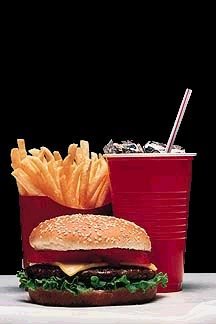
There is also evidence to suggest that the artifical sweeteners commonly found in diet drinks can cause an insulin reaction in the body. It's a simple reaction to the sweetness, not the carbs as there are no carbs in diet drinks. The body simply associates the taste of sweetness with the presence of carbs and assumes that carbs are present, increasing insulin levels in response.
What do you get when you have fatty foods in the presence of increased insulin levels? Simple. You get fat.
My advice is this: if you're going to eat fatty foods (we all do it at some point or other), drink water, not soft drinks or even diet soft drinks. Save the diet drinks for times when you're not eating fatty foods.
[ 4. ] Constant snacking on energy foods will make you gain fat.
- I'm all for frequent eating to boost the metabolism and snacking on healthy foods is definitely not a bad thing. That's not what I'm talking about here. I'm talking about giving your body a constant supply of food energy.
Consider this: if you give your body a constant supply of energy, it will not have a reason to dip into stored bodyfat for energy. You'll never dip into the battery on your laptop computer if you leave it plugged in. The body is no different.
A constant supply of outside energy means it won't have to use its own stored energy supplies. The result: you put on fat because the body doesn't need to burn any of it for energy.
[ 5. ] Stress without physical exertion will make you gain fat.
- The jury is not out on evolution. The human body evolved to deal with
- in certain ways. Before we became "civilized," stress was all about fight-or-flight. Stress was that you were about to be eaten by a lion so you'd better run!
In response, the body needed a mechanism for quick energy to be available and a system to help deal with shock and injury. It was all about survival.
The result? In stressful conditions, the body secretes cortisol - a hormone that immediately starts breaking down muscle tissue for fast energy (it also acts as an anti-inflammatory in case of injury; cortisone is a relative of cortisol).
These days, we very rarely have to worry about being eaten by pretty much anything. But the basic responses of the body can't distinguish between that stress and the stress of, say, your boss taking away your treasured red stapler that you love so much and moving your desk to the basement.
In the past, stress would be immediately followed by physical exertion. You'd run as fast as you could from the lion or you'd fight off what was attacking you. Now, there is rarely physical exertion following stress so the cortisol is not dissipated. It continues to break down muscle and promote fat storage.
This is why constant stress without regular exercise will make you gain fat.
[ 6. ] Toxic substances in your food will make you gain fat.
- Your body's reaction to a toxic substance is simple: protection. There are two primary ways the body does this. First, it tries to flush the toxins out. If that fails, it will try to lock the toxins away.
Think about it this way - what do nuclear power plants do with radioactive waste? They seal it in concrete and bury it. This is essentially the same thing your body does with toxins that you ingest. If it can't get rid of them, it seals them up in fat cells and locks them away.
Have you ever experienced headaches or other general ill feelings when you've gone on a diet? This is typical and is a result of previously stored toxins being released into the body again as you burn or release fat. You are, in essence, unsealing the toxins and flushing them out. This is one of the primary reasons it's critical to drink plenty of water when you're losing fat.
Minimize foods that contain toxins such as preservatives, pesticides (wash your fruit and vegetables thoroughly), antibiotics, and heavy metals (such as the mercury increasingly found in some species of fish). Your body will protect itself by holding onto fat to lock the toxins away.
[ 7. ] Losing muscle mass will make you gain fat.
- The engine of your metabolism is your muscle mass. This is where the majority of calories are burned in the body. If you go on a diet and you lose a lot of muscle, it is pretty much a guarantee you'll gain the weight back (and often more!) and make it harder to lose fat again.
If you don't protect your muscle mass, the more you diet, the fatter you'll get.
[ 8. ] Overconsumption of fructose will make you gain fat.
- Even though fructose is a sugar found in fruit and fruit juice, please, please, please don't take this point to mean that simply eating fruit is going to make you fat. It's not. Here's what I mean:
Your body stores carbohydrates in the form of glycogen in the muscles and in the liver. When your body needs energy, it breaks the glycogen down into sugar (glucose) for use in various bodily processes.
When your glycogen stores are full, extra carbohydrates will have a tendency to be stored as fat unless burned by activity. Fructose is more efficently converted into fat (more specifically, it's converted into the chemical backbone of triglycerides, which are fat molecules) than are other carbohydrates such as glucose. This makes it that much easier for excess fructose to be converted into fat.
While high fructose corn syrup is by far the main culprit when it comes to fructose and fat gain, even the fructose found in fruits and fruit juices can have this effect. Because fructose has "nicer" associations with it (being a fruit sugar) than other sugars such as sucrose (table sugar), a person may think they can drink all the juice they want and not run into the same trouble as if they drank the same amount of a sugary drink containing sucrose.
Fruit juices are essentially a concentrated source of fruit sugar and calories - as much as 150 calories or more per glass! Certainly, juice has more nutritional qualities to it than a soft drink but it is nevertheless important to realize that juice actually has a lot of calories and that the sugar it contains can easily be converted into fat.
What to do about it? Eating your fruit and drinking your fruit juice earlier in the day will greatly minimize any chance of spillover into fat stores. Also, take steps to minimize consumption of high fructose corn syrup, which is found in foods and drinks such as soft drinks and fruit beverages, cookies, gum, jams, jellies and baked goods. As always, read the labels!
[ 9. ] Drinking alcohol frequently will make you gain fat.
- Alcohol can make you fat in so many ways. Consider these points:
- Alcohol inhibits both the fat-burning enzymes and the muscle-building hormones in your body for many hours after consumption.
- Alcohol is normally consumed later in the day/evening, a time when your body has the least need for the extra calories.
- Alcohol is preferentially stored as fat and is very efficiently converted into fat in the body.
- Alcohol is not an intelligence-enhancing substance and can lead you to make poor late-night food choices, again, a time when your body needs the extra calories the least.
- Alcohol is a depressant that will eventually make you tired. Remember what Sumo wrestlers do to gain fat quickly? Take in a lot of calories then go directly to sleep.
- Alcohol contains a lot of calories (7 calories per gram) with very little, if any, redeeming nutritional value.
When you look at these points all together, imagine how quickly you'll gain fat if you drink a lot of alcohol late at night, eat fast food then go directly to sleep. There are few better ways to gain fat this quickly.
Conclusion
Keeping an eye on the above factors can help you keep your weight under control. Add exercise into the mix and that extra fat will be a thing of the past!