

What would you consider to be the perfect bodybuilding diet? If such a thing existed it would meet the following criteria:
- Allow you to build muscle without accumulating fat when bulking. You'd stay lean all year round.
- Allow you to lose fat without losing muscle when cutting.
- Induce an increase in serum anabolic hormones naturally (without supplements).
What would it mean to you and your bodybuilding goals if this diet was not something that only existed in fairytales, but was available to you right now!
You may have heard of this strategy before, but dismissed it. I advise you to keep an open mind and test it for yourself, many others including Hugo Rivera have tried it with amazing results.
Origins And Method
This diet did not originate with me of course. However, because of the massive impact it had on my results, I feel compelled to share it with as many people as possible. I would like to credit the following people for their wisdom before I go any further:
- Dr. Mauro Di Pasquale
- Anthony Colpo
- Gary Taubes
- Dr. Michael Eades
- Dr. Robert Atkins
- Dr. Jeff Volek
So what is this diet? It's a Cyclical Ketogenic Diet, or CKD for short. CKD basically means that you cycle periods of low carb, high protein, and high fat with periods of high carb, high protein, and low fat.
The majority of time you will be consuming a low carb diet, with a period set aside each week for carbing-up. This isn't for the fun of it; there are real scientific reasons for this, reasons with exciting implications for the bodybuilder.
Increasing Anabolic Hormones
A diet that maximizes serum levels of growth promoting hormones is a dream come true. Specifically we're talking about:
- Testosterone
- Growth Hormone
- IGF-1 (Insulin-like growth factor 1)
I'm sure that all sounds good to you. So how do you actually implement a Cyclical Ketogenic Diet?
For most of the time you will be consuming a high fat, high protein, low carb diet. This is interspersed with smaller periods of high carb, high protein, low fat nutrition. There are variations on the CKD but the standard (and my favorite) way is to implement it in the following way:
- 5-6 days of low carb.
- 1-2 days of high carb.
This gives a manageable and sociable weekly cycle where you carb up over the weekend and return to your low-carb diet during the week.

Please note: Depending on how intense you train, some people may find that their gym performance deteriorates towards the end of the low-carb phase. In this case, it is highly recommended that you implement a mid-week carb-spike to replenish your muscle glycogen stores by having another high-carb, high-protein, low-fat day on a Tuesday or Wednesday.
The Low-Carb Advantage
When you keep your carbs sufficiently low, you body switches to a fat metabolism; this is called the "Metabolic Switch". Switching from a carbohydrate to a fat metabolism has some real advantages for the bodybuilder:
- Increased Lipolysis (breakdown of fat)
- Decreased Lipogenesis (accumulation of body fat)
This metabolic switch usually takes around 3 days to take full effect. Synthesizing the correct enzymes in sufficient quantities to become a fat-burner takes a little time. This is why some new comers to low carb diets can feel foggy at the beginning.
Please do not confuse this short period for the whole diet; your energy will be back up in no time, and for some people, better than ever!
The Role Of Insulin
Some of you may have noted that I left out an important anabolic hormone in the above list—insulin.
What Does Insulin Do?
Insulin is a hormone with extensive effects on both metabolism and several other body systems (eg, vascular compliance). Insulin causes most of the body's cells to take up glucose from the blood (including liver, muscle, and fat tissue cells), storing it as glycogen in the liver and muscle, and stops use of fat as an energy source. When insulin is absent (or low), glucose is not taken up by most body cells and the body begins to use fat as an energy source (ie, transfer of lipids from adipose tissue to the liver for mobilization as an energy source). As its level is a central metabolic control mechanism, its status is also used as a control signal to other body systems (such as amino acid uptake by body cells). It has several other anabolic effects throughout the body.
So when does our body produce insulin? Insulin is secreted by our pancreas primarily in response to the carbohydrates in our diet. Since we are keeping carbs low, our insulin levels will also be low. Does this mean we miss out? Not at all.
This is where the carb-up period comes in. Once a week you should load up on carbs and let your insulin levels spike. Insulin will shuttle amino acids into the muscle tissue, but we also refill our depleted muscle glycogen stores during this time.
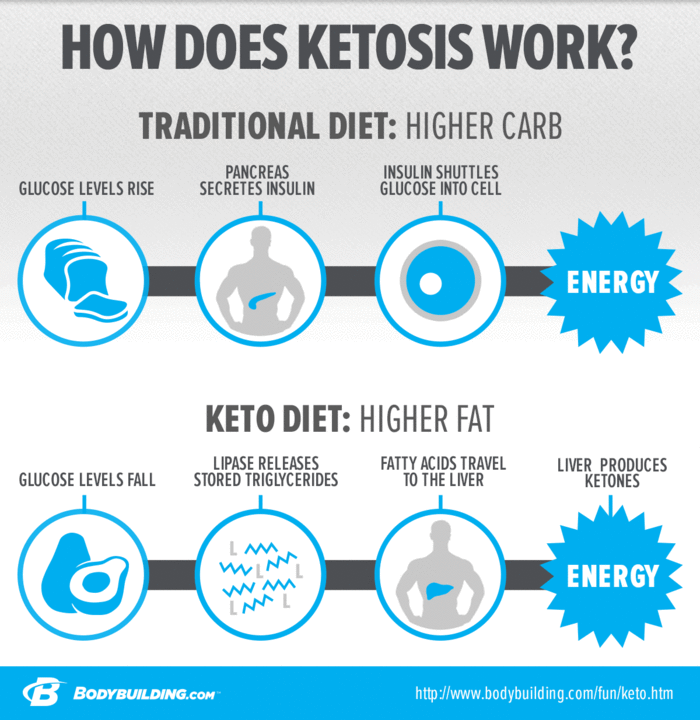
Our muscles are like tanks for glycogen. They fill up and empty again when we workout. Unfortunately when we eat too many carbs these tanks become satiated. Some glycogen is then stored in the liver and any excess is converted to triglyceride and stored as fat. This is where traditional high-carb diets can let us down. So why fill them at all?
Muscle glycogen means better performance in the gym. We load up on it and fill our tanks. By the end of our low-carb period we have once again emptied the tanks and we repeat the cycle over again.
Growth Hormone and Insulin
These two hormones have a strange relationship. It seems that when one is in abundance, the other is nowhere to be found. We therefore do not want chronically elevated insulin levels as:
- Our growth hormone production will be blunted
- We may overspill our glycogen tanks and start to lay down fat (lipogenesis)
Fat and Testosterone
Testosterone and dietary fat have a positive correlation; i.e. diets higher in fat and dietary cholesterol lead to higher concentrations of circulating testosterone.[1] We all know how important this hormone is to maximizing our lean muscle gains. You could be throwing away potential gains by consuming a low-fat diet, that goes for the ladies too.[2]
How Many Carbs Is Low-Carb?
In order to become a 'fat-burner', you should consume around 60 grams or less of net carbohydrate per day (total carbs minus fiber). However, in order to determine just how many carbs you personally should be consuming, a little trial and error is necessary.
The general rule is this:
Eat the smallest amount of carbs it takes to allow maximum output in the gym.
This will vary from person to person. Please bear in mind that fat will become your main source of energy and large quantities of carbs are unnecessary.
If you are unsure, try beginning at 30 grams and adjust as necessary.
What About Post-Workout Carbs?
Remember, our goal is to keep insulin low and growth hormone elevated for most of the week. Post-workout carbohydrates will therefore work against you here.
Apart from blunting growth hormone levels, carbohydrates may do nothing to increase protein synthesis in the post-workout period beyond that which protein can do by itself [3]. Take the following study for example:

The following study took place in the Netherlands, the subjects being healthy young men. The study split the men into 3 groups, each ingesting different combinations of protein and carbohydrates. Therefore the only variable was the level of carbohydrate.
Each group performed resistance training for 60 minutes and was given either protein or a combination of protein and carbohydrate each hour for 6 hours after training. The amount of protein for all the groups was 0.3g per kg of bodyweight. The protein and carbs varied as follows:
- Group 1—Just protein, no carbs
- Group 2—Protein with 0.15 g per kg of body weight of carbohydrate
- Group 3—Protein with 0.6 g per kg of body weight of carbohydrate
Protein synthesis rates were then measured for 6 hours after training. The results?
- The intake of protein after training increases protein synthesis.
- The addition of carbohydrate (whether in small or large amounts) to this protein did not further increase protein synthesis at all.
This is good news for those interested in or currently living a cyclical ketogenic lifestyle.
What To Eat
Any anabolic lifestyle is only as good as it is practical to actually live.
Perhaps you think a low-carb diet is too restrictive. Maybe you've even tried something like this before and failed because you felt that there wasn't a wide enough variety of food. This is understandable.
In order to experience the awesome benefits of this diet and also make it enjoyable, I am continually searching for recipes and concocting a few of my own. To show you just how tasty and easy it is to live this lifestyle here's a typical 1-day eating plan:
 Bacon
Bacon
 Eggs
(scrambled)
Eggs
(scrambled)
 Wrap
(low-carb wrap filled w/ Tuna, Mayo, Cheese)
Wrap
(low-carb wrap filled w/ Tuna, Mayo, Cheese)
 Salad
(Caesar)
Salad
(Caesar)
 Taco Salad
 Protein Shake
(Post-workout)
Protein Shake
(Post-workout)
 Protein Bar
Low Carb Concerns
When the light of science shines on the concerns some people have about low carb diets, they vanish without a trace.
Sluggish Gym performance
Once your body gets fully fat-adapted (3-14 days) this isn't a problem. Also, you fill you glycogen stores once or twice per week.

Once your body gets fully adapted sluggishness isn't a problem.
Saturated Fat and Cholesterol
Is a high fat/low-carb diet increasing your risk of cardiovascular disease? Not on your life! This belief is based on an unproven hypothesis from the 1950's. The surprising truth is that low carb/high-fat diets consistently outperform all others in improving lipid profiles. Typically, HDL (good) cholesterol rises, LDL (bad) cholesterol drops and triglycerides plummit, producing a much reduced risk of heart disease. [4,5]
Brain Fog
This does not happen to everyone though some experience it only in the initial 'metabolic switch' period. A fat metabolism requires different enzymes to function than a carbohydrate one. Synthesizing the correct enzymes in sufficient quantities to become a fat-burner takes a little time, stick it out.
Conclusion
So there's no reason to not give this a go. Prepare for some initial water weight loss at the beginning, you'll put it back on every carb-up phase.
This could be the step you've been waiting for. Take your game to the next level!
References
- Alteration of the Lipid Composition of Rat Testicular Plasma Membranes by Dietary (n-3) Fatty Acids Changes the Responsiveness of Leydig Cells and Testosterone Synthesis.
- Elena Sebokova, Manohar L. Garg, Antoni Wierzbicki, Alan B. R. Thomson* and M. Thomas Clandinin. Nutrition and Metabolism Research Group, Department of Foods & Nutrition. Department of Medicine, University of Alberta, Edmonton, Alberta, Canada T6G 2C2,
- Effect of low-fat diet on female sex hormone levels. Ingram DM, Bennett FC, Willcox D, de Klerk N. University Department of Surgery, Queen Elizabeth II Medical Centre, Nedlands, Western Australia. Am J Physiol Endocrinol Metab. 2007 Sep;293:E833-E842.
- Weight loss with a low-carbohydrate, Mediterranean, or low-fat diet. N Engl J Med 2008 Jul 17; 359:229.
- Krauss, Ronald, et al. Carbohydrate, Weight Loss, and Atherogenic Dyslipidemia. American Journal of Clinical Nutrition 2006 May;83(5):1025-31.