

 Why Is Weight Training Important?
The objective of Progressive Resistance Training or weight training is to build lean muscle on our bodies. Building lean muscle will boost metabolism and that is what we want to achieve.
In fact, you'll even start burning more calories even while you rest. I'll let you in on a little known secret:
You need lean muscle because that is where fat is burned!
And, the more lean muscle you have, the more fat you will burn. That is what we are trying to accomplish with weight training. In order to build lean muscle, we must get stronger every workout. Let me repeat ... in order to build lean muscle (and lean sexy muscle for you women), we must get stronger every workout. That is what we call progressive - striving to get just a little stronger each time.
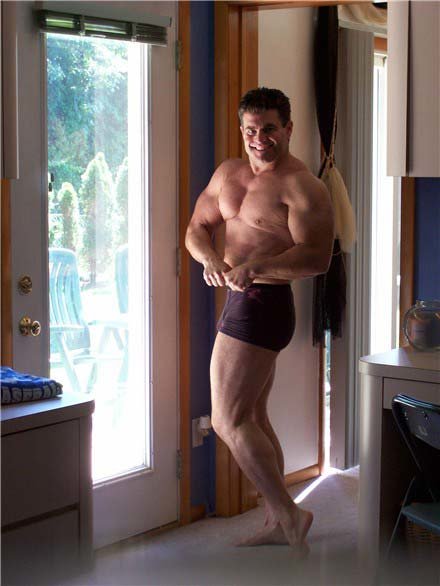
 Click To Enlarge.
 Striving To Get Just A Little Stronger Each Time.
Where Bare Minimum Training Comes In:
Weight train only twice per week with each session lasting about 20-to-30 minutes, or less! Most people think they must go to the gym and weight train five to six nights a week for 2-to-3 hours a night to get fit. This, in my view, is a misconception and is totally wrong thinking and is certainly not Bare Minimum.
In fact if you weight train on this type of a schedule you are putting yourself at a great risk of injury. The way I teach my clients to get fit is by going to the gym to weight train only twice per week with each session lasting about 20-to-30 minutes. This is generally followed by about 18-to-30 minutes of cardiovascular exercise (more on cardio in the next chapter). I know this works - my clients are proof of the Bare Minimum Training system!
You see, you are not actually trying to grow your muscles while you are in the gym. The objective is to give your muscles the right amount of "stimulus" to grow. This is accomplished within the first half hour of weight training. After that, if you don't have time to do cardio that night, your total session is over and you are free to do other things. After you leave the gym, your muscles grow and repair themselves while you're at rest or sleeping.
I don't know about you, but when I look around at the various gyms out there, I see over 95% of people spending way over 30 minutes on their weight training. Some even spend more than one or two hours on just weight training. That is because they fall into the trap that "more is better." That is definitely not true. You will do much more harm than good to your body if you over-train.
The result of overtraining is you break down your body, get sick a lot, feel tired most of the time and in general not feel like doing much of anything. Of course, if you under train you will not accomplish your goals. You have to find the right balance. Keep reading and I will tell you what the right balance is: Bare Minimum.
Most people think they must do the standard 3 sets of 10-15 repetitions on a multitude of exercises. Before you know it, over 2 hours went by. Why do the vast majority of people do this? Because they don't know any better plus most gyms like the floor full of people so it looks busy so more people join! Bottom line, gyms want to sell memberships and they are not going to tell you to come only twice per week for about 30 minutes. Come to think of it, once you paid for your membership they don't care if you show up at all! It's really all up to you!
Let's talk about multiple sets. You don't need them! That's right, they are a waste of your time! I'll give you an analogy. When you want to turn on the lights, what do you do? You go over to the light switch and turn the light switch on - once. You do not stand there and turn the switch on and off, on and off, on and off, over and over again do you? No, you don't. Why not? Because the light switch will eventually wear out and break. Well that is what you're doing with your body in the gym spending hours doing multiple sets. You are wearing out your body and getting poor results.
What you do need to do is keep track of your workouts and strive to get stronger each and every workout. Even if it is only one repetition stronger. Let's say on a Monday you bench-pressed 100 pounds for 8 repetitions. Well your goal for the next Monday is to bench-press that same 100 pounds for at least one more repetition. So you would lookup in your log book that the previous Monday you bench pressed 100 pounds for 8 reps, so one more rep would be 9 so your goal would be to get at least 9 reps for that exercise. However, don't stop at 9 reps for that exercise; if you can do more, get 10 or 11 or 12! Stop when you can't lift the weight anymore. (You will need someone to spot you.)
If you got more than 10 reps, it's time to increase the weight the next Monday. Increase the weight to at least 105 pounds on the bench press. If again you get more than 10 reps, you would then increase the weight the following Monday to at least 110 pounds or even 115 pounds or 120 pounds. You want to get between 6-10 reps each time. If you increased the weight and only got 4 reps, that's OK, you'll get 5 or 6 reps the next week. As long as you keep increasing your reps each week and you reach 10 or more reps in any exercise, you can increase the weight the next week.
This is an example of Progressive Resistance Training. It means getting stronger over time, progressively. You must get stronger every work out. Lifting the same weights over and over again and talking to your friend is not doing anything to change your body.
I'll give you another analogy. What if you had this block of wood with a nail sticking out and I told you that your main goal was to knock this nail through the wood. So you go over and get a hammer and start hammering the nail but the nail doesn't go through, so you keep on hammering over and over again, for an hour, two hours, 12 hours, one day, one week, one year, still hammering away but the nail is still sticking out of the wood.
So I come along and tell you to go over there and pick up that sledgehammer over in the corner. You do so and then even though it's difficult you raise this sledgehammer and whack that pain in the neck nail through that wood in ONE SHOT! The goal is accomplished with one blow compared to years of whacking away with that plain old little hammer. Well my friend, when you lift lightweights or stay with the exact same weights over and over again you are using that little old hammer. You need to increase your power to that of the powerful sledgehammer.
|
|
The example workouts I have included in this chapter, Workout A and Workout B, will illustrate what I have explained. But before you start please review my checklist:
BMT "Getting Started" Checklist:
- Weigh yourself initially and then hide the scale.
- Take some "before" pictures, then put them away.
- Get medical clearance from a physician.
- Hire a fitness professional for at least a month, if you have no experience.
- Keep track of your workouts in a logbook.
Finally, I ask that you provide some feedback. I would sure like to know if the Bare Minimum Training program works for you as well as it has for many of my clients. So please:
Let me know about your progress and successes via email. Send me your before and after pictures
Email to billbelfert@yahoo.com
| GET MORE FROM BODYBUILDING.COM! | |||||||||
|
|||||||||
Workout A - Chest, Back & Shoulders:
Chest:
- Incline Bench Press: 1 or 2 warm-up sets - then 1 set for 6-10 reps
- Chest Press (machine): 1 set for 6-10 reps
Back:
- Dead Lifts: 1 or 2 warm-up sets - then 1 set for 6-10 reps
- Bent Over Barbell Rows: 1 set for 6-10 reps
- Close Grip Lat Pull downs: 1 set for 6-10 reps
Shoulders:
- Dumbbell Shoulder Press: 1 or 2 warm-up sets - then 1 set for 6-10 reps
- Dumbbell Lateral Raises: 1 warm-up set - then 1 set for 6-10 reps
 Click Here For A Printable Log Of The BMT Workout A.
Workout B - Legs, Biceps, Triceps & Abs:
Legs:
- Squats: 1 or 2 warm-up sets - then 1 set for 6-10 reps
- Leg Extensions: 1 set for 6-10 reps
- Leg Curls: 1 set for 6-10 reps
- Standing Calf Raises: 1 or 2 warm-up sets - then 1 set for 6-10 reps
Biceps:
- Standing Barbell Curl: 1 or 2 warm-up sets - then 1 set for 6 - 10 reps
Triceps:
- Cable pushdowns: 1 or 2 warm-up sets - then 1 set for 6-10 reps
- Dips: 1 set until failure
Abs:
- Leg Raises: 1 set to failure
- Cable Crunches 1 set for 6-10 reps
Click Here For A Printable Log Of BMT Workout B.
That's it! Bare Minimum Training! What? You don't think this is enough? Remember the "light switch" we just want to turn the lights on, we don't want to wear out the switch. With your body, you just want to give it enough stimuli to grow strong and lean. That stimulus is lifting a weight to positive failure. Once you reach this point, that's it, go onto the next exercise in the workout. If you don't and continue to do multiple sets, you will just break down your body and your muscles will not grow - in fact you might even get smaller!
Training Exercises By Body Part:
Workouts A & B above are the basic workouts I suggest to start out with, but some people don't like or just can't do some of the exercises. So I'll give you what I think are the best exercises to choose from for each part of your body.

Chest Exercises:
- Incline barbell bench press
- Incline dumbbell bench press
- Flat barbell bench press
- Flat dumbbell bench press
- Incline bench press (machine)
- Chest press (machine)
|
|
Incline Barbell Bench Press.
Choose only two exercises for chest. Make sure you do one or two warm-up sets on the first exercise you choose then one main set for 6-10 reps. Then go to the next exercise with no warm-up. Check your workout logbook and find the weight you used the week before (e.g. Chest press (machine) 100 pounds x 9 reps) and go right to your main weight 100 pounds and get at least 10 reps or more. The following week, you will increase your weight.
Back Exercises:
- Dead lifts
- Bent over barbell rows
- Close grip lat pull-downs
- Low cable pulley rows
- Pull-ups
- One arm dumbbell row
- Two arm dumbbell rows
Choose only three exercises for back. Remember to do one or two warm-up sets on the first exercise only. You are already warm and can go right to your main weight on the second and third exercise.
Shoulder Exercises:
- Dumbbell shoulder press
- Barbell shoulder press
- Shoulder press machine
- Dumbbell side lateral raises
- Dumbbell front raises
- Upright rows
Choose only two exercises for shoulders. Do one or two warm-up sets on the first exercise then go to your main weight for the first exercise. Then do one or two warm up sets on the second exercise and go to your main set for the that second exercise.
Leg Exercises:
- Barbell squats
- Dumbbell squats
- Leg press
- Hack squats
- Leg extensions
- Lying leg curl
- Standing leg curl
- Seated leg curl
- Lunges
- Standing calf raises
- Seated calf raises
|
|
Dumbbell Squats.
Choose four exercises for legs.
1st exercise - you want to choose barbell squats, dumbbell squats, hack squats or leg press. (Choose one)
2nd exercise - Leg extensions
3rd exercise - choose between lying leg curl, standing leg curl, lunges or seated leg curl. (Choose one)
4th exercise - choose standing calf raises or seated calf raises.
Warm-ups are needed for the first exercise and fourth exercise.
Bicep Exercises:
- Standing barbell curl
- Standing e-z bar curl
- Standing dumbbell curl
- Seated dumbbell curl
Choose only one exercise. Perform one or two warm-up sets, then one main set.
Triceps Exercises:
- Cable pushdown
- Lying barbell or lying e-z bar extensions
- Dumbbell kickbacks
- Seated dumbbell triceps press
Choose one exercise for triceps. Do one or two warm-up sets then one main set to failure. Then perform one set of dips to failure.
Abs Exercises:
- Leg raises
- Cable crunches
- Regular crunches
- Crunches with legs involved
- Leg raises from a flat bench
- Bicycle crunch
Choose only two exercises. For cable crunches choose a weight and do between 6-10 reps. Increase weight once 10 reps are reached.
Example Training Regimen:
Here is an example of what your workout logbook might look like over two weeks time. Always rest at least one day before you do the next workout. Choose two days, for example, a Monday and Thursday or Tuesday and Friday, or a Monday and a Wednesday. You are only performing workouts A & B each once per week. Anymore than that and you will break down your body. Here is a special note - never do the same workouts A & B back to back.
First Week:
- Monday: Resistance Workout A
- Tuesday: Cardio - 18 minutes
- Wednesday: Cardio - 18 minutes
- Thursday: Resistance Workout B
- Friday: Cardio - 18 minutes
- Saturday: Rest
- Sunday: Rest
1st Week Resistance Workout A:
| Exercise | Set Type | Weight lbs. | Reps |
| Incline Bench Press | Warm Up | 100 | 10 |
| Incline Bench Press | Warm Up | 110 | 10 |
| Incline Bench Press | Main Set | 150 | 6- |
| Chest Press Machine | Main Set | 125 | 11^ |
| Dead Lifts | Warm Up | 145 | 10 |
| Dead Lifts | Warm Up | 185 | 10 |
| Dead lifts | Main Set | 225 | 8- |
| Bent Over Barbell Rows | Main Set | 185 | 10^ |
| Close Grip Lat Pulldowns | Main Set | 170 | 9- |
| Dumbbell Shoulder Press | Warm Up | 25 | 10 |
| Dumbbell Shoulder Press | Warm Up | 30 | 10 |
| Dumbbell Shoulder Press | Main Set | 35 | 7- |
| Dumbbell Side Lateral Raise | Warm Up | 20 | 10 |
| Dumbbell Side Lateral Raise | Main Set | 25 | 10^ |
Click Here For A Printable Log Of 1st Week Resistance Workout A.
1st Week Resistance Workout B
| Exercise | Set Type | Weight lbs. | Reps |
| Squats | Warm Up | 135 | 10 |
| Squats | Warm Up | 225 | 10 |
| Squats | Main Set | 285 | 9- |
| Leg Extensions | Main Set | 120 | 8- |
| Leg Curls | Main Set | 125 | 11^ |
| Standing Calf Raise | Warm Up | 100 | 10 |
| Standing Calf Raise | Main Set | 155 | 10^ |
| Standing Barbell Curl | Warm Up | 85 | 10 |
| Standing Barbell Curl | Warm Up | 95 | 10 |
| Standing Barbell Curl | Main Set | 100 | 8- |
| Cable Pushdowns | Warm Up | 30 | 10 |
| Cable Pushdown | Warm Up | 40 | 10 |
| Cable Pushdown | Main Set | 45 | 9- |
| **Dips | Main Set | Body weight | 4 |
| Leg Raises | Main Set | Body weight | To failure |
| Cable Crunches | Warm Up | 60 | 10 |
| Cable Crunches | Main Set | 100 | 4- |
Click Here For A Printable Log Of 1st Week Resistance Workout B.
Workout Schedule Legend:
- Stay at the same weight for next week
^ Go up in weight for the next week
** Add weight to your body (weight belt or hold a dumbbell between your legs) for added resistance once 10 reps are reached.
Second Week:
- Monday: Resistance Workout A
- Tuesday: Cardio - 18 minutes
- Wednesday: Cardio - 18 minutes
- Thursday: Resistance Workout B
- Friday: Cardio - 18 minutes
- Saturday: Rest
- Sunday: Rest
2nd Week Resistance Workout A:
| Exercise | Set Type | Weight lbs. | Reps |
| Incline Bench Press | Warm Up | 100 | 10 |
| Incline Bench Press | Warm Up | 110 | 10 |
| Incline Bench Press | Main Set | 150 | 8- |
| Chest Press Machine | Main Set | 130 | 8- |
| Dead Lifts | Warm Up | 145 | 10 |
| Dead Lifts | Warm Up | 185 | 10 |
| Dead lifts | Main Set | 225 | 9- |
| Bent Over Barbell Rows | Main Set | 190 | 7- |
| Close Grip Lat Pull Downs | Main Set | 170 | 12^ |
| Dumbbell Shoulder Press | Warm Up | 25 | 10 |
| Dumbbell Shoulder Press | Warm Up | 30 | 10 |
| Dumbbell Shoulder Press | Main Set | 35 | 10^ |
| Dumbbell Side Lateral Raise | Warm Up | 20 | 10 |
| Dumbbell Side Lateral Raise | Main Set | 30 | 7- |
Click Here For A Printable Log Of 2nd Week Resistance Workout A.
2nd Week Resistance Workout B:
| Exercise | Set Type | Weight lbs. | Reps |
| Squats | Warm Up | 135 | 10 |
| Squats | Warm Up | 225 | 10 |
| Squats | Main Set | 285 | 13^ |
| Leg Extensions | Main Set | 120 | 10^ |
| Leg Curls | Main Set | 130 | 8- |
| Standing Calf Raise | Warm Up | 100 | 10 |
| Standing Calf Raise | Main Set | 160 | 9- |
| Standing barbell Curl | Warm Up | 85 | 10 |
| Standing Barbell Curl | Warm Up | 95 | 10 |
| Standing barbell Curl | Main Set | 100 | 10^ |
| Cable Pushdowns | Warm Up | 30 | 10 |
| Cable Pushdown | Warm Up | 40 | 10 |
| Cable Pushdown | Main Set | 45 | 12^ |
| **Dips | Main Set | Body weight | 6 |
| Leg Raises | Main Set | Body weight | To failure |
| Cable Crunches | Warm Up | 60 | 10 |
| Cable Crunches | Main Set | 100 | 7- |
Click Here For A Printable Log Of 2nd Week Resistance Workout B.
Workout Schedule Legend:
- Stay at the same weight for next week
^ Go up in weight for the next week
** Add weight to your body (weight belt or hold a dumbbell between your legs) for added resistance once 10 reps are reached.
|
|
Leg Extension.
As shown in this example training schedule, you will have to use weights that are good for you - a weight which you can do between 6-10 reps. You can see that once you reach 10 or more reps on a main set, it is time to increase the weight on that exercise the next week. After 4 weeks or so, if you get bored with a particular exercise, or hit a plateau (you can't reach 10 or more reps) you can change the exercise.
As an example you can change incline barbell bench press to flat dumbbell bench press and do that new exercise for a few weeks until you again feel the need to change the routine. This is common, but fortunately, there are many different exercises to choose from to keep things fresh. That's it. The "magic" is getting progressively stronger on a consistent basis over time as well as training just enough - The Bare Minimum - to stimulate your body in the creation of lean muscle and burning fat.
Copyright © Bill Belfert, Managing Member Bare Minimum Training LLC. All rights reserved. No liability is assumed by Bare Minimum Training LLC., Nor the author for any information contained herein. This text does not provide medical advice. Specific medical advice should be obtained from a doctor. Bare Minimum Training LLC. advises all to consult a physician and gain medical clearance before you begin any new nutrition, exercise, or dietary supplement program. Results are not typical. Any application of the techniques, ideas and suggestions in this book is at the reader's sole discretion and risk.