

|
|
![]() By: Matt Weik
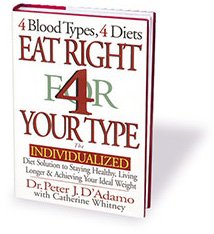
First things first... I need to make it clear that I am no expert about this topic. In fact, I am still learning as I go. A good friend and co-worker told me about this book that he was reading and it sparked my curiosity. This article is based on research found in the book "Eat Right 4 Your Type" written by Dr. Peter J. D'Adamo and my personal experience while testing out this unique diet. Some of you probably never heard of this diet, yet the book was published in 1996. This book has been named one of the top ten most influential health books ever written. Again, I stress that I am no expert on this topic and encourage you to look into and read the book to fully understand all the concepts mentioned in this article in depth.
We all heard of "The South Beach Diet", the "Atkins Diet", and just about every yo-yo diet that has been out over the past several years. Have they worked? I guess you can say yes to some of them. Has the weight stayed off? Most of the time no, because people don't stick with diets very long before cravings take the best of them and they jump ship faster than the Titanic going down. Were the fad diets over the past year healthy? NO! Look at the Atkins Diet... Who would have thought that eating such large quantities of protein and fat would help people lose weight? Well the truth is that it did work because you cut out pretty much every carbohydrate on the planet. Was it healthy? Heck no!
![]() Click Image To Enlarge.People Don't Stick With Diets Very Long Before Cravings Take The Best Of Them. Take a good look at all the fat consumption taking place in that particular diet. Now I am by no means saying that you should eliminate fat from your diet. We all need fat in our diet to help function and protect our organs. But think of all the meat they were suggesting you eat on a daily basis. Is there really a diet out there that can specifically work for you as an individual? We might have finally found it! Dr. Peter D'Adamo has been doing research on blood type, food, and disease for over 25 years. His father did extensive work in the field on this subject as well and Dr. Peter D'Adamo followed in his footsteps continuing to research the connection between all of these variables. Hence through all the research, his book was created.
After going through health class in school we all know there are 4 unique blood types (A, B, AB, O). Each one of these blood types has different characteristics. With that being said, I'm not going to bore you by breaking down each individual blood type. I'll let you do some research on your own if you want all the details... We can call it your homework. I urge you to read this book to fully understand the concepts behind this diet and the studies behind each blood type. I will briefly mention what D'Adamo categorized the blood types by.
I'm sure you are wondering what could possibly cause the differences between blood group diets and what the theory is behind it. A large part of D'Adamo's theory on this diet stems from lectins. Lectins are sugar and carbohydrate-binding proteins. They are found in both plants and animals. Lectins resemble antibodies and are what D'Adamo focuses on in his book. According to D'Adamo, these antibodies can be detrimental to ones health if present in a specific blood type diet. Lectins also have agglutinating properties which causes cells to clump together and could destroy the contents rather than allowing them to be utilized by the body. For instance, those who are blood type A are told to avoid dairy products because they act as a type B blood in the body - therefore the body thinks it is an intruder and wants to eliminate and destroy it.
![]() Click Image To Enlarge.Those Who Are Blood Type A Are Told To Avoid Dairy Products Because They Act As A Type B Blood In The Body.
Ok, enough with the background information and the boring history lecture. Hopefully that didn't put you to sleep... Wake up class! Let's get into the nitty-gritty on my personal reaction and experiences with this diet. Since I am blood type A, I am labeled to be a vegetarian. I am to stay away from all red meats and only eat chicken/turkey/fish/eggs occasionally. To be honest with you, when I read that I thought to myself, "there is no frickin' way". I love my steak and beef just as much as the next guy.
I thought there was no way I would be able to control myself and stay clear of meat products. As the days and weeks have gone by, I have found that monitoring the things I should avoid really wasn't as hard as I originally thought. Being that it recommends that I can eat poultry up to 3 times a week, seafood up to 4 times a week, eggs up to 3 times a week, I'm finding it not too difficult to follow these guidelines. Sure I have to check the list of "ok to eat" and "avoid" foods from time to time to ensure I stick to the diet, but it has been fairly easy. To me following this diet is no different from following a cut diet or simply cleaning up your diet to eat more healthy foods. So you are probably wondering how I reach my protein requirements if I can't eat meat and have to limit other types of protein. Besides having the proper quantity of chicken, turkey, fish, and eggs, I also get protein through cheese, nuts, seeds, soy products, and beans.
I started this journey so to speak with an open mind but I still had some doubt about its validity to produce results. My caloric intake stayed the same as it was when eating foods that were on the "avoid" list and my workouts and cardio are exactly the same. I wanted to keep everything the same and just change up my diet so I would have a good comparison to this new diet versus what I would consider my "normal" diet. To my surprise, after a couple weeks I had already lost body fat while having my weight stay the same.
To me weight is just a number and the focus on body fat is more of a concern compared to what we consider "weight". In my opinion, anyone who puts more focus on their weight compared to their body fat has no idea what they are doing. Let me put it into perspective for you. Take 2 guys, both having the same height and the same weight. Now one of them has 10% body fat while the other has 20% body fat. Who is going to look better at that weight and be healthier? The guy with 10% body fat obviously. Therefore it really comes down to body fat when all other factors are equal.
The results thus far have exceeded my expectations. Even though while reading the book and understanding the concepts, things made sense based on my food allergies growing up and how my body reacts to certain foods I eat to this day. For those of you who don't know my past allergies (most probably don't), as a child I was allergic to dairy and sugar. Yes, being a child and not being able to eat pizza, or ice cream or candy was horrible when all your friends were eating them.
Imagine going trick-or-treating on Halloween and then not being able to eat any of the candy you were given. Yeah, it sucked. I grew out of my allergies by the time I was 10. However, to this day I find that when I have dairy products (specifically milk) my stomach becomes upset. Luckily being allergic to sugar growing up I have never really taken a liking to candy and sugary foods, so I can say they are something to this day I avoid all together. In closing, there are many factors in this diet that can contribute to success. Not only does this diet help clean up your poor eating habits, but it also helps outline what someone would need to eat throughout the day to see results.
In my opinion, this is something that majority of people today lack anyway. Most people don't spend time planning out their diet and what they need to eat on a daily basis. Most people roam around and when they feel hungry they run to a vending machine or even worse to a fast food chain. It's for that reason that it is recommended that you don't go grocery shopping when you are hungry - you tend to buy things on impulse since you are hungry rather than getting exactly what you need nutritionally.
If people would spend just a minimal amount of time planning out their meals for the day they would find they make great progress and achieve their goals much quicker. When people are in a pinch they grab something that is fast, which is generally the worst thing for you.
Now I know there are a lot of skeptics out there on the diet. However, I believe that whole, natural foods are the way to go. With most things these days being processed and/or having all sorts of additives, you don't get the full benefit of eating healthy freshly prepared foods (again, most of the time it comes down to how much time someone has in the day). You can actually taste the difference from eating things fresh compared to eating something out of a can or container. For the skeptics I will say this, is this diet the best thing out there? Maybe... maybe not. But until you try the diet for yourself and see the changes it can make in your physique, you will only be on the outside looking in.
Don't knock something that you haven't tried. I feel the best I have in a long time. So can you. See for yourself and you might not just change your views, but also your body. Related Health Diets Articles: Resources:
Recommend this article to a friend by e-mail here!
Related Articles
|
|||||||||||||||||||||||||||||||||||||||||||||||||


Click Image To Enlarge.


