The Question:
Free weight and body weight exercises have their advantages, as do machines. Machines can be useful to achieve certain fitness goals.
What is the best all-machine workout? Be specific.
What are some advantages to using an all-machine workout?
What is your favorite machine exercise?
What are some of the differences between machines and free weights?
Cables vs. Machines: Which do you prefer? Why?
Show off your knowledge to the world!
The Winners:
1. RC26 View Profile
2. BurningHeart View Profile
3. bitterplacebo View Profile
3. TUnit View Profile
1st Place - RC26
Contact This Author Here.
Free weight and body weight exercises have their advantages, as do machines. Machines can be useful to achieve certain fitness goals.
Machines are the safest muscle builders ever created, and in some cases, they serve as the best means of isolating certain muscles.
This article is targeted to those looking to build muscle and lose fat with the exclusive use of machines. Detailed explanations of the most effective machines are included, along with the best all-machine workout.
Workout:
What Is The Best All-Machine Workout? Be Specific.
Stack Machines:
Stack machines have been around for decades and for good reason, they work. What separates this type of machine from others is its quick weight acclimation design. When looking to change the amount of weight lifted, all that needs to be done is an upward or downward change of pin position.
Below are detailed explanations of the most effective stack machines.
Incline Press Building massive upper pectorals is a difficult task for many, and this machine was designed to help those individuals break through that plateau and blast their pectorals.
Vertical Press Tearing a pectoral muscle is becoming more common among bodybuilders with exercises such as the barbell bench press. This machine eliminates that risk and serves as a great chest builder.
Pec/Rear Delt Fly Those individuals looking for maximal isolation and stretch in their pectorals and rear delts need to consider using this machine. Reps in the 12-to-15 range provide best results.
Lat Pulldown A safe and effective way to train the latissimus dorsi muscles is with this machine. Finally, you can attain that V-Taper you've dreamt of.
Seated Overhead Press Performing heavy barbell shoulder presses without a spotter can be risky on your rotator cuff muscles. Well, this machine eliminates problems like these and serves as an efficient deltoid exercise.
Seated Lateral Raise Everyone knows that strict form provides best results, and with this machine, you can exclude using momentum and focus on isolating the side delts.
Preacher Curl Isolating the bicep muscles, especially the long head, has never been so simple. This machine eliminates the cheating since your elbows are positioned on a pad.
Triceps Extensions This machine is designed to build and separate the triceps lateral, long and medial heads simultaneously.
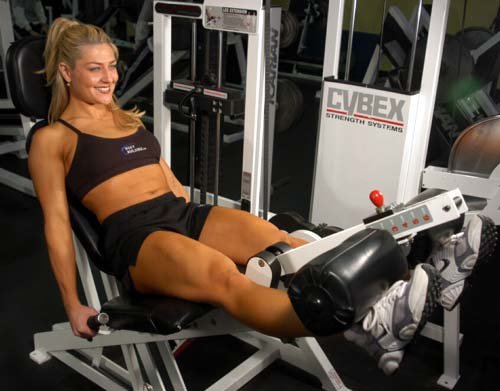
Leg Extension If you lack separation between the quadriceps, then you need to utilize this machine. Reps in the 15-to-30 range provide best results.
Leg Press This machine builds mass in the quadriceps and takes pressure off the spinal erectors of the lower back.
Lying Leg Curl This machine is arguably the best hamstrings builder and provides a great pump when performed for 15-to-20 reps.
Seated Leg Curl Build your hamstrings without the risk of injury with this machine. Changing foot positions shifts the work from the biceps femoris to the semimembranosous and semitendinosus.
Seated Calf Toe Press This machine builds and defines the calf muscles, which consist of the gastrocnemius and the soleus.
Abdominal Crunch Thanks to this machine, building 6-pack abs has never been so simple, all the while increasing core strength.
Lower Back Extension Most people overlook lower back training, then they complain about lower back pain and lack of core strength. This machine is easy to use and builds the spinal erectors of the lower back.
Plate Loaded Machines:
Many bodybuilders prefer lifting plates and putting them on machines, as it provides extra strength and muscle. Plate loaded machines are effective and highly recommended for beginners.
Below are detailed explanations of the most effective plate loaded machines.
Incline Press This machine is an exact replica of the regular incline press, except the exclusion of a barbell, an inclusion of handles and a decrease in injury.
Vertical Press This machine targets the middle and lower pectorals, which are the most massive areas of the chest muscles.
Lat Pulldown Build your upper and lower latissimus dorsi muscle through this machine. At the end of the movement when you squeeze your shoulder blades together, your rhomboids and trapezius muscles are also involved.
Compound Row This machine builds the latissimus dorsi, teres major and trapezius muscles. Unlike barbell rows, the chances of injury are low.
Deadlift/Shrug To cap off you V-Taper, you need massive traps, which are heavily involved in this machine exercise.
Biceps Curl This machine is excellent for beginner and advanced bodybuilders, as it provides a full range of motion and superb isolation to both biceps heads.
Triceps Extensions This machine provides independent arm movement which is a vital for balance and symmetry between the triceps muscles.
Leg Extension This machine should be used first in your quadriceps workouts, as it will warm-up all four quad muscles.
Incline Leg Press This is the real quadriceps mass builder, and it's recommended you use maximum weight to stimulate maximum growth.
Lying Leg Curl This machine isolates the hamstrings and provides a full contraction. Reps in the 15-to-20 range provide best results.
Seated Calf Raise Since calf training usually consists of machine only exercises, you can rest assured that all bodybuilders use this machine. Since this is a bent leg exercise, most of the tension is placed on the soleus, although the gastrocnemius is also involved.
Smith Machine This popular machine is found in nearly every gym, and can provide a full body workout. You can literally perform every major exercise on this machine, from bench presses to squats.
Smith Machine Exercise Descriptions:
- Smith Machine Incline Bench Press
- Smith Machine Bench Press
- Smith Machine Close-Grip Bench Press
- Smith Machine Bent-Over Row
- Smith Machine Shoulder Press
- Smith Machine Behind The Neck Shoulder Press
- Smith Machine Shrug
- Smith Machine Upright Row
- Smith Machine Squat
- Smith Machine Stiff-Legged Deadlift
- Smith Machine Reverse Calf Raise
Home Gym Machines:
Many people don't own gym memberships, yet they still desire to train. Well, thanks to companies like Powertec, these people can own their own home gym. These machines provide an effective full body workout.
Cardio Machines:
Not everyone is looking to build muscle, as most of the population desires losing fat. Cardio sheds away excess fat while minimizing muscle burning.
Treadmill The most popular type of cardio is running on a treadmill. Every gym has treadmills, and most of the time, each one is being used by an individual.
TreadClimber Many people prefer walking over running, which is why this revolutionary machine was created. This machine is both fun and effective for maximal fat loss.
Elliptical This machine was designed for those who experience foot pain from running and/or walking. The foot pedals track the natural movement of the foot throughout the entire range of motion, which tends to be comfortable.
Stairmaster There has never been an easier way to train your cardiovascular system than with a Stairmaster machine, which duplicates walking up stairs.
Exercise Bike This form of cardio is a great intensity booster and tends to be a fun activity. This can also be used pre-workout as a warm-up.
Exercises:
The goal here is to choose 2-to-3 exercises per muscle group, depending on size. If you choose to create your own workout or tweak the one below, then you will need to follow these guidelines.
- Chest- 3 exercises (1 for upper pecs, 1 for middle/lower pecs, 1 for overall pecs)
- Back- 3 exercises (2 for lat width, 1 for lat thickness)
- Shoulders- 3 exercises (1 for each deltoid head- front, side and rear)
- Quadriceps- 3 exercises (1 isolation, 2 compounds)
- Hamstrings- 3 exercises
- Biceps- 2 exercises
- Triceps- 2 exercises
- Calves- 2 exercises
- Traps- 2 exercises
- Abdominals- 1 exercise
- Lower Back- 1 exercise
- Neck- 1 exercise
The machines listed in the first section will be used, however, I have given you the option of choosing between stack and plate loaded machines.
Sets:
3 sets per exercise will be sufficient for muscle growth, but I recommend you begin each exercise with a warm-up set consisting of 15-to-30 reps. The warm-up set highly determines the muscle pump you obtain, since it gets blood flowing to the targeted muscle.
Reps:
The first set for upper body muscles consists of 12 reps, and each set's reps thereafter gets reduced by 4. For lower body muscles, begin with 15 reps, then go down to 12 reps, and end with 8 reps. The reason lower body muscles include a higher amount of reps is they're bigger, stronger and more enduring.
Core and neck muscles are also trained with different rep ranges. Abs are trained with 25 reps, while lower back and neck muscles are trained with 15 reps.
Rest:
In between sets, it's imperative you get adequate rest to restore muscle strength. 60-to-90 seconds will suffice, and this excludes the warm-up set. Rest 30 to 60 seconds following the warm-up set, which should never be performed to failure.
The Best All-Machine Workout
The Split:
- Monday- Chest, Biceps
- Tuesday- Back
- Wednesday- Rest Day
- Thursday- Legs
- Friday- Traps, Abs, Neck
- Saturday- Shoulders, Triceps
- Sunday- Rest Day
Monday - Chest, Biceps:
- Incline Press Machine
- Smith Machine Flat Bench Press
- Pec Fly Machine
- Bicep Curl Machine
- Preacher Curl Machine
3 sets of 12, 8, 6, reps with 60-90 second rest inbetween
Click Here For A Printable Log Of Monday.
Tuesday - Back:
- Lat Pulldown
- Smith Machine Bent Over Row
- Compound Row Machine
- Lower Back Extension Machine*
3 sets of 12, 8, 6, reps with 60-90 second rest inbetween *15 reps
Click Here For A Printable Log Of Tuesday.
Wednesday - Rest Day:
Thursday - Legs:
- Smith Machine Stiff-Legged Deadlift
- Seated Leg Curl
- Lying Leg Curl
- Leg Extension
- Incline Leg Press
- Smith Machine Squat
3 sets of 12, 8, 6, reps with 60-90 second rest inbetween
Click Here For A Printable Log Of Thursday.
Friday - Traps, Abs, Neck:
- Smith Machine Upright Row
- Deadlift/Shrug Machine
- Machine Crunch
- 4-Way Neck Machine
3 sets of 12, 8, 6, reps with 60-90 second rest inbetween
Click Here For A Printable Log Of Friday.
Saturday - Shoulders, Triceps:
- Smith Machine Shoulder Press
- Seated Machine Lateral Raise
- Rear Delt Fly Machine
- Close-Grip Bench Press
- Triceps Extension Machine
Click Here For A Printable Log Of Saturday.
Sunday - Rest Day.
Notes:
Perform all exercises at a moderate pace and concentrate on the target muscle. Since you are only using machines, you won't have to worry about using correct form.
When performing chest exercises, stick your chest out, squeeze your shoulder blades together and squeeze your chest on each rep. You can make 50 pounds feel heavy if you contract your pecs on each rep and go through the full range of motion, so don't limit yourself.
When performing back exercises, try to use your arms as hooks and pull with your back. Too many people use their biceps and forearms more than their back, then complain about not having a V-Taper. I recommend you buy straps and use them, as they help your grip and decrease biceps and forearms involvement.
When performing smith machine squats, go through the full range of motion and you can even pause for a couple of seconds on the bottom part of the movement. There is no point in using heavy weight and going through quarter movements, unless you plan to get hurt.
I recommend you warm-up and stretch for 5-to-10 minutes as part of your pre-workout routine. That way your muscles will be filled with blood and ready to go. I also recommend you attain proper post-workout recovery techniques to decrease muscle soreness and speed up recovery. Contrast baths and massages will convene your necessities. Lastly, try to incorporate intensity techniques such as supersets, drop sets and forced reps, as they will assist your overall progress.
Cardio:
On Tuesdays and Fridays, perform cardio for 30-to-60 minutes on any of the cardio machines that were listed in the first section of this article.
Don't neglect cardio, since it train your cardiovascular system, increases aerobic endurance, and decreases fat. Cardio also benefits your workouts, since it improves blood flow and increases muscle pumps.
Diet:
Your diet is arguably the most critical factor that determines both performance and results, which is why I chose to include this section. Follow the guidelines below and create a diet according to your goals.
Each day, you should eat small meals every two to hours, and drink plenty of water throughout the day. Eat 1-to-2 grams of protein and 2-to-4 grams of carbs per pound of bodyweight. Minimize fat intake to 75-to-150 grams per day.
Consume natural foods such as lean red meat and fish, while also supplementing with whey protein, casein protein, and a multivitamin/multimineral.
Rest/Recovery:
As you can see in the workout split, there are two off days that you need to take advantage of. Avoid any sport activities and sleep at least eight hours each day. Follow these guidelines and your muscles will grow constantly. Remember, consistency is key, and this includes your workouts, diet and rest.
Advantages:
What Are Some Advantages To Using An All-Machine Workout?
- Complete Isolation Unlike most free weight exercises, machines provide complete isolation in almost each exercise. Some machine exercises even have a longer range of motion than free weights, which is better for muscle growth.
- Correct Form Machines force you to use correct form in all exercises, which is necessary for maximal muscle growth. It can take weeks for an individual to learn correct form with free weights, but machines eliminate that problem.
- Decreased Risk Of Injury If there was one reason to choose machines over free weights, it has to be because of the reduced risk of injury. Machines move along a certain plane which you can easily control, while free weights can move in any direction and lead to a muscle tear or a severe injury.
- No Need For A Spotter When you reach failure on a machine, all you need to do is let go of the handles, so there's no need for a spotter. On the other hand, unless you have a spotter when using free weights, you run the risk of dropping the weights on yourself and getting injured.
- Quicker Workouts Unless you choose to train with plate loaded machines, your workouts will be quicker since you won't be moving plates on and off the machines. This can decrease your chances of overtraining and you will have more time to enjoy other aspects of your life.
What Is Your Favorite Machine Exercise?
My favorite machine exercise is the rear delt fly, because it has helped me build my lagging rear deltoid muscle. My front and side delts were overpowering my rear delts, and this exercise resolved the problem.
I prefer using a grip where my palms face away from one another, as it helps further isolate my rear delts. I use a full range of motion while squeezing my shoulder blades together on each rep, to involve additional muscles such as the traps and rhomboids.
Another reason I like this exercise is that it helped me improve my posture, since my chest muscles were pulling my shoulders forward and my back/traps/rear delt group wasn't balanced. Eventually this problem was corrected and as of this day, I still include this exercise on each shoulder workout to maintain good posture and balanced delts.
Differences:
What Are Some Of The Differences Between Machines and Free Weights?
Although machines are very effective, free weights are the best in terms of building both muscle and strength. Ask any bodybuilder, and they will agree that free weights rule the world of bodybuilding. Machines are truly revolutionary, but one can't solely rely on them year round if they expect to look like a pro bodybuilder. With that said, let us begin the comparisons, and find out which is better.
Below are ten differences between the two.
- Machines are safer and provide better isolation, while free weights run a greater risk of injury.
- Machines are easy to use, while free weights can take weeks to get used to.
- Stacked machines provide quick workouts, while free weights need to be racked.
- Plate loaded machines are almost the same as free weights except safer.
- Machines provide complete leg workouts while free weights have limited leg exercises.
- Free weights build more mass than machines.
- Free weights build more strength than machines.
- More exercises can be performed on free weights than machines.
- Free weights last longer than machines.
- Free weights cost less than machines.
As you can see, both free weights and machines have positives and negatives, so combining both is best.
Cables vs. Machines:
Which Do You Prefer? Why?
I prefer a mix of cables and machines, because each has its own benefits. I use cables to fully shape a muscle, and machines to fully isolate a muscle. However, if I had to only choose one, I would choose machines, because I can perform a full body workout with machines. Cables can't provide good leg workouts, which is a major disadvantage.
Although most of my workouts consist of free weights, I use machines on leg workouts because I can't efficiently train my quadriceps and hamstrings without exercises like leg extensions and leg curls.
Well, you've know learned everything about machines, including the best all-machine workout and the benefits of machines. Try the workout or at least include some machine exercises, and hopefully it will help you reach your goals.
I hope you enjoyed reading this article and good luck!
References:
- www.bodybuilding.com/fun/freeormachine.htm
- www.bodybuilding.com/fun/ronharris5.htm
- www.bodybuilding.com/fun/trainingstation3.htm
- www.bodybuilding.com/fun/bbinfo.php?page=MachinesVsFreeWeights
- www.nautilus.com
2nd Place - BurningHeart
What is the Best All-Machine Workout?
Contact This Author Here.
Free weight and body weight exercises have their advantages, as do machines. Machines can be useful to achieve certain fitness goals.
Machines have been growing in popularity in workout routines as an addition or even a replacement for free weights. Some people new to bodybuilding incorporate machines in their workout because they look more like "beginner equipment" more so than free weights.
Others feel safer with using machines than free weights because they are not holding the actual weight themselves. Then there are those that use machines because the exercises are already apparent on the machines, they do not know how to use free weights. Finally there are people that see and know the advantages of machines, and that is why they use them.
For whatever reason people use machines, they do have their advantages, and knowing these advantages will further your weightlifting progress and help to enhance your routines.
Part 1:
What Is The Best All-Machine Workout? Be Specific.
The best all-machine workout would be a one that targets every body part and works it with maximum exertion. The muscles that are practical to work only on machines are listed below:
- Traps (Trapezius)
Shoulders (Deltoids) Front (Anterior) Side (Lateral) Back (Posterior)
Chest (Pectoralis) Front Chest (Pectoralis Major)
Upper Front Chest (Pectoralis Major, Clavicular)
Front Chest (Pectoralis Major, Sternal) Side Chest (Pectoralis Minor)
Arms Triceps (Triceps Brachii) Biceps (Biceps Brachii)
Abs (Rectus Abdominis)
Back Side Back, Lats (Latissimus Dorsi) Middle Back (Rhomboids)
Legs Quads (Quadriceps) Hamstrings (Biceps Femoris) Calves (Gastrocnemius)
Now we take these muscles and put them in a weekly routine, in an easy to read table.
Day Of The Week:
Day 1
- Abs
- Shoulders
- Traps
Day 2
- Arms
- Legs
Day 3
- Back
- Chest
Day 1:
- Ab Crunch Machine*
- Machine Military Press
- Machine Lateral Raise
- Machine Rear Delt Row
- Machine Shrugs
3 sets, 12 reps *15 reps
Click Here For A Printable Log Of Day 1.
Day 2:
- Seated Leg Press
- Lying Leg Curl
- Seated Calf Raise
- Machine Preacher Curls
- Dip Machine
Click Here For A Printable Log Of Day 2.
Day 3:
- Seated Machine Row
- Machine Pulldowns
- Incline Machine Bench Press
- Machine Bench Press
- Butterfly Machine
Click Here For A Printable Log Of Day 3.
Schedule:
For maximum rest and recovery the routine should look like this:
- Day 1...
- Off...
- Day 2...
- Off...
- Day 3...
- Off...
- Repeat.
For maximum muscle growth the routine should look like this (only for those who are mostly inactive during the day and get top nutrition):
Day 1...
Day 2...
Off...
Day 3...
Day 1...
Off...
Off...
Warm-Up:
A set of warm-up exercises should be done with any exercise where weight is used in order to stretch the muscles and increase blood flow to them, thus preventing injuries. A warm-up set should be half of the set's weight, done for 12 reps. Stretching should be done only after workouts to keep your muscles from contracting over time due to the workout, thus decreasing their flexibility.
Weight:
The amount of weight used on a set should be the highest amount of weight possible while doing the recommended amount of reps. You should always try to increase the weight when working out in order to make the most progress in muscle growth.
Time Length:
The total workout time should not last for more than an hour. Working out over an hour is believed to be disadvantageous to your muscles, causing them to enter a catabolic or muscle eating state. The rest time between sets should be 1 minute, and between exercises 3 minutes.
Nutrition:
As with any routine, the proper nutrition is required to feed your body the nutrients it needs to properly repair itself and build muscle after a workout.
Creatine is a widely popular and recommended supplement to take, along with a post workout protein shake. Multivitamins are also strongly recommended to replenish your body with needed vitamins and minerals that you may not get enough or any at all during the day.
Fat:
Healthy fats are required in a bodybuilding diet because they aid in maintaining healthy hair and skin, promoting healthy cell function, function in energy storage and vitamins A, D, E, and K can only be digested and used by the body in the combination with fats. Healthy fats include such foods as olive oil, flax seeds and nuts. Fats should equal 20-25% of your total caloric intake.
Protein:
At least 1 gram of protein per pound of bodyweight is recommended for a weightlifting routine, protein aids in the building and repairing of your muscles. Healthy forms of protein include fish, lean red meat, poultry, protein shakes, eggs and skim milk. Protein should equal 35-40% of your total caloric intake.
Carbohydrates:
Carbs aid in the immediate usage of energy. Carbs require less water to digest than fat and proteins; therefore they are the most commonly used energy source in the body. Healthy forms of carbohydrates would be foods such as wheat bread, brown rice, oatmeal and nuts. Carbohydrates should equal 40-45% of your total caloric intake.
Calories:
Total calories can be roughly calculated by multiplying your body weight times 15. Then consider these factors:
If Bulking - Consume 6-8 balanced meals with a total of 800 excess calories. If Cutting - Consume 6 balanced meals with a total deficit of 500 calories.
Sleep:
The right amount of sleep is also needed, 7-8 straight hours is required to repair your muscles adequately and for your CNS (Central Nervous System) to recover. If you have problems sleeping try taking ZMA or Melatonin before bed.
Also avoid drinking anything two hours before you go to sleep, use the bathroom right before bedtime, cut out all lights in the room, loosen and relieve any pressure you may have on your bladder before bed, do not take a nap in the day and relax yourself, as to not worry about any days' events.
Part 2:
What Are Some Advantages To Using An All-Machine Workout?
Provides the widest range of exercises out of free weights, bodyweight and cables. There are machines for every exercise you need.
With free weights, you are limited to only doing exercises that is natural for your body to support and additional racks (power, squat racks) are required to hold the weight and place it on when done with the exercise.
Example: Incline Presses can only be done with free weights unless you have a special rack that holds the weight at the right level along with an adjustable bench.
While using your bodyweight, you are limited to the exercises by how you can position your body, and also are limited to using only your bodyweight for the exercises.
Example: There is no way to use bodyweight to build your traps. You also are limited to only your bodyweight for exercises such as push-ups, squats, pull-ups and dips, exercises that can require more weight over time.
Cables are a close 2nd to machines' versatility; however they often are harder to find in gyms than machines. Also cables, while providing some range of motion assistance, do not match the total set range of motion of machines.
Example: A beginner who does not know much about the good range of motion for cable flyes will often not use the correct range of motion with them, and incorporate more shoulder, back and arm work than chest. A machine sets a certain motion when doing the exercise, thus eliminating any issues with an incorrect range of motion.
Eliminates the need for a spotter which is great for the people who do not have a workout partner. The machine holds the weight for you, so you cannot drop it on yourself or worry about balancing the bar; thus allowing you to use more weight than you would with free weights.
Example: You come into the gym to do bench press; you set up the machine and start a set. You go for your last rep but the weight is too heavy, you can get it up all the way. Since you are on a machine, you simply let the bar go and you're fine.
Speeds up the workouts because there is no need to remove and add heavy plates every time you want to change the weight.
All of the weight is on the machine already, and it is changeable with the simple moving of a pin.
Example: It's time for your pyramid bench press sets. With free weights you'd have to first find the plates you need and bring them to the barbell. After every set you'd have to get another plate and add it on, and then when you are done you have to unstack all of the weights and put them back. With a machine you just move a pin after every set.
Puts your body in a natural position which can prevent injury.
Often to achieve the same workout on free weights or cables you must place yourself in an unnatural position during an exercise.
Example: You proceed to work your posterior deltoids. With free weights you would have to lay face down on a bench and raise dumbbells up and down to work those muscles, and even that awkward position forces you to you a lot less weight than you could do with a machine, which doesn't place you in an odd position for the exercise.
Example #2: Or instead you would have to carry a heavy dumbbell to a bench and proceed to do bent over rows with that dumbbell, something that puts unnecessary strain on your lower back and isn't ideal for people with past back problems. With a rowing machine however, there would be little to no strain on your lower back when doing this exercise.
Part 3:
What Is Your Favorite Machine Exercise?
I feel that triceps are often some of the most worked muscles yet the least efficiently hit out of all the muscles. What I mean by this is everyone wants big arms, so they will do many tricep exercises such as pushdowns, extensions, skull crushers, kickbacks and such.
And in my opinion at least, I did not see or feel a great improvement from those exercises. My elbows would hurt more than I'd feel my triceps in some of those exercises. Hence my triceps were lagging way behind, and I needed a change.
So I researched and made a change, and now my favorite machine exercise by far is the smith machine close-grip bench press (SM-CGBP). I discovered this exercise about a year ago, and I can't believe I've gone so long without it. After 3 sets of SM-CGBP, I actually feel satisfied with the work I've done with my triceps. I've seen a great improvement with adding these in my routine, my triceps now are actually 2/3 of my arm, instead of 1/2 like they used to be.
The advantage of doing close-grip bench on the Smith machine is the ability to use a no thumb grip and not having to worry about not being able to rack the weight if it gets too heavy. Using no thumbs on this exercise allows you to move your elbows closer inward, which stimulates more tricep movement and less shoulders and chest.
Another benefit from doing SM-CGBP is it is one of the best tricep exercises in terms of elbow comfort. While many tricep exercises are killer on your elbows, your elbows do not hurt and feel like you are injuring them when doing SM-CGBP, which is a plus for everyone.
Also with the Smith machine, there is no need to balance the weight, which can be very difficult when holding a barbell with a close grip. I can focus all of my mind and energy to just stimulating the triceps, and it has paid off tremendously.
Part 4:
What Are Some Differences Between Machines & Free Weights?
Machines Offer More Exercises Than Free Weights Do:
You can find a machine for any exercise or body part you wish to work. With free weights you are limited to having a certain setup, such as a bench or rack in the right spot to be able to perform an exercise.
Machines Offer More Stability Than Free Weights Do:
Since the machine holds the weight for you, there is no need in having to spend energy balancing a bar, thus enabling you to use more weight to stimulate the muscle.
Machines Place Your Body In A Natural Position Unlike Free Weights:
In order to stimulate certain muscles using free weights, you have to place your body and weights in awkward positions, such as barbell tricep extensions. This exercise places much strain on your elbow joints and often is hard to balance a bar with a lot of weight over your head. The triceps can be stimulated just as well and even better with Smith machine close grip bench presses or machine dips.
Machines Are Faster With Loading/Unloading The Weights:
Adding another 60 pounds is as quick as pulling a pin out and placing it in a different hole. A lot faster than finding and racking 2-25-pound plates and 2-5-pound plates on a barbell.
Free Weights Are More Abundant And More Accessible:
It is easy to find free weights in a gym. You may have trouble finding a gym with a machine for every kind of body part, and if you do, there is a chance they will always be taken.
In reference to a home gym, free weights are the only way to go in terms of cost and limited space. A single machine will cost you around 4x's more than a complete free weight set would cost. Plus machines are big and bulky, they cannot be easily moved around as free weights can.
Free Weights Allow For Improvising:
On a curl machine, you will not be able to supinate your curls, use a hammer grip or do concentration style curls for example; you are limited to doing them only as the machine is built.
Part 5:
Cables Vs. Machines, Which Do You Prefer? Why?
I prefer machines much more than cables. I feel that cables force you to move the weight in an unnatural way, such as using cables for squats. Cable squatting makes you actually hold on to the "weight" at your side and pull yourself up. Since your legs are not being loaded with the weight, they are not resisting the weight through the whole range of motion like barbell squats do, which takes a lot of effectiveness away from cable squats.
Cable squats are not the only exercise like that either; take standing cable curls for example. With standing cable curls you are not moving the weight as you do with a machine or free weight. The cables make you pull the weight from a farther distance than if you have the weight in your hand.
Pulling from a distance forces you to sacrifice weight in order to keep yourself standing upright and balanced. Also this unnatural movement often incorporates more strength from other body parts than what you are trying to work, just to be able to stabilize yourself.
Cable squats and cable curls are just two of the exercises with cables that make you lift the weight in an awkward fashion, there are others such as:
- Lying cable tricep extensions
- Cable overhead tricep extensions
- Flat bench cable flyes
- Incline bench cable flyes
- Reverse cable curls
- Tricep cable pushdowns
and many more...
In conclusion I hope this article has improved everyone's knowledge of machine exercises and the benefits of them. Many bodybuilders with some experience like to write off machines as "beginner workouts," however I proved that is not the case at all.
Machines have their place in weightlifting, as do free weights, cables and bodyweight. This applies to the many aspects of bodybuilding that people may consider to be insignificant, because every type of exercise has its uses. Machines can and should be incorporated in your workouts to fill some gaps that free weights and cables can't fill.
References:
- www.bodybuilding.com/fun/exercises.htm
- www.exrx.net/Lists/Directory.html
- en.wikipedia.org/wiki/Carbohydrate
- en.wikipedia.org/wiki/fat
3rd Place - bitterplacebo
Contact This Author Here.
Exercise machines are a common sight in most every gym. They are there for a reason, offering certain desirability not found in free weights. They tend to be unpopular, but it's best to know how to make the most out of those machines. The following workout plan can help take physiques to new and exciting levels.
Workout:
What Is The Best All-Machine Workout? Be Specific.
Protocols:
- Before any workout be sure to do a light warm-up consisting of light cardio or light weights.
- Stretching target muscle groups should occur after a workout. Hold stretches for 20-30 seconds.
- Use "shocking" techniques like drop sets, supersets, partial reps, negatives, forced reps and x-reps sparingly. They can unnecessarily tax recovery abilities.
- Increasing the weight used in each exercise should be attempted on consecutive workouts. Otherwise, an increase in reps per set, or an extra set should be done to ensure progression. Remember: "If you always do what you've always done, you'll always get what you always got."
Day 1 Legs:
- Hack Squat: 3 sets, 8-12 reps
- Narrow Stance Leg Press: 2 sets, 8-12 reps
- Wide Stance Leg Press: 2 sets, 8-12 reps
- Leg Extensions: 2 sets, 8-12 reps
- Seated Leg Curl: 2 sets, 8-12 reps
Click Here For A Printable Log Of Day 1.
Day 2 Chest:
- Smith Machine Incline Bench Press: 3 sets, 8-12 reps
- Smith Machine Bench Press: 3 sets, 8-12 reps
- Narrow-Grip Smith Machine Bench Press: 2 sets, 8-12 reps
- Butterfly: 2 sets, 8-12 reps
Click Here For A Printable Log Of Day 2.
Day 3 Back/Calves/Abs:
- Wide-Grip Lat Pull-down: 3 sets, 8-12 reps
- Wide-Grip Lat Pull-down Behind Neck: 3 sets, 8-12 reps
- T-Bar Row: 3 sets, 8-12 reps
- Seated Calf Raise 3 sets, 10-20 reps
- Calf Press on Leg Press Machine: 3 sets, 10-20 reps
- Ab Crunch Machine 2 sets, 10-20 reps
- Cable Crunch: 2 sets, 10-20 reps
Click Here For A Printable Log Of Day 3.
Day 4 Shoulders:
- Smith Machine Overhead Shoulder Press: 2 sets, 8-12 reps
- Front Cable Raise: 2 sets, 8-12 reps
- Bent-Over Low-Pulley Side Lateral: 2 sets, 8-12 reps
- Cable Seated Rear Lateral Raise: 2 sets, 8-12 reps
- Smith Machine Shrug: 2 sets, 8-12 reps
- Smith Machine Upright Row: 2 sets, 8-12 reps
Click Here For A Printable Log Of Day 4.
Day 5 Arms:
- Narrow-Grip Machine Preacher Curls: 2 sets, 8-12 reps
- Wide-Grip Machine Preacher Curls: 2 sets, 8-12 reps
- Cable Hammer Curls - Rope Attachment: 2 sets, 8-12 reps
- Reverse Cable Curls: 2 sets, 8-12 reps
- Dip Machine: 2 sets, 8-12 reps
- Reverse-Grip Tricep Push-down: 2 sets, 8-12 reps
- Cable Rope Overhead Tricep Extensions: 2 sets, 8-12 reps
- Tricep Push-down: 2 sets, 8-12 reps
Click Here For A Printable Log Of Day 5.
Day 6 Off:
Day 7 Off Or Start Back At Day 1.
Nutrition/Recovery Tips
With any exercise program it's important to make sure to take extra care in eating correctly and resting adequately. The following advice will help one to avoid overtraining, a state which causes poor performance, irritability, depression, muscle wasting and bad sleep among other things.
Maintain a good caloric intake. An easy way to calculate maintenance energy requirements would be to take 15 times one's weight in pounds. This gives how many calories are required daily for a person to maintain their weight. Adjust this number in accord with fitness goals.
Nutrient ratio guidelines. In order to just maintain muscle mass a minimum of 1g of protein per pound of body weight should be consumed daily. For carbohydrates, it's normally best to aim for around 40% of calories from complex carbohydrates.
Simple sugars should be avoided for the most part because they tend to supply more energy than the body currently needs and this spills over into fat stores. Dietary fat can be around 20% of total caloric intake without being unhealthy. Fat aids in optimum bodily function and in absorbing the fat-soluble vitamins A, D, E, and K.
Post workout nutrition should be available to deter further muscle breakdown. An easily digestible cocktail of simple sugars and whey protein does well to aid putting the body into an anabolic growth state.
Keep hydration as a priority. Depending on the situation, a person can need between one and seven liters of water per day. Remember that dehydration to any degree for a contest should never come into play more than a week before it. A person can quickly get into serious health trouble in a matter of days if their fluid intake drops too low.
Sleep is especially important to anyone on a training program. Getting at least eight hours every night is usually sufficient for the body to rebuild from strain of regular physical activities.
Supplements can drastically improve the results of any fitness program and enhance recovery abilities. Some suggestions would be a multivitamin, amino acids, nitric oxide, creatine, protein powders, or natural testosterone boosters.
Advantages:
What Are Some Advantages To Using An All-Machine Workout?
Just their existence tells us there's something important about machines. They're often frowned upon, mostly for the wrong reasons. They're commonly seen as inadequate or soft-core by more avid attendants of gyms. It's unfortunate that this is the case because they offer many advantages over other forms of resistance training.
One of the best benefits of using a machine in the gym is that they enforce the proper execution of an exercise. Not only does this drastically reduce the risk of injuries, but it also helps cause greater overloads to the target muscles. There's less room to cheat, and less worry about stabilizing muscles giving out first, so they can easily put more stress directly on a specific muscle.
An all machine workout not only nurtures good form and technique, but it creates a safe environment for the lifter. It would allow for someone to go through exercises with heavy weights without the need to find a spotter or training partner.
Because the weight stack is balanced by the machine instead of the lifter, assisting stabilizer muscles need not be fatigued unnecessarily. This allows for better performance on following exercises or workouts, simply because the machine does the work of balancing the weight.
One of the last big advantages of a machine is that it acts as a stand-alone unit. There's no need to inconveniently lug around plates or rack weights. Adjusting the resistance on a machine is simple and fast. This also makes it easy to employ super set and drop set methods.
Together, the benefits of an all machine routine work to create a simpler method of exercising. With no need for a spotter and easy adjusting, working out with machines can save a vast amount of time.
What Is Your Favorite Machine Exercise?
Personally, I do not use many machine exercises, but the one machine that I thoroughly enjoy is the leg press machine. This piece of equipment allows for all muscles of the leg to be exercised in different fashions.
For example, a standard leg press can target the outer sweep of the legs with a narrow stance and the inner thighs with a wide stance, toes pointed outward. This same trick also works when doing a calf press to target different portions of the calves. Also, one can stress the quadriceps during leg presses more by pressing with the balls of the feet and the hamstrings by pushing with the heels.
Even using the equipment for a normal leg or calf press is an excellent, yet safe, way to test physical limits. With the simplicity of the leg press machine, I'm consistently able to recognize the ability to surpass pain thresholds. No matter how it gets used, an unrivaled physical and mental challenge is always present in the leg press machine.
Differences:
What Are Some Of The Differences Between Machines & Free Weights?
While it's possible to improve physiques through either machines or free weights, there are pretty big differences between each method. In general, free weights are more often used correctly by advanced trainees. Machines are a great way for a beginner to get acquainted with regular fitness training.
The major difference between the execution of a machine exercise versus a free weight movement is their dependence on stabilizing muscle groups. Free weights require the use of these muscles to help balance the weight and keep it controlled. This does lead to more overall muscle fiber growth stimulation, but at the risk of improper execution, injury, and unnecessary fatigue of secondary muscles.
Without taking the proper precautions, free weights are definitely more likely to cause injury. Safety should always be the number one priority of any physical training program. This is where machines shine. They often employ a pulley system to safely put the lifter out of the weight stack's preferred gravitational motion.
A great downfall of free weights is that exercises are much more likely to be performed incorrectly and inefficiently with them. The human body naturally tries to take the easiest path during any task, and without great mental discipline, free weight exercises can be next to useless.
People can use momentum, other muscle groups and positional leverage during free weight movements, essentially taking the stress of the target muscle. This does not occur with machine exercises because it positions the body so that form remains rigid throughout execution.
Also, machines are more convenient in that they are complete stand-alone units, all that need be done is adjust the weight and the seat/lever positions. Plates, barbells, dumbbells do not need to be moved around, wasting energy that could result in better performance on the next working set.
Although some adjustments can be made with a machine, they are limited. For some individuals, it's impossible to get certain exercise machines to feel natural or comfortable. On the other hand, free weights can always facilitate full ranges of motion through multiple angles. This is often necessary to achieve complete muscular development. Machine variety is often just too limited to offer these abilities.
With many more moving parts than free weights, machines are susceptible to breakage. This gives good reason not to rely too much on machine workouts. Plates, bars and dumbbells, on the other hand, will always be functional throughout a lifetime of use.
Cables vs. Machines:
Which Do You Prefer? Why?
Most often, I prefer to use cables over a machine. Cables are more adjustable and more yielding than machines, which enforce a stricter body position. Unfortunately, this position does not always allow for full ranges of motions. A greater variety of exercises and angles are also possible with cables.
By using a cable, you not only get the safety associated with the pulley/weight stack method, but also the additional benefits of recruiting some stabilizer muscles to execute an exercise with correct form. It's not to the same degree as free weights, but definitely more so than rigid machine exercises.
Both cables and machines offer tremendous abilities for isolating muscles in a safe way. I prefer cables because they offer more possibilities and flexibility, but machines certainly do not deserve to be overlooked. Exercise machines are the best way to implement workouts that stress proper form and safety in order to achieve fitness developments.
3rd Place - TUnit
Training with Machines
Contact This Author Here.
Free weight and body weight exercises have their advantages, as do machines. Machines can be useful to achieve certain fitness goals. For example, machines can be used to perform sets with a high percentage of your one repetition maximum (1RM) when spotters are not available. Machines can also be used to work around an injury.
There are a few popular machine exercises:
- Leg Curls
- Triceps Pushdowns
- Lat Pulldowns
- Leg Extensions
- Leg Press
- Hack Squat Machine
- Calf Raise Machine
- Seated Calf Raise Machine
There are also some less popular but still utilizable machines. Here is a list with the free weight counterparts.
Traps:
Free Weights
- Shrugs (and variations)
- Upright Rows
Machines
- Machine Shrugs on Calf Raise Machine
- Smith Machine Shrugs
Shoulders:
Free Weights
- Military Press
- Lateral Raises
- Front Raises
- Rear Lateral Raises
Machines
- Machine Military Press
- Machine Lateral Raises
- Machine Rear Lateral Raises (Reverse Pec Deck)
Chest:
Free Weights
- Bench Press (Barbell and Dumbbell)
- Incline Bench Press (Barbell and Dumbbell)
- Decline Bench Press (Barbell and Dumbbell)
- Flat, Incline, Decline Flyes
- Dips
Machines
- Machine Bench Press (also: Smith Machine Bench Press)
- Machine Incline Bench Press (also: Smith Machine Incline Bench Press)
- Lever Chest Dips
- Pec Deck
- Machine Decline Bench Press (also: Smith Machine Decline Bench Press)
Biceps:
Free Weights
- All Curl Variations (Barbell, Dumbbell, Hammer, Incline Dumbbell, Concentration, Preacher)
Machines
- Machine Curls
- Machine 1-Arm Curls
- Machine 1 and 2 Arm Curls (2 Arms on concentric, 1 Arm on eccentric)
- Machine Preacher Curls
Triceps:
Free Weights
- Close Grip Bench Press
- Skull Crushers
- Triceps Extensions (all variations)
Machines
- Lever Overhead Triceps Extensions
- Triceps Pushdowns
- Machine Seated Close Grip Bench Press
Forearms:
Free Weights
- Wrist Curls, Extensions
- Reverse Curls
- Barbell, Dumbbell, Plate Holds
- Wrist Roller
Machines
- Lever Grip Machine
- Machine Wrist Curls, Extensions
- Machine Wrist Roller
- Machine Reverse Curls
Back:
Free Weights
- Pull-Ups and Chin-Ups (all variations)
- Bent Over Rows (all variations)
- Dumbbell Rows
- Pullovers (Dumbbell and Barbell)
Machines
- Machine Bent Over Rows (also: Smith Machine Bent Over Rows)
- Seated Rows (lever)
- Lat Pulldowns
- Machine Pullovers
- Back Extensions
Quadriceps:
Free Weights
- Back Squats
- Split Squats
- Front Squats
- Hack Squats
- Lunges
- Step-Ups
Machines
- Leg Press (all variations)
- Hack Squat Machine
- Smith Machine and Lever Back Squats
- Smith Machine Front Squats
- Smith Machine and Lever Split Squats
- Leg Extensions
Hamstrings & Glutes:
Free Weights
- Deadlifts (all variations)
- Glute-Ham Raises
- Good Mornings
Machines
- Leg Curls
- Smith Machine and Lever Deadlifts (all variations)
- Hip Extensions
- Reverse Hyperextensions
Calves:
Free Weights
- Barbell and Dumbbell Calf Raises
Machines
- Machine Standing Calf Raises
- Machine Seated Calf Raises
- Calf Raises on Leg Press Machine
Abs & Obliques:
Free Weights
- All Crunch variations
- All Sit-Up variations
- Side Bends
- Russian Twists
Machines
- Machine Sit-Ups
- Rope Crunches
- Roman Chair
This list covers the basic machine exercises for each muscle group. Each gym is different so all the listed machines may or may not be available.
Workout:
What Is The Best All-Machine Workout? Be Specific.
Machine workouts, just like free weight workouts, need to be individualized to specific goals.
Option 1 - Muscle Size Routine (Hypertrophy)
Weeks 1-4, Weeks 6-9 (Deload Weeks 5 and 10 by cutting volume in half)
Monday - Lower:
- Hack Squat Machine - 5 Sets x 8 Reps (2 Min Rest)
- Machine Lever Deadlifts - 3 Sets x 8 Reps (2 Min Rest)
- Leg Press - 2 Sets x 15 Reps (2 Min Rest)
- Leg Curls - 4 Sets x 8 Reps (1 Min Rest)
- Machine Calf Raises - 4 Sets x 5 Reps (1 Min Rest)
- Lever Wrist Curls - 3 Sets x 12 Reps (1 Min Rest)
Click Here For A Printable Log Of Monday.
Tuesday - Upper:
- Lat Pulldowns - 3 Sets x 8 Reps (1 Min Rest)
- Bench Press Machine - 5 Sets x 8 Reps (2 Min Rest)
- Seated Row Machine - 5 Sets x 8 Reps (2 Min Rest)
- Pec Deck - 2 Sets x 12 Reps (2 Min Rest)
- Machine Lateral Raises - 2 Sets x 12 Reps (2 Min Rest)
- Superset: Machine Curls/Machine Dips - 2 Sets x 10 Reps (2 Min Rest)
Click Here For A Printable Log Of Tuesday.
Thursday - Lower:
- Machine Lever Deadlifts - 5 Sets x 8 Reps (2 Min Rest)
- Leg Press - 3 Sets x 8 Reps (2 Min Rest)
- Leg Extensions - 2 Sets x 15 Reps (2 Min Rest)
- Leg Curls - 4 Sets x 8 Reps (1 Min Rest)
- Seated Calf Raise Machine - 3 Sets x 12 Reps (1 Min Rest)
- Lever Grip Machine - 3 Sets x 12 Reps (1 Min Rest)
Click Here For A Printable Log Of Thursday.
Friday - Upper:
- Lat Pulldowns (Reverse Grip) - 4 Sets x 8 Reps (2 Min Rest)
- Incline Bench Press Machine - 4 Sets x 8 Reps (2 Min Rest)
- Machine Lateral Raises - 4 Sets x 12 Reps (1 Min Rest)
- Machine Seated Rows - 2 Sets x 12 Reps (1 Min Rest)
- Superset: Triceps Pushdowns/Machine Preacher Curls - 4 Sets x 10 Reps (1 Min Rest)
Click Here For A Printable Log Of Friday.
Option 2 - Muscle Strength Routine:
Weeks 1-4, Weeks 6-9 (Deload Weeks 5 and 10 by cutting volume in half)
Monday:
- Hack Squat Machine - 4 Sets x 6 Reps
- Leg Curls - 3 Sets x 6 Reps
- Bench Press Machine - 4 Sets x 6 Reps
- Seated Row Machine - 3 Sets x 6 Reps
- Military Press Machine - 4 Sets x 6 Reps
- Lat Pulldowns - 3 Sets x 6 Reps
Click Here For A Printable Log Of Monday.
Wednesday:
- Leg Press - 4 Sets x 6 Reps
- Lever Deadlifts - 3 Sets x 6 Reps
- Incline Bench Press Machine - 4 Sets x 6 Reps
- Lat Pulldowns - 3 Sets x 6 Reps
- Machine Dips - 4 Sets x 6 Reps
- Machine Curls - 3 Sets x 6 reps
Click Here For A Printable Log Of Wednesday.
Friday:
- Hack Squat Machine - 4 Sets x 6 Reps
- Leg Curls - 3 Sets x 6 Reps
- Bench Press Machine - 4 Sets x 6 Reps
- Seated Row Machine - 3 Sets x 6 Reps
- Military Press Machine - 4 Sets x 6 Reps
- Lat Pulldowns - 3 Sets x 6 Reps
Click Here For A Printable Log Of Friday.
Advantages:
What Are Some Advantages To Using An All-Machine Workout?
Machines have a few advantages when it comes to training.
Using High Weight Without A Spotter - Machines allow you to lift a heavy weight without a spotter safely. When using a machine, you cannot drop the weight or lose balance in such a way that will injure you.
Working Around Injuries - If you have an injury in a body part that is workout slightly in a free weight exercise then you can use a machine to work around this injury. For example, if you always perform full back squats but you sustain a hand injury you can still do leg presses if you want to work your quadriceps.
Similarly, if you are nursing an elbow injury and you always do barbell calf raises you can instead perform machine calf raises. Additionally, if your grip strength is not up to par and you have strong traps, you can perform shrugs on the calf raise machine and still effectively stimulate your traps.
Cutting Down Workout Time - Sometimes if you have little or no time to workout or are on vacation, you could perform a machine workout to save time. With free weights, you spend time changing the plates on the bar from exercise to exercise and from set to set.
With machines, however, you just have to adjust the pin in the weight stack and you can change the weight completely. Moving from exercise to exercise is not a problem either because you can simply move from machine to machine and sometimes you can perform multiple exercises on a machine.
Focusing On A Specific Muscle Group - Machines allow you to effectively isolate muscle groups, more so than do free weights. With free weights you have to balance you body at all times which does not always let you isolate it. For this reason most isolation movements can be done on machines.
What Is Your Favorite Machine Exercise?
My favorite machine exercise is the leg curl. It is one of the few machine exercises that cannot be duplicated with free weights. It is effective for building hamstrings mass and strength and is simple to perform. There are a few variations to leg curls which makes it an even better exercise to perform. It is a great hamstrings isolation exercise and the tension on the hamstrings generated during leg curls cannot be duplicated in other lifts.
Differences:
What are some of the differences between machines and free weights?
While machines may have some benefits for certain situations, free weights almost always prevail in terms of building muscle and improving strength.
Free Weights Build More Muscle And Improve Strength Better Than Machines Do:
Free weights enhance and improve your motor skills. You learn to balance weight and you also work your stabilizer muscles that would not be utilized if you were using a machine. Free weights put more demand on each muscle group being worked than machines do. For this reason, more muscle is built and more strength is gained when free weights are used.
With Free Weights You Can Perform Many More Exercises Than With Machines:
While there are some exercises than can only be performed on machines, with free weights you have many more options in terms of training. You can perform any workout routine with free weights. With machines, on the other hand, you need to have various machines to perform different exercises. With free weights, you use one barbell and dumbbells if necessary and you can do any exercise you choose to by simply adjusting the weight.
Free Weights Are More Cost Effective If You Train At Home:
If you look in the right places you can get a 300-pound Olympic weight set for as little as $150. With a set like this and a basic bench and squat rack, you can perform virtually every exercise possible.
Cables vs. Machines:
Which Do You Prefer? Why?
I would definitely prefer cables over machines for a variety of reasons. First of all, cables place constant tension on each muscle group that you are working. In this regard, cables are even superior to free weights because of the constant tension on the muscles.
For example, during a barbell curl, there is no tension on the biceps at the top of the movement but in a cable curl the most tension is generated at the top of the movement, making it a great alternative to a typical free weight curl. Secondly, cables are much closer to free weights in terms of building muscle and improving strength than machines are. Cables are also easier to use and transport than free weights or machines are which adds to their value.