
Who in the heck wants big triceps? If observations of efforts in gyms all across America are any indication, then no one wants them! By taking a quick glance at most trainer's programs, the triceps get little or no attention while the biceps steal the spotlight.
"Make a muscle!" I hear across the gym floor and inevitably I see a shirt sleeve roll up and someone is trying to flex their biceps peak while their triceps lies underneath ignored, underused and underappreciated. What is a bodybuilder to do?
As you may have heard many times, the triceps makes up most of the upper arm mass - if trained correctly. The triceps - tri meaning three heads - should be trained and developed just as intensely and methodically as the biceps. Impressive arm development is just that - biceps and triceps.
As the antagonistic counterpart to the biceps, the triceps actually will indirectly aid in the development and strength of the biceps creating greater blood flow and nutrient uptake in the upper arm area.
Your goal should be to hit the triceps from all angles utilizing many movements and the right amount of volume so you too can own some impressive and complete "guns" lock, stock, and barrel. Well built, shirt-busting, horseshoe-shaped triceps will make any arm look balanced, proportionate and huge.
Earlier in the 10 Series I talked about how to build mountain-peaked biceps. Here is the other piece of the puzzle - the biceps forgotten sibling: the triceps.
I hope to shed some light on what it takes to safely and maximally develop this trouble area for most trainers. High and low reps, compound and isolation movements, volume adjustments, and angel selection should all be considered when structuring a sound program.
With the right tools, know-how, and intensity anyone can move their triceps development to a higher level. So quit curling for just a few minutes and read on about the untold story of bigger arms!
Quick Anatomy Lesson
The Triceps Brachii has three heads which connect the humerus and scapula to the ulna (in the forearm). The Lateral, Medial and Long heads make up the triceps.
The head that is most responsible for the horseshoe shape is the Lateral head which is located on the outward facing side of the humerus. The Medial head is located towards the midline of the body and the Long head (the largest of the three) is located along the bottom side of the humerus.
Extending the elbow (straightening the arm) is the primary function of the triceps. The Long head has a secondary function: it assists the Latissimus Dorsi in adduction of the arm (bringing the arm down toward the body).
Horseshoe Triceps Action
Now that you know a little about anatomy and function, let's delve into what makes outstanding triceps. The movements and routines presented are designed to get the most out of each trip to the gym. Remember to always use good form and not to use too much weight to compromise your safety.
Cable Press-downs
No triceps program would be complete without the tried and true cable pressdown. Preformed with a straight bar, V-bar or rope attachment, pressdowns are invaluable to achieving that coveted "squeeze" contraction when performed correctly.
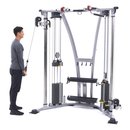
Triceps Push-down
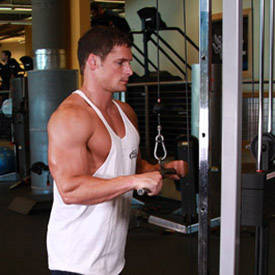
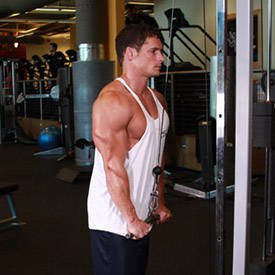
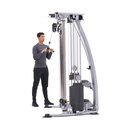
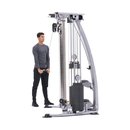
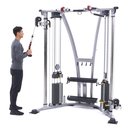
Stand in front of an upright cable apparatus with a shoulder width stance. Grasp your chosen attachment with a firm grip and your elbows by your side. With your elbows stationary, press the bar or rope down toward your upper thighs and straighten your arms out to fully contract the triceps.
Under control, return to the top position (make sure to get a full range of motion), making sure your elbows remain by your side. It is also important to keep proper posture during the movement by avoiding hunching over with your back. Maintain a straight and firm posture with the entire body.
A trick you may want to try is to imagine pressing the weight in an arch toward the wall behind you instead of straight down. This will ensure you will not use too much weight. Also, try different grip attachments. The straight bar tends to stress the larger inner long head while any movement with your thumbs pointing up as in rope extensions will work more of the outer head giving the horseshoe look.
Quick Hit: For maximum contraction without a lot of weight try reverse grip pressdowns with a cambered (EZ) bar. You will have to use slightly less weight, but the contraction is a killer! Grasp the bar as if you were going to do EZ bar curls (thumbs higher than your pinkies) and press down as if performing a regular cable pressdown.
Lying, Seated, And Standing French Presses
The granddaddy of triceps moves is the lying French press (or more famously known as nosebreakers or skullcrushers). Simply lie on a flat bench with either a straight bar or EZ bar and extend the weight directly over your upper body with your arms locked.
Angle your arms at the shoulder joint back slightly toward your head while maintaining the locked elbows. This will place constant tension on your triceps.
To start the movement, bend only at the elbows and lower the bar toward the top of your head while maintaining that angle in your upper arms at all times. Stop the bar an inch or so above your head and then reverse the motion bringing the bar to the angled position once again straightening your arms.
For seated and standing French presses, stand or sit with the weight directly overhead and lower it under control for a deep stretch. Be sure to keep your elbows somewhat pointing up - it is fine if the elbows jet out to the sides slightly, just make sure they don't angle laterally too much. Once in the bottom position, reverse the motion and extend your arms overhead once again.
Quick Hit: For a little variety in your skullcrushing efforts try performing the same movement on a decline or incline bench. Be sure to perform the movement the same as described above. However you may find yourself using slightly less weight on the decline bench and you will be able to use a little more weight on the incline bench. Keep switching angles for each workout for variety and to keep the muscle guessing for more triceps development.
Dumbbell And Cable Overhead Extensions
Similar to the overhead French press, dumbbell and cable overhead extensions will treat the triceps to a deep growth-inducing stretch. Using a dumbbell or rope attachment may prove more comfortable for your elbows as they position the wrists and forearms in a more natural angle.
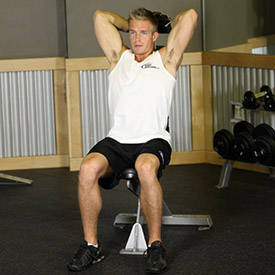
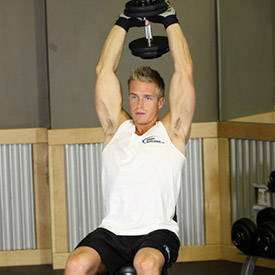
Seated Triceps Press
For two-arm dumbbell extensions grasp a single dumbbell keeping both hands flat against the inside of the plates. With the weight directly overhead lower the weight behind your head feeling a deep stretch in your triceps and then return to the starting position.
You may also perform this movement single-arm with a lighter dumbbell. However, for the single-armed version, you will lower the dumbbell laterally instead of straight back. The elbow will be pointing outward and the dumbbell will travel behind your head for a deep stretch.
For overhead rope extensions, utilize similar form as described above. Grasp a rope attachment from a low pulley station and perform the movement in a rhythmic pattern making sure you use an appropriate amount of weight to complete the prescribed number of reps in a safe manner.
For a little variety rope extension can also be performed horizontally by pulling from a pulley apparatus that is set about shoulder level and positioning your upper body parallel with the floor and in a slight lunge stance. Pulling the rope from behind your head, extend the cable perpendicular to the apparatus and squeeze the triceps.
Quick Hit: Many trainers in the gym tend to set the cable apparatus pulley much too low for overhead rope extensions - this can sometimes create difficulty in getting into the correct position. A tip is to set the cable pulley about waist level to make it easier to get into that desired position. This will make it much less stressful on your back, shoulder, and other joints when starting and ending the movement.
Dips
Dips are an invaluable tool in the pursuit of bigger triceps. Not only are they effective in packing on the mass, they are also allow you to use a higher amount of resistance due to being a compound, multi-joint movement.
There are two types of dips being referred to for this article. The first is the parallel dip. You may see many trainers in the gym utilize this move for chest development; however, it can be just as effective for triceps.
Simply grasp the parallel bars that are about shoulder width with your arms straight - your body should be as perpendicular to the floor as possible.
With your legs pointing somewhat straight below you, lower yourself while keeping your body as upright as possible and your elbows by your sides. This upright position will ensure the stress is placed on the triceps - if you lean too far forward and/or allow your arms to flare out to the sides, the stress is shifted to the chest.
Lower yourself where you are comfortable and avoiding any shoulder pain. A good rule of thumb is to form a 90-degree angle in the elbow joint.
Be sure you can perform parallel dips for the desired reps and range of motion before utilizing a weight belt. Too many trainers try to lift too much weight and compromise their form and risk injury.
Another form of dips is the bench dip. This is performed with two benches side by side. Sit sideways on one bench grasping the edge of the bench on either side of your hips.
Place your feet on the other bench with just your heels touching and legs straight. Lift yourself off of the bench you are sitting on and drop your butt below the bench getting a 90-degree or so angle in your elbows. Extend back up to the top position straightening your arms and flexing your triceps then repeat.
Quick Hit: A good way to really torch those tris once your strength has significantly improved on bench dips is to add a few plates to your lap. Once you have reached failure, have your workout partner take one plate off, then continue your set. Depending on how many plates you have to remove, continue this stripping method until you are doing your last set with just your bodyweight.
Close-Grip Bench Press
Last but certainly not least is another compound favorite—the close-grip bench press. Again, since this is a multi-joint movement, more resistance is able to be placed on the triceps so be careful not to let your ego take over and lift too much weight or be unsafe in your technique.
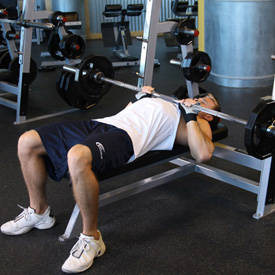
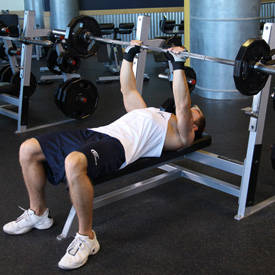
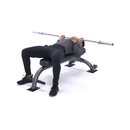
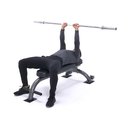
Close-Grip Barell Bench Press
Lie back on a flat bench as if you were about to perform a bench press and grasp the bar with a shoulder-width grip (any closer may put stress on your wrists).
Unrack the bar and lower the bar with your elbows close to your sides—this will ensure that most of the stress will be placed on the triceps and not the chest. Either you can touch the bar to your chest or an inch above it then return to the extended position.
Flex your triceps hard at the top focusing on their contraction. Repeat making sure your elbows are not flaring out to the sides—keep them close to your body.
Quick Hit: To put a new angle on an old favorite, try doing close-grip bench presses on a decline bench. This is somewhat similar to doing a pressdown with a freeweight and will allow for a greater load on the bar. Performing these on a decline will also take a little stress off of the shoulder joints. Be sure to adhere to the same technique and safety concerns as described above.
Giant-Sized Horseshoe Schedules

BodyFit
$6.99/month- 2,500+ expert-created single workouts
- 3,500+ how-to exercise videos
- Detailed workout instruction
- Step-by-step workout tips
- Training at gym or at home
- Access to Workout Plans
- Access to Bodyfit App
- Store Discounts
Already have a Bodybuilding.com account with BodyFit? Sign In

What comes with BodyFit?
- Instructional Videos
Don't risk doing a workout improperly! Avoid injury and keep your form in check with in-depth instructional videos.
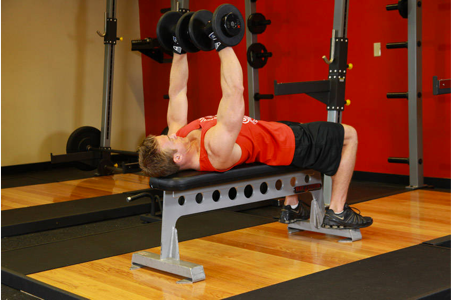
- How-to Images
View our enormous library of workout photos and see exactly how each exercise should be done before you give it a shot.
- Step-by-Step Instructions
Quickly read through our step-by-step directions to ensure you're doing each workout correctly the first time, every time.
BodyFit
$6.99/month- 2,500+ expert-created single workouts
- 3,500+ how-to exercise videos
- Detailed workout instruction
- Step-by-step workout tips
- Training at gym or at home
- Access to Workout Plans
- Access to Bodyfit App
- Store Discounts
Already have a Bodybuilding.com account with BodyFit? Sign In
What comes with BodyFit?
- Instructional Videos
Don't risk doing a workout improperly! Avoid injury and keep your form in check with in-depth instructional videos.
- How-to Images
View our enormous library of workout photos and see exactly how each exercise should be done before you give it a shot.
- Step-by-Step Instructions
Quickly read through our step-by-step directions to ensure you're doing each workout correctly the first time, every time.
BodyFit
$6.99/month- 2,500+ expert-created single workouts
- 3,500+ how-to exercise videos
- Detailed workout instruction
- Step-by-step workout tips
- Training at gym or at home
- Access to Workout Plans
- Access to Bodyfit App
- Store Discounts
Already have a Bodybuilding.com account with BodyFit? Sign In
What comes with BodyFit?
- Instructional Videos
Don't risk doing a workout improperly! Avoid injury and keep your form in check with in-depth instructional videos.
- How-to Images
View our enormous library of workout photos and see exactly how each exercise should be done before you give it a shot.
- Step-by-Step Instructions
Quickly read through our step-by-step directions to ensure you're doing each workout correctly the first time, every time.
BodyFit
$6.99/month- 2,500+ expert-created single workouts
- 3,500+ how-to exercise videos
- Detailed workout instruction
- Step-by-step workout tips
- Training at gym or at home
- Access to Workout Plans
- Access to Bodyfit App
- Store Discounts
Already have a Bodybuilding.com account with BodyFit? Sign In
What comes with BodyFit?
- Instructional Videos
Don't risk doing a workout improperly! Avoid injury and keep your form in check with in-depth instructional videos.
- How-to Images
View our enormous library of workout photos and see exactly how each exercise should be done before you give it a shot.
- Step-by-Step Instructions
Quickly read through our step-by-step directions to ensure you're doing each workout correctly the first time, every time.
BodyFit
$6.99/month- 2,500+ expert-created single workouts
- 3,500+ how-to exercise videos
- Detailed workout instruction
- Step-by-step workout tips
- Training at gym or at home
- Access to Workout Plans
- Access to Bodyfit App
- Store Discounts
Already have a Bodybuilding.com account with BodyFit? Sign In
What comes with BodyFit?
- Instructional Videos
Don't risk doing a workout improperly! Avoid injury and keep your form in check with in-depth instructional videos.
- How-to Images
View our enormous library of workout photos and see exactly how each exercise should be done before you give it a shot.
- Step-by-Step Instructions
Quickly read through our step-by-step directions to ensure you're doing each workout correctly the first time, every time.
BodyFit
$6.99/month- 2,500+ expert-created single workouts
- 3,500+ how-to exercise videos
- Detailed workout instruction
- Step-by-step workout tips
- Training at gym or at home
- Access to Workout Plans
- Access to Bodyfit App
- Store Discounts
Already have a Bodybuilding.com account with BodyFit? Sign In
What comes with BodyFit?
- Instructional Videos
Don't risk doing a workout improperly! Avoid injury and keep your form in check with in-depth instructional videos.
- How-to Images
View our enormous library of workout photos and see exactly how each exercise should be done before you give it a shot.
- Step-by-Step Instructions
Quickly read through our step-by-step directions to ensure you're doing each workout correctly the first time, every time.