What about training your hamstrings with such vigor that afterward Frankenstein walks with more grace than you do? PAIN is the #1 reason many trainees shun leg training. But nothing comes easy. If you want great legs, you've got to annihilate the muscles and train them with maximum intensity.
Before beginning the leg training routine, warm up by riding a stationary bicycle for approximately 10 minutes, then stretch to loosen up the leg muscles. Stretching the quadriceps and hamstrings reduces tension on the tendons and relieves pressure on the knee during activity.
The Exercises
Killer Quad Training
Squats - View Exercise
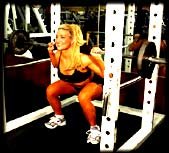 Without a doubt, the king of all leg exercises is squats. There is no exercise that generates as much agony and trepidation than squats. Many would prefer to run through fire soaked in gasoline than go through the grueling agony of squatting. Since squats are the most challenging element of your leg routine, do them first while you are at full strength and at the peak of your energy level.
At the Department of Exercise & Sport Sciences, Ithaca College, Ithaca, New York, researchers looked at the effects of exercise order on performance of isotonic muscle contractions. They found that by performing prime mover exercises first such as squats, bench press, and military press, the subjects were able to lift significantly heavier weights, which improved overall strength and muscle size. Conclusion-the greatest gains in regard to strength training come by performing the most demanding exercises first (1).
Utilizing the proper technique is paramount when performing squats. Recently at the Centre for Sports Science, West Sussex, England, a series of tests were performed to establish if varying foot positions during squats had an effect on the recruitment patterns of the quad muscles. Electrodes were placed on the subject's quads and results of the study indicated that the quad muscles would do the same amount of work if the feet were turned inward, outward, or straight ahead. The study noted that the best squat position is the position in which you feel the most stable and comfortable (2).
Place the barbell behind your neck across your shoulders and resting on your trap muscles. Keep your eyes straight ahead and focused. Slowly begin your descent into the squat position. Take 3-5 seconds to go down, pause, and take 2-3 seconds to come up. Perform 4 sets of 8-12 reps.
For a change in your normal squat routine, perform single-leg squats a few times per month. Single leg squats are an exceptional exercise for those with leg imbalances. To perform them stand inside a power rack/squat rack. Standing straight up, begin to lower yourself on one leg while holding on to the power rack frame/squat rack. Place the opposite leg straight out so that the heel of that leg stays just off the ground at all times. Bend the supporting knee and go down as far as you can while keeping your foot flat on the ground.
Another technique to raise the intensity of squats is to take advantage of the effects of the stretch shortening cycle (SSC). Concentric (shortening) and eccentric (lengthening) muscle contractions frequently occur in daily activities and sports. During movements such as running or jumping, the two types of contractions are combined into a sequence referred to as the stretch-shortening cycle. By combining concentric and eccentric contractions into this sequence, the work performed by the muscle is maximized.
Data also suggest that a given amount of work is done more economically if a stretch-shortening cycle is involved and that a muscle is able to absorb energy during an eccentric contraction, which may protect bone, cartilage and ligaments exposed to high-impact forces during exercise (3). The stretch-shortening cycle, characterized by a rapid deceleration of a mass followed closely by rapid acceleration of the mass in the opposite direction is essential in the performance of competitive sports, particularly those involving running, jumping and quick changes of direction (4).
For example, if you relax your muscles at the fully extended position of a lift you will find it much more difficult to contract the muscle again. Any one who has tried a max squat or bench press will have experienced this. If you were to completely pause in the bottom position, it would be much harder to get the weight moving again. To increase the intensity of the squat (using the SSC), lower yourself in a very controlled manner and pause at the bottom position, do not bounce. After a slight pause begin to raise the weight in a slow controlled fashion.
If you are looking for the ultimate technique to add intensity to your training, give the SSC a try.
Unilateral Leg Presses - View Exercise*
To build a great physique, you must also use your brain. If you notice that a particular body part has a size or strength imbalance you can correct this through unilateral training. Unilateral training is exercising one limb at a time (if you continue using both limbs you will only make the condition worse). Using one leg at a time, lower the weight in a slow, controlled manner. Each rep should take 5-10 seconds to lower. Don't get carried away with load on day one-start with 50-100 pounds. Explode up to the starting position and repeat this cycle for 3 sets of 8-10 reps.
Take a 30 second break, get a drink of water, and move on to leg extensions.
* Shown with both legs.
Leg Extensions - View Exercise
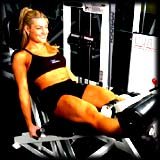 After completing your last set of unilateral leg presses, your legs should be numb but it's not time to stop yet. Jump on the leg extension machine and perform 10-12 reps of extensions using 6-8 seconds to complete each rep. While performing the extensions, look straight ahead and to don't grip the side handles too tight because this may increase blood pressure and can cause dizziness. You can also use unilateral training while performing leg extensions and I suggest you include this technique a few times a month.
Another variation of leg extensions is the 1½ routine, a favorite of Australian strength coach, Ian King. To perform this exercise extend the leg to the top position, pause, lower the weight ½ way down, pause, return to a full extension and squeeze your quads, pause, and then lower the weight all the way down. This would be considered one full rep. One of the benefits of this routine is that you don't have to do as many sets but the intensity is increased. Perform 2 sets of 10-15 reps.
Lunges - View Exercise
As you stagger off the leg extension machine the high levels of lactate acid in your quads will have you feeling like someone is poking them with a knife. You're thinking, "This @#$%^&#^ hurts! I quit." This is the time to intensify your focus, pump up the music, and tackle the next exercise!
Lunges are great for developing the vastus medialis and vastus lateralis muscles. These muscles create the much-desired "quad sweep." Use a shoulder width position with your eyes straight ahead. Take a deep breath and step forward. Keep your back in a slightly arched position. Take a comfortable stride forward bending your front knee and slowly descending to the floor. You can either perform all reps on the right or left leg first or you can alternate back and forth. I suggest doing your weaker leg first. Perform 2 sets of 8-12 reps.
Take a few minutes to reenergize and get ready for hamstring training.
Killer Hamstring Training
Stiff Leg Dumbbell Deadlift - View Exercise
This is an excellent exercise for developing the hamstrings. Use a shoulder-width stance with eyes straight ahead. With a dumbbell in each hand bend your knees slightly and lean forward at the waist. Slowly begin to rise up into an erect position with chest out and shoulders back. Repeat this routine for 4 sets of 10-12 reps.
Lying/Standing Leg Curl - View Lying - View Standing 
The leg curl can be done lying face down or standing. When using a lying leg curl machine, the back of your lower leg should rest comfortably against the underside of the rollers. Hold the grips along side the bench and slowly curl the weight toward you. Remember to concentrate on the eccentric portion of this exercise and use enough weight to stimulate the muscle. 3-5 sets of 6-8 reps.
The Routine
Week One
Squats - 4 sets of 8-12 reps
Unilateral Leg Presses - 3 sets of 8-10 reps
Leg Extensions - 2 sets of 10-15 reps
Lunges - 2 sets of 8-12 reps
 Click here for a printable log of week one!
Week Two
Stiff Leg Dumbbell Deadlift - 4 sets of 10-12 reps
Lying/Standing Leg Curl - 3-5 sets of 6-8 reps
Click here for a printable log of week two!
Each week alternate between doing quad and hamstring exercises first. For example, week 1 perform your quad based training session first. During week 2, perform your hamstring training routine first. This will help to correct any muscles imbalances you may have developed.
12 Leg Training Tips
The following suggestions may help you enhance your leg training routine:
- For a change of pace and to correct imbalances, train one leg at a time. Tests have shown that it is very common for one leg to be more dominant than the other with a disparity of up to 20%.
- Use eccentric (the lowering of the weight) training. Since hamstrings are composed of fast-twitch muscle fibers, they respond well to heavy weights, low reps, and eccentric training. Triple jumpers and long jumpers are known for their hamstring development due to the high impact landings which prompts high levels of eccentric contractions from the hamstrings.
- Due to the shearing forces and tremendous amount of stress placed on the anterior cruciate ligament (ACL) avoid or limit squats on the Smith machine.
- Because each exercise offers a unique pattern of overload, use a variety of exercises for maximum hamstring development and change your routine on a frequent basis.
- Since the hamstrings consist mainly of fast-twitch muscle fibers that take longer to recover, allow plenty of time for full recovery. Train legs once every four or five days.
- Eat a light meal at least two hours prior to training.
- Wear shoes that both fit properly and are in good condition to help maintain balance and leg alignment during training.
- If you injure one of your hamstrings immediate treatment is essential to ensure full recovery. The correct method of treatment for a hamstring injury is Rest, Ice, Compression, and Elevation (RICE). Use this method of treatment for 48 to 72 hours and if the injury has not improved consult with a physician or qualified rehabilitation specialist.
- If pressed for time and you can only do one exercise for your legs, squats would be the best choice. Studies conducted at the University of Miami investigated and compared the muscle electromyographic (EMG) activity during the squat, leg press and knee extension exercises. EMG activity is an objective measure of the amount of muscle activity during the exercise which allows exercises to be compared.
The study used experienced lifters and determined the 10-repetition maximum weight for each exercise. This assured that all exercises required the same amount of effort. The team found that the squat elicited significantly more quadriceps EMG activity compared to the knee extension. The study concluded that because of this the squat should be seen as the superior quadriceps exercise, especially since it is a functional movement (5).
- Feeling lethargic prior to training? If so, don't train. If you feel tired or sluggish this is a signal from your body that it has not fully recovered from a previous workout and needs a bit more rest. Postpone your workout until the following day-only if you feel better. Two intense training sessions in a row are about as much as a natural athlete can recover from so be careful not to overtrain.
- By taking in ample amounts of carbohydrates immediately after training and again an hour later, athletes can get a head start on re-fueling their muscles after workouts, but they will also shape muscle-protein dynamics to favor protein creation and disfavor protein catabolism. This is essential for full recovery. Athletes who fail to take carbohydrates following their workouts because of sheer negligence or a desire to shed weight are losing out in the long run, because their recovery processes are sub-optimal (6).
- Each week alternate between doing quad and hamstring exercises first. For example, week 1 perform your quad based training session first. During week 2, perform your hamstring training routine first. This will help to correct any muscles imbalances you may have developed.

Belts & Knee Wraps
Belts and knee wraps are training aids used by many while performing strength training exercises. There is an ongoing debate on their usage and I think it's up to the individuals to decide what works best for them.
Conclusion
Enhancing your leg development is a matter of training with intensity, consistency, and total focus. You can have the best routine of all time, but without the effort and necessary sweat needed to produce improvement nothing will change. After all, nothing beats a great pair of legs!
About The Author
Rob Wilkins, originally from Linden, New Jersey, is a Master Sergeant in the US Air Force stationed at The Pentagon, Washington, DC. Wilkins is also a Special Assistant to the International Federation of Bodybuilders (IFBB) and a recipient of the IFBB Gold Medal. To contact Wilkins e-mail him at robifbb@yahoo.com.
References:
1. The Journal of Strength and Conditioning Research: Vol. 10, No. 1, pp. 20-24.
2. Journal of Strength & Conditioning Research, 14(4): 379-382, 2000
3. www.agatonfitness.com/Method/scientific.html
4. www.nsca-lift.org/publications/PosStatements.htm
5. Brandon, Raphael, Squats, leg press or knee extensions - which exercise is best for the quads?, www.pponline.co.uk
6. Dr. Anderson, Owen, How a spoonful of sugar helps keep your muscle protein from going down. www.pponline.co.uk
Thanks,