
Everybody would like to have the perfect body. And the ones who read my first article already know I am here to help. After seeing quite a few people not using proper techniques in the gym when training with weights, I felt the need to point out the top 3 improvement delays in the gym.
I will also provide accompanying pointers and training tips for those who haven't seen much result yet after months or years of time spent in the gym, and who would like to see some of that result! It's time for some anti-improvement delay guidelines!
[By reading this article you agree to take full responsibility of all the progress and results you will have by following these guidelines. You will not blame/thank anyone but yourself for having to shop for new clothes, for any complications resulting from dating multiple people and for having others following you in the mall.]
Delay 1: Lifting Weight The Pretty-Yoga-Girl Way
How It Works:
When you train with heavy weight, you are actually trying to damage the muscle (group) you are working on. After feeding them with enough protein during the day, they recover and they grow bigger than they were before, to protect you from the heavy weightlifting you just did. This is when you keep lifting heavier weights in time, so that your body gets shocked all over again and repeatedly gets triggered to grow.
What Needs To Improve:
Many times, however, I have seen people lifting very light weight, to take an example, while doing front laterals for the shoulders. They would slowly lift the weight up, and slowly bring it down, in about 10 seconds for the entire movement. And they would do a set of about 30 of those. This is a total waste of time.
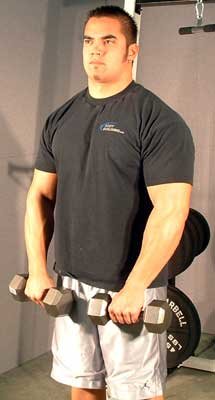
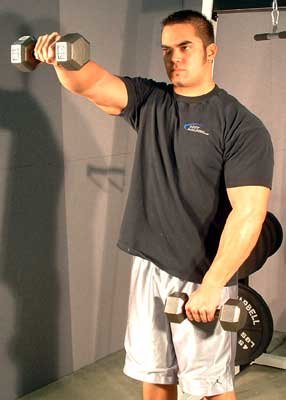
 Click Image To Enlarge.
 Front Dumbbell Raise
There will barely be results from this light level of exercise. If you have been training for a while and haven't seen much result, this could be one of the reasons why.
How To Do It:
Use a weight heavy enough for you to have to work as hard as you can to lift it properly for the amount of repetitions you want to do. Let's say you're doing 15 repetitions. Then your weight must be heavy enough to do 15 reps in the first set, have difficulty doing 15 reps in the second set and barely make it to do another 15 reps in the third set.
Then you try to increase the weight. For your last set (3 or 4 sets per exercise) you're using a heavier weight, with which you cannot do 15 reps and have to do a few less repetitions, or use a lower weight to squeeze a few more repetitions out. You focus on really squeezing the muscle going up, and holding back the weight going down.
Guidelines:
You do not have to look calm or pretty when lifting weight. Go heavy, and don't be afraid to sweat and work hard for it. That is the only way to achieve your goals. PS: Don't worry; you won't end up looking like a bodybuilder after using these proper training techniques. That takes a lot of extreme dieting, discipline, hard work and years of time.
Summary:
- Train with as heavy weights as you can to complete your reps.
- Try to increase the weight with each set during the exercise.
- Lower the weight if you can't finish the reps and do a few more reps.
- Work hard when you train! Treat yourself to something relaxing later.
Delay 2: Not Finishing What You Started/Too Much At Once
How It Works:
You need to work the muscle (group) you are working on in different angles through different exercises. For each major muscle group (back, chest, quads, hamstrings and shoulders) you need 3-4 exercises and for each minor muscle group (biceps, triceps, calves) you need 2-3 exercises.
You can do 1-2 for abs after training. Now, for each exercise you need 3-4 sets. This way you will be training the muscle (group) you are working on to the max. It will be sore the next day and the day after, and as you feed it with enough protein during the day.
What Needs To Improve:
I surprise myself at the amount of people I have seen doing the following thing. They will use about 6 different exercises in a rotation, working on their entire body at once. From one exercise for back, doing one set, going to the other exercise for chest, doing 1 set, going to yet another exercise for legs, doing 1 set... this will go on for their entire "body workout".
They will rotate many exercises in a rotation system, if there is any rotation system at all. This may seem smart. However, this way you do not get to properly train each muscle group.
Instead you are working on all of the muscle groups insufficiently. Now they all have not been trained well enough and none of the muscles are triggered enough to grow to notice any results. This as well is a waste of your precious time and energy.
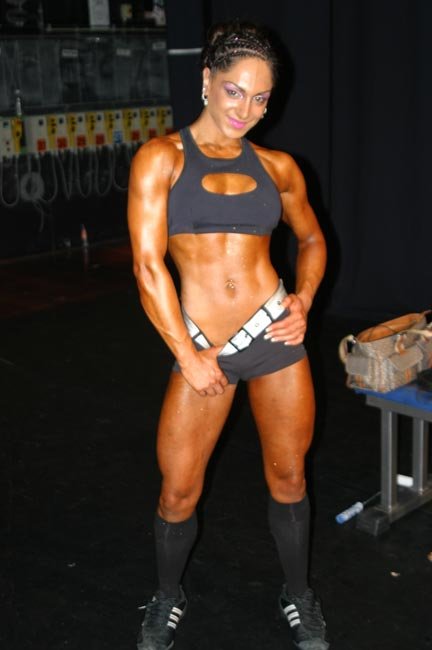
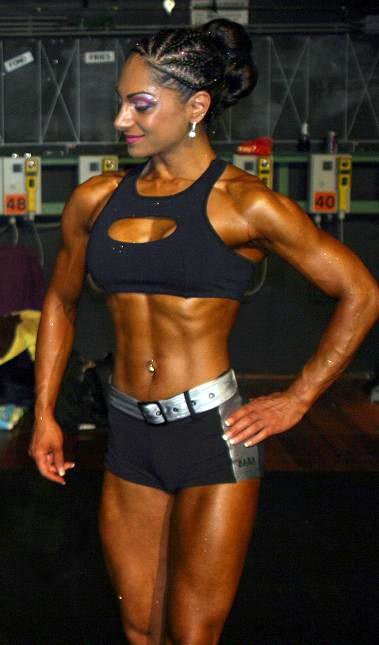 Click Image To Enlarge.
 Don't Waste Your Time With An Inefficient Rotation.
How To Do It:
Be organized. Which muscle (group) would you like to train today or tomorrow? It's smart to plan when you train all the muscle groups of your body for the week. That way you will be sure to hit all of them, and not skip/forget any of them. This way you can also think of the exercises you would like to do today or tomorrow for that specific muscle (group).
You get to really concentrate on that specific muscle (group) for the training session and you will work your entire body well, as you concentrate on all your muscles separately in all your training sessions. Train every muscle (group) once a week.
Guidelines:
You can train one major muscle group and one minor muscle group per training session. After that do 1-2 exercises for calves or abs.
Summary:
- Do 3-4 exercises per major muscle group, 2-3 exercises per minor muscle group.
- Do 3-4 sets per exercise.
- Train every muscle (group) once a week.
- Train one major muscle group and one minor muscle group per training session.
 Click Image To Enlarge.
 Try For 3-4 Exercises Per Major Muscle Group.
Delay 3: Training Together, Or "Training" Together?
How It Works:
Training together can be a good thing. You can motivate each other, spot each other when your partner needs help and that way train heavier with the help of your partner, and feel safer knowing he or she is there to help. But whether training with a partner compliments or abstracts from your training, is something you have to pay close attention to.
Change or adjustment is needed when it is taking away from your training instead of motivating and helping you with it.
What Needs To Improve:
Often it turns out that training with a partner distracts from your training instead of adding to it. How? Ever noticed that when you train with your buddy, you chat during the sets or exercises? Or that when your partner doesn't feel like training today, you won't go either? These are the dangers that abide when you team up with a friend to hit the gym together.
How To Do It:
Be disciplined - If you answered 'yes' to the above questions, you need to do something about the way you train together. Have a talk with your training partner. Tell him or her that during exercise you both promise to be focused on the training, and training yourselves and each other.
After training you are allowed to chat. Also be more disciplined to go to the gym when your partner, for whatever reason, doesn't want to go. Even joke to him or her saying you will go ahead and work on your results, as he won't, and motivate your partner to go. Otherwise just go by yourself.
It's good to train by yourself too, you will be focused only on your body. And you will be focused and your great results. If your partner can't seem to keep the promise not to chat during training, or your partner doesn't help or motivate you, feel free to train by yourself.
Losing a training partner does not mean losing a friend, so don't be afraid to do what's best for you. You can meet up after training and go out and have fun as friends, no matter what.
Guidelines:
Be nice. Don't insult your training partner if he or she doesn't stop chatting during training or keeps you from training well in any other way. Try to improve the situation, or if that doesn't work training alone or with someone else. But don't lose a friend over it. Discuss it and talk about it nicely.
The Results
For the 1 hour a time you spend training in the gym, you get:
- A well toned physique
- Working on a more symmetrical body (paying more attention to areas that need it)
- A muscular physique (when dieting and training harder)
- Being fitter; being able to run or walking the stairs without shortness of breath
- Feeling healthier
- Having a lot more fun shopping for clothes
- Feeling happier with yourself and how you look
- Getting compliments of losing body fat and improving your physique all the time
- Having a lot more energy and feeling like going out and having fun more
- Looking HOT in a bikini or swimming trunks
- And a lot more...
Yours in health,
Mercedes Khani
IFBB Pro Figure, International Fitness Model and Personal Trainer