
One of the biggest debates among coaches and trainers that always arises every few years is the topic of recovery. Some say you need to be beating yourself up week in and week out and always increasing your work capacity by simply doing more, more, and more work over time.
Others in the HIT (high intensity) camp emphasize recovery with a mantra that says, "less is always< more". So who's right? Are you gonna get better results by constantly training yourself into the ground or will that approach leave you chronically overtrained?
Is that overtraining maybe a good thing? Or will you get better results by sitting on your butt 5 days out of every 7 and attacking your workouts with ferocity when you do?
Or will that approach leave you undertrained and so inactive that you pile on enough fat to make Warren Sapp look like a GQ model??
Terminology
Well first lets define some terminology. What most of us call overtraining is really over-reaching. Overtraining is more like a disease then a temporary state. For 95% of us, "over-reaching" is what we're really referring to when we say overtraining.
Over-reaching
Over-reaching is pushing yourself into a mild state of fatigue with your training. Regression in performance sometimes does occur during an over-reaching period<, yet performance rebounds back very quickly, usually above and beyond it's previous level, with a short period of rest or lowered volume (within days). It can be good or bad depending on how you use it.
Overtraining
Overtraining occurs when you chronically over-reach for months or years on end. This leads to performance regression that can take months to recover from and is associated with multiple and sometimes permanent endocrine disruptions.
Although there are some athletes who are chronically overtrained and don't realize it (distance runners, bodybuilders, and some basketball players come to mind), most athletes don't ever reach a true overtrained state.
Under Reaching
Under-reaching occurs when you intentionally "take it easy". This is like taking your foot off the gas in your training intentionally. It also can be good or bad depending on how you do it.
Key Claims
Now let's start with a few key claims I'm going to make.
First Claim
First, let me state that from my observations, the reason many people train hard and consistently and don't make the gains they feel they should, is because they spend too much time over-reaching and not enough time under-reaching.
Notice I said "consistent hard trainees" there. That statement doesn't apply unless you train both hard and consistent.
Next Claim
Next, let me state that if you have to choose, you're almost always better off under-reaching then over-reaching unless you really know what you're doing. With those comments you would probably think that over-reaching is a bad, bad, BAD thing. Well, in truth it's quite the opposite.
Over-reaching by design can be a very good thing.
Notice that I said "unless you know what you're doing". That's what I intend to help you do in this article.
Recovery and Supercompensation
Recovery can be defined as—regaining what was lost—however, for the athlete this is not enough as it returns them only to where they started. Adaptation can be defined as the process of long-term adjustment to a specific stimulus. This process of adaptation can include adjustment in a number of factors such as the athlete's physiology, psychology and mechanics.
These alterations can ultimately lead to improved performance—which is a more satisfying goal. We want to jump higher, run faster, get stronger, run longer etc. In order to get fit we must stimulate some fatigue so that our body adapts. We must push ourselves beyond our limits some of the time - which is fatigue. Let's call a training cycle a 30-60 day "period" of training.
All good periodized training answers this question: What is the optimal amount of fatigue to induce over the course of the next training cycle in order to optimize the fitness that results from it?
Example
In other words, if I want to run faster and jump higher 30 days from now, how tired should I make myself this week and next week so that when I test myself in 30 days, I'll run faster and jump higher?
All things being equal, if I do no training (assuming I'm not in an over-reached state) then I likely will not improve at all, and in fact may slip back. On the other hand, if I work out daily and intensely and continue adding volume, I'm also likely to slip back.
So there must be an optimal blend of both fatiguing myself or over reaching (in order to improve) and resting myself or under reaching, so that I can see the gains from the over reaching I've done.
Under reach too much and you won't get the results you want because you haven't forced your body to adapt; over reach too much and you won't get results because your body is shot.
The rest of this article is about how to solve this puzzle and determine how to intelligently over reach at the beginning of a training cycle, and under reach at the end of a cycle, in order to boost the overall results of each training cycle.
Walk Or Run But Don't Do Both
The basic point I want to make in this article is that you should either be training a little harder then what feels comfortable or a little less then you think you should. This is an implementation of the Two-Factor theory model of stress and adaptation. Let's talk a little bit about the 2-factor theory.
The Two-Factor Theory
The two factors represent the relationship between fatigue and fitness. One factor is fitness the other factor is fatigue.
Two-factor theory: A stress adaptation model that bases a training plan around the long term relationships between stress and fatigue.
When you train you accumulate both fatigue and fitness. That observation itself should be worthy of a nobel prize. However, what many people don't realize is that the fatigue that accumulates over the course of a training cyle itself "masks" the fitness gains that you make.
Fitness persists about 3x longer than fatigue. This means that when all traces of fatigue are gone from a bout of exercise or a cycle of training, the fitness gained will persist for 3 x as long as the fatigue. That's why most people make gains when they take a few days off from time to time. What I want to do is show you how to make this process predictable.
The One-Factor Theory
Before we get into how to implement the 2-factor theory you first need to understand the one factor theory.
The One-Factor Theory: The basic stress adaptation model that is usually taught in high school, bodybuilding, and is the grand de jour model used to explain high intensity training. With this theory you look at physical ability as one short term factor. You load, recover, load, recover—always recovering fully before loading again.
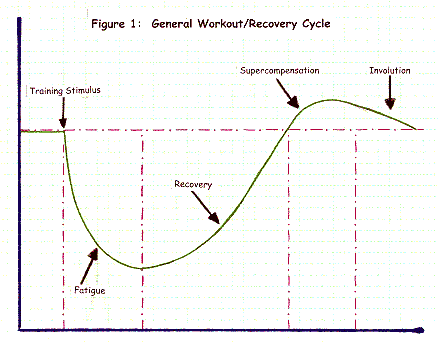
Super Compensation Curve
 Click To Enlarge.
The problem with this approach is you are left with the problem of timing workouts to correspond to the supercompensation wave. Anything sooner or later will lead to a bad workout.
Another problem is there is only so much systemic stress that can be thrown on the body in one workout. If you prolong the length of the stress (loading and fatigue) period in the above chart by days or weeks, instead of a single workout, you increase the overall stress.
Therefore, providing you to allow recovery to take place after prolonged loading, you increase the height of the supercompensation curve as well.
More On The Two-Factor Theory
You will often here training according to the 2 factor theory called many different things. You'll hear it called concentrated loading, load/unload, step-type loading or any number of other things. It's nothing fancy and most of you are probably already using it to an extent.
Comparing The One-Factor Approach to the Two-Factor Approach
Let's start off by comparing a "one-factor" training approach to a "2-factor" approach. We have 2 four week training schemes. One we'll call "A" and will be the one factor approach. The other we'll call "B" and is the 2-factor approach. Here's what they look like.
Training Scheme A: Here we train according to the traditional supercompensation curve. We train then fully recover, train then fully recover etc. Let's say we train once every 4-5 days and recover completely between workouts for 4-weeks.
Training Scheme B: Here we train hard for the first 3 weeks three times per week so that we never ever are completely recovered from any workouts. Then, on the 4th week we train only once or twice the entire week at a low intensity and low volume.
During the 4th week we're allowing fatigue to dissipate so that we can display the fitness we've gained from the previous 3 week's of training. During this low intensity/low frequency week, the physiological indicators we've stimulated the previous 3 weeks "rebound" back up and above where they were before.
Comparing The Schemes: OK. Now if you were to compare those 2 schemes we would find that version B will actually bring about greater gains particularly for intermediate and advanced athletes - That is providing the athletes are in a well rested state prior to initiating the 4 week block of training.
Homeostasis is disrupted and prolonged during the 3 week loading period. Although we won't see a whole lot of progress during this 3 week phase itself, when we pull back on the volume during the reduced loading period the functional indicators will then rebound back above baseline. The ultimate "rebound", or performance increase, in scheme B will be greater than the summation of smaller rebounds from scheme A.
So what we're doing is building up fatigue and fitness by over-reaching slightly and then pulling back on the fatigue by under-reaching. Nothing really complicated about it.
Most Athletes Are Already Implementing The Two-Factor Theory And Could Benefit By "Under-Reaching" For A While
OK. Now the important thing to note is that most athletes are already over-reaching slightly even though they don't realize it! They never allow recovery to take place and some haven't been fully recovered in years.
Basketball players are among the worst here. They are never recovered daily, they never allow recovery to fully take place, and thus they don't make gains due to chronic over-reaching.
Therefore, I almost always start athletes off with more recovery so that they can allow all the fatigue they've been accumulating during their previous months or years of training to dissipate.
It's also important to realize that recovery doesn't have to be "complete" between training sessions in order for one to experience gains.
People are rarely ever 100% completely recovered but still make gains. Athletes in most sports are always experiencing some level of constant fatigue. What you want to do is maximize those gains which you can do by intentionally manipulating the relationship between fatigue and fitness.
Intentionally Creating A Regression In Performance
The magnitude of the incomplete recovery you create during a loading period will vary. In fact, the practice of "shock" concentrated loading is practiced by many countries for different sports. In a traditional concentrated loading phase, the goal is simply to beat the body into an over-reaching state where the actual goal of the training is a decrease in performance. Loading of any primary emphasis may be used (strength work, speed works, jumps etc.)
The lower that performance falls during the loading period (within acceptable limits of 10-15% or so), the greater that performance rises during the unloading period. I don't recommend intentionally loading to the point that performance falls off noticeably due to injury risk, but you can still incorporate and benefit a less intense version of the same process.
How You Can Apply and Benefit From Planned Over-Reaching
The basic tenet is that instead of always looking at each workout as a separate "fatiguing" session, followed by a separate "recovery" session of a day or two of rest, begin thinking in terms of weeks. In other words, you have one, two or three weeks which are "fatiguing." Think of this time period the same way some people think of one workout.
You accumulate fatigue the whole time, you never "completely" recover. You might make gains but you're never really completely recovered. Then you have another one or 2 weeks in which you train with reduced frequency, volume, or intensity and allow recovery to take place. I favor keeping intensity fairly high, cutting volume by at least half, and slightly lowering frequency. In any event the overall training stress is lower.
The main benefit of the higher volume phase isn't the gains you make on it, but the gains you make when you switch to a lower volume phase.
Accumulation and Intensification
You can also alternate between cycles of incomplete vs complete recovery which is often called accumulation/intensification. Version A I described above (training with full recovery), will work wonderfully when transitioning from a period of increased loading.
In other words, accumulate fatigue and train frequently for a while and then transition into a period of time where you train with full recovery between sessions for a while.
Say you train 3 x per week for 3-4 weeks and then once every 4 days for 4 weeks. Your gains will be out of this world during the 2nd phase because you heighten your ability to adapt in the first phase. That works very well.
Examples:
There are numerous ways we can incorporate a loading/unloading scheme. At it's most basic level a loading period of 2 or more consecutive workouts will be followed by an unloading period of one or more days.
An example of this is a simple "block loading" scheme often practiced by endurance athletes that can also be used successfully by others. In fact this is a scheme used in many university team sports.
"Block Loading": Here we might train hard with weights, sprints, plyos, etc. on Monday, Wednesday, and Friday and do conditioning on Tuesday and Thursday. We then rest completely on Saturday and Sunday.
By Friday the athlete will be worn down and performance very well may have regressed over the course of the week. Yet by having 2 consecutive days off (Saturday and Sunday), we allow a lot of that fatigue to dissipate.
Thus, the body supercompensates and the athlete goes into Monday with enhanced ability—for a few weeks anyway.
Generally speaking, anymore than 3-4 weeks consecutive loading will fail to bring about gains unless a one week unloading period is inserted.
The body will tolerate 3 such 3/1 blocks of loading/unloading before a longer recovery period is necessary.
This means that we'd do 3 consecutive 3/1 cycles before taking 2-3 weeks of training at a lower intensity.
Should I Seek Out Performance Regression?
The intensity of the loading period will vary as well. During loading periods it's ok for some regression to take place but no more then 10%. That means if your vertical jump is 30 inches you can train yourself to a 3 inch decrease and when you recover fully it'll rebound back up above 30.
The same thing goes for your strength etc. Remember, the greater the decrease in function the greater the rebound above baseline during the unloading period. There is one caveat here however.
The more regression that takes place the longer your unloading period will need to be. If you train to the point of big time (10%) regression, you will need a 2 week rather then 1 week unloading period.
Specific Examples
Here's an example of an accumulation/intensification cycle for the squat. This is the old 5 x 5 routine first written by Bill Starr and popularized by Glenn Pendlay. Here we train the squat 3 x per week for 4 weeks then twice a week for 4 weeks.
Volume Phase 4 weeks: Deloading Period 1 week
Intensity Phase 4 weeks
Note: Sets and reps for the intensity phase are in parentheses.
Monday:
- Squat: 5x5 (3x3)
- Bench Press: 1x5 (1x3)
- Row: 1x5 (1x3)
 Click Here For A Printable Log Of Monday.
Wednesday:
- Squat 5x5 with 15-20% less than Monday (drop this lift)
- Deadlift: 5x5 (3x3)
- Military Press: 5x5 (3x3)
- Pull-ups: 5x5 (3x3)
Click Here For A Printable Log Of Wednesday.
Friday:
- Squat: 1x5 (1x3)
- Bench Press: 5x5 (3x3)
- Row 5x5 (3x3)
Click Here For A Printable Log Of Friday.
Volume Phase: Weeks 1-4
Use 5 sets of 5 reps with the same working weight for all sets. Increase the weight week to week and try to set records in weeks 3 and 4.
For exercises you do twice a week you have a separate day which you perform a single set of 5 reps with the goal of setting records on the 3rd and 4th week for your best set of 5.
Don't start the weights too high. Lower the weight if need be but get the sets and reps in—except where you are setting records.
Deloading Week: Week 5
On week 4 drop the Wednesday squat workout, begin using the Intensity set/rep scheme (in parentheses), and keep the weight the same as your last week in the Volume Phase.
Click Here For A Printable Log Of Monday.
Click Here For A Printable Log Of Wednesday.
Click Here For A Printable Log Of Friday.
Intensity Phase: Week 6-9
Everything is the same principal except that you use 3x3 and 1x3 setting records on week 8 and 9. No Wednesday squatting. The important aspect of this phase is the weight increases.
If you are so burned out that you need an extra day here and there that's okay. If you can't do all the work that's okay too. Just keep increasing the weight week to week.
Click Here For A Printable Log Of Monday.
Click Here For A Printable Log Of Wednesday.
Click Here For A Printable Log Of Friday.
Example Of Volume Phase Transitioning Into Intensification Phase For A Football Player
Here is a setup I used recently for an athlete preparing for several football tryouts and combines. His lower body strength levels were more then adequately in place but he was coming off a mass gain phase and needed quite a bit of work on the field speed work, wanted to drop some fat, and needed to increase his upper body strength.
Phase I: High Volume/High Frequency
This phase consisted of 2 consecutive 3 weeks load/ 1 week unload schemes. The loading portion looked something like this:
Monday:
- AM: starts, short sprints, agility drills, position specific drills, ~500 yards total.
- PM: Weights, 3 x 3 at 80%
- Squat
- RDL.
Tuesday:
- Conditioning: 100 yds x 15 with 30 second rest intervals
Wednesday:
- AM: Plyo, speed drills, 4-6 sets depth jumps/ 1 position specific agility drill/ 4 sets straight leg sprints/ 4 sets 60 yard buildups
- PM: Maximum Strength Upper Body Training mainly on the bench press
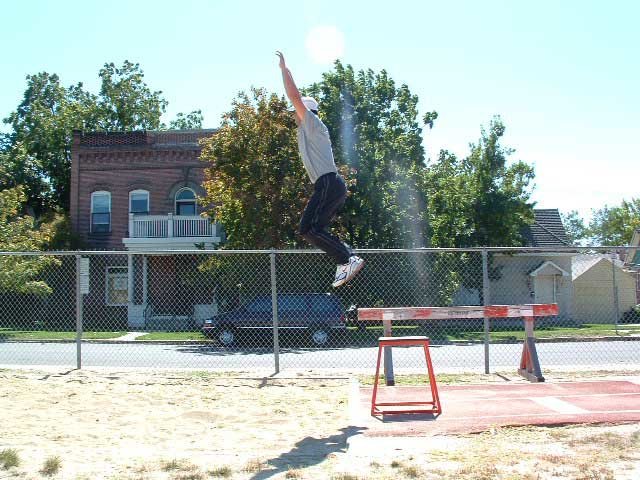
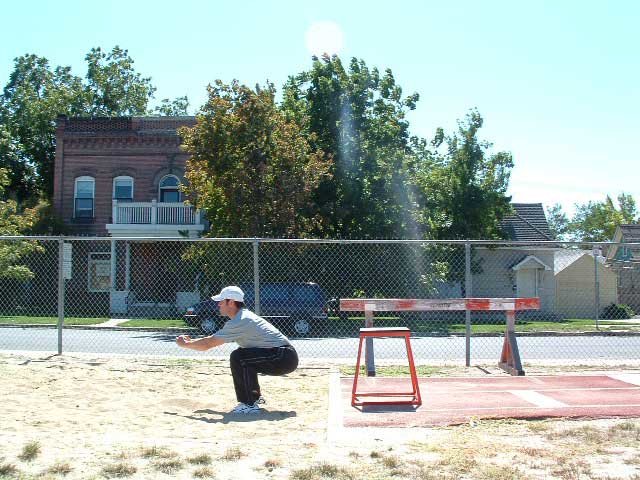
Depth Jumps
Click To Enlarge.Thursday:
- Conditioning: 100 yds x 15 with 30 second rests
Friday:
- AM: start technique, maximum speed sprints and flying 20's, agility drills, position specific drills, 500 yards total.
- PM: Strength Training
- Clean: 3 x 3 85%
- Squat: 3 x 3 85%
- Glute Ham Raise: 3 x 3
Saturday - AM- Agility technique, buildups, Upper Body strength endurance focusing on the bench press
Sunday - Off
Click Here For A Printable Version Of This Page.
He'd follow that for 3 weeks and then unload for 1 week. The unloading period consisted of 1/2 the volume of on field work on Monday and Friday and elimination of plyo, speed, agility work on Wednesday.
After about 6 weeks of training, it was obvious to me he had got about all he was gonna get from this scheme. He seemed a little burned out and he complained of sore joints.
I knew that this just meant he was slightly over-reached and his performance would rebound up big time once we tapered into a lower volume phase. He's always been able to transfer functional ability into technical ability.
From experience we knew that as his vertical jump goes so does everything else and as his shoulder press and incline press goes so does his bench press.
We ended up dramatically lowering the overall lower body volume. On upper body we got him away from the bench press for a while and worked on his weak points. The routine ended up looking like this:
Phase II: Low Volume Intensification
Session 1: LB
- Depth Jump, standing triple, one leg hops onto box, 4-6 sets each x 3-5 reps
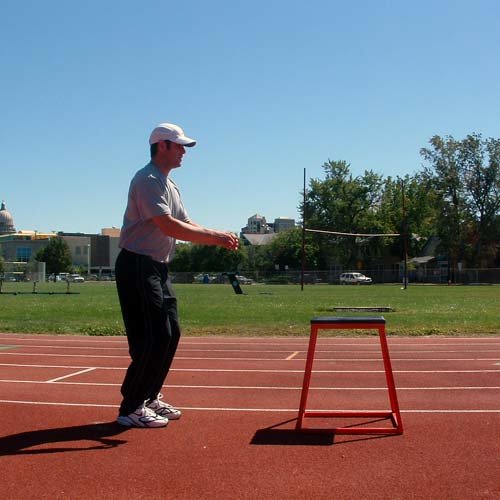

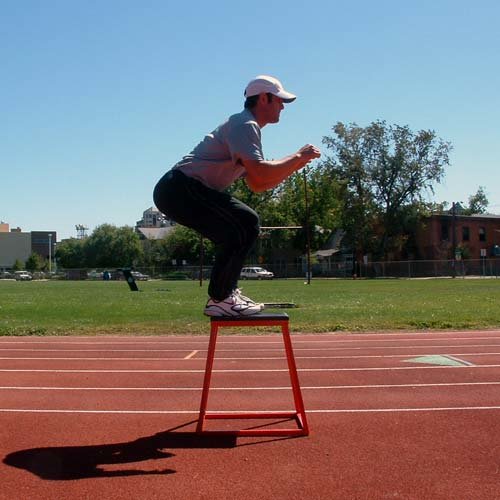
One Leg Box Hop (Shown Two Legged)
Click To Enlarge.Session 1: UB
- Incline DB Press
- Row
- Heavy Triceps
- Rear-delt Raise
- 4-6 sets of 5-8 reps each
Session 2: LB
- On the track with 60 yd build ups to 90%, 50 yd bounding, lateral hurdle hops, squat runs x 10 seconds. 4-6 sets each

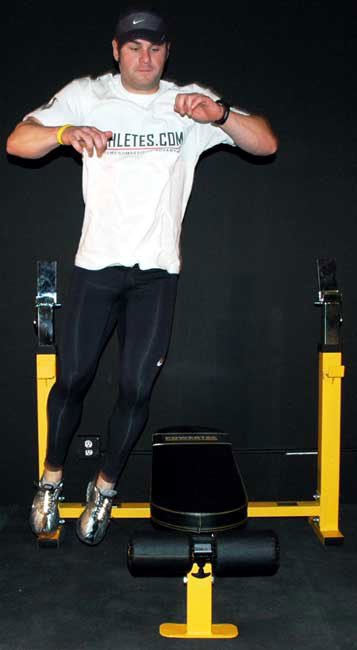

Lateral Hurdle Hops
Click To Enlarge.Session 2: UB
- Push Press or Push jerk
- Pull-up
- 4-6 sets of 3-8 reps each
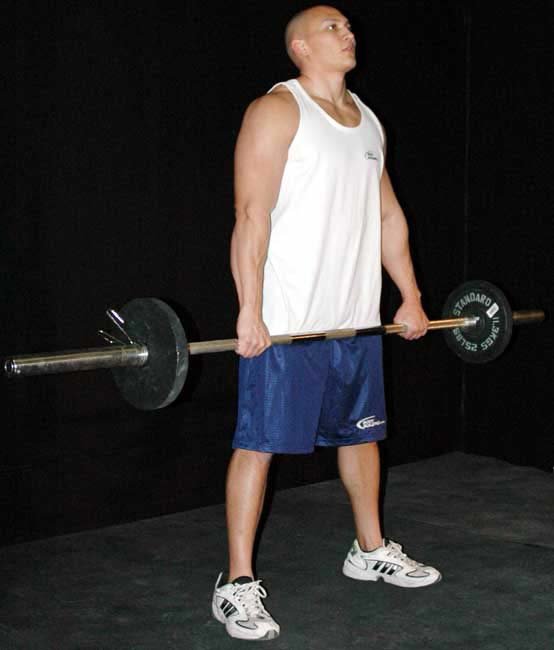
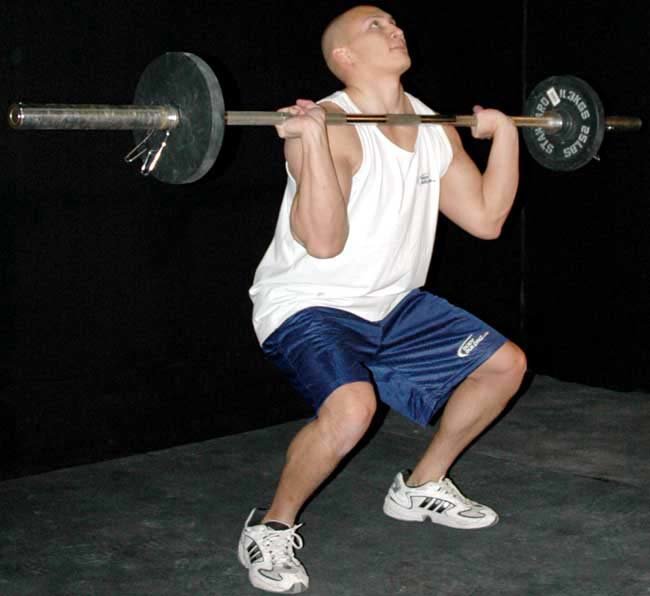

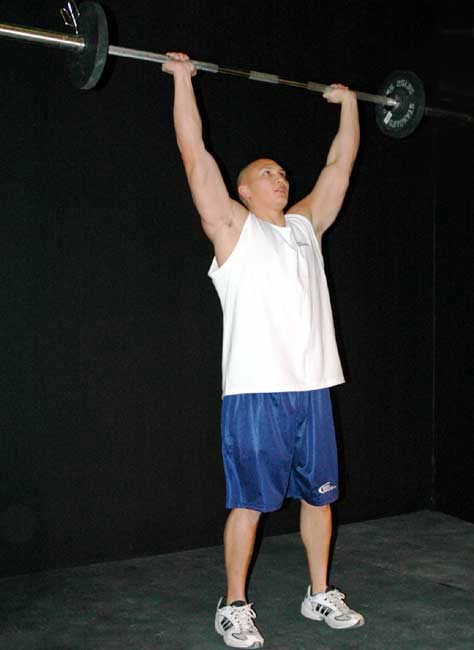
Push Jerk
Click To Enlarge.- Session 1: LB Off
- Session 1: UB Off
- Session 2: LB Off
- Session 2: UB
Therefore, he was getting 4 days rest between body part workouts and 8 days between like sessions. This allows him near full recovery and he was able to set records nearly every workout for a month long period which coincided perfectly with the timing of his workouts and tryouts.
EMS was also used on his legs to maintain his strength. It's important to note that the gains from this phase weren't just made from this phase itself, but they were made and set-up in the previous phase as well.
Conclusion
Those are a couple of examples how to set things up. Hopefully you can begin implementing some of these ideas into your training. Stay tuned for a future article on the same topic in which I'll cover how to stimulate that same adaptation by simply engaging in cyclical eating patterns.