|
|
![]() By: Josh Henkin
PART 2 - Some Basic Lifts By now we hopefully realize that Weightlifting is a sport in itself. A sport that includes the competitive lifts, Snatch and Clean & Jerk. Now, weight lifting is using weighted implements to improve various forms of strength and body composition. However, Weightlifting offers numerous benefits for those lifters that are either looking to improve their sporting performance, or a much needed variation in their training programs. Now, I still receive questions from people concerning the relative safety of learning and using such lifts. It is interesting to note that running and jumping creates forces six to eight times one's bodyweight. This is far greater than the force any lift can create, whether it be in extremely heavy or moved very quickly. Many therapists and coaches also forget that there are various forms of flexibility, the most crucial being dynamic range of motion. The core lifts and all their variations are superior than any machine or isolation exercise in increasing an individual's functional range of motion. Therefore, any coach, parent, or therapist should feel very comfortable in implementing these lifts as long as proper technique and loading are used. It is of the utmost importance to remember it is the speed of movement rather than load that is going to dictate the usefulness of such exercises. Let us now get into some of the progressions of the Olympic Lifts. I am listing these exercises in the order I find to be very effective in progressively learning correct body positioning and speed of movement. Deadlift
Many lifters may have already been using the deadlift, unfortunately somewhat misguided upon the use of the exercise. The deadlift is considered predominately a hamstring, glute, low back exercise. It is extremely useful in learning how to pull from the floor to set up the explosive phases of the other lifts. We teach correct low back positioning and hip movement from the deadlift. Here are some key points to remember when performing the lift.
Front Squat
The Front Squat is a must exercise to not only build up the strength of the thigh muscles, but to also teach how to properly catch the bar in the clean. Many sports programs have only used the Power Clean and Power Snatch in their programs. While this is not bad, when you do not use the full versions you do lose some of the range of motion and proprioception benefits. By performing front squats the lifter builds flexibility in the low position and can learn how to "get under the bar" more effectively when it comes time to perform the Clean. The gripping of the bar is very important. While in general lifting the method of crossing the arms is acceptable, we must make our lifters now use a clean grip. Many lifters lack proper wrist extension to catch the bar in the clean efficiently. Therefore, by taking the clean grip we will build this range of motion rather quickly and we will have a head start on proper technique is the clean.
Overhead Squat
In my opinion there is no exercise that can test flexibility and strength like the Overhead Squat. While many coaches like to test their athlete's max bench press, I believe a great Overhead Squat will provide an athlete with more functional strength for the field. If you have never performed this lift, just begin with the Olympic bar, or even a dowel rod. This movement will help the lifter learn how to catch in the Snatch and become more comfortable with loads above the head.
Dumbbell Swings
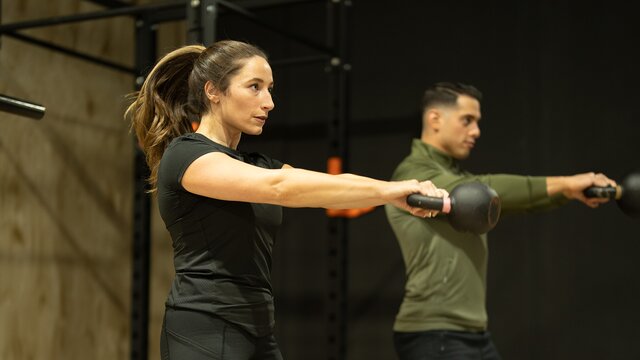
This is an old Russian exercise that Athletic Performance Coach, John Davies, introduced me to using. This is an outstanding exercise for the low back, glutes, and hamstrings. The DB Swing teaches the lifters how to effectively use their back side in an explosive manner. Being able to perform such action is paramount in learning the Olympic Lifts effectively. This exercise is extremely easy to learn, but is very beneficial. A lifter may use this exercise as a warm-up before their training, a strength-endurance exercise, or a heavier strength-speed movement. This would obviously depend on the loads, sets, and reps.
This exercise can be done with a kettlebell as well. Using such a tool does make a difference because of its shape. As my good friend and colleague, Keats Snideman, remarked, "the kettelbell is completely different than a dumbbell in every respect." Of course this was after Coach Snideman had performed his first set of high rep snatches with the kettlebells and we almost revisited our dinners. These are the lifts I would begin to learn and implement in the training program. How fast someone can progress depends upon their ability to maintain good technique. The benefit of having a qualified coach is obvious in that the lifter can have proper instruction and guidance on how to correctly use all the lifts. Hopefully these pictures provide enough information for all lifters to utilize these movements. Never forget to begin with a lighter weight until the form feels comfortable. Then you can slowly begin to increase load, but never at the expense of technique. Recommend this article to a friend by e-mail here! Visitor Reviews Of This Article!
Related Articles
|