Whenever the great physiques of our time are compared, one competitor invariably stands out as having the most desired look and the greatest proportion and aesthetically pleasing shape of them all.
That man is Frank Zane and his look, always magnificently presented and hewn like polished marble, has proven popular among fans and fellow professional bodybuilders alike ever since he first came on the scene proper back in 1965 when he won the IFBB Mr. Universe medium class.
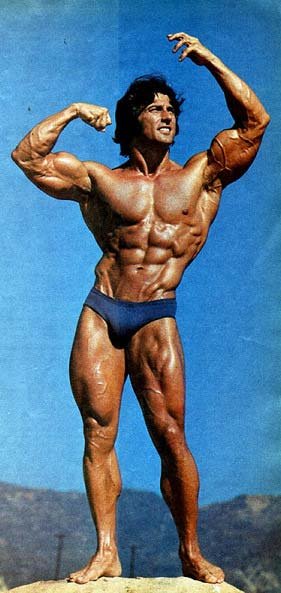
Broad shoulders, small waist, beautiful lines, full muscle development and graceful presentation characterise the Zane physique. To many his complete look, a perfect melding of size and aesthetics, epitomises what a bodybuilding champion should look like.
In a recent poll bodybuilding fans overwhelmingly said that of any physique of the 20th century Zane's would be the one they would want to attain. Although clearly possessing one of the very best physiques of all time, Frank would have to overcome judging panels biased toward the larger physique, a phenomenon that still seems to exist today.
A smaller body type, Frank had to present something pretty spectacular to get the recognition and, ultimately, the rewards, including three Mr. Olympia titles (in 77, 78 and 79) that eventually came his way. And at five feet nine inches and 185 pounds ripped he did exactly that - with a style all of his own.
When people talk of Frank Zane today the expressions "master poser" and "perfect proportion" are mentioned quite frequently. But one must not forget the intellectualism Frank brought into the sport.
His writings on the mind muscle link, and thought processes and how they effect physical development are, much like his physique, in a class of their own. He remains an articulate spokesman for the sport he dominated in the late 70s.
Persistence is also another word that we could use when describing Frank Zane. It was only after 10 years of hard training that he won his first major titles - the 1968 Mr. America and Mr. Universe. In the latter he beat an emerging Austrian hulk named Arnold.
Today Zane is training and dieting with the tremendous focus he is known for and is by all accounts in great shape. He still frequently trains people from all over the world at his base, The Zane Experience, in Palm Spring California and runs a successful mail order business.
I spoke with Frank recently and he discussed his life as one of bodybuilding's greatest, what he has been doing in recent years and his thoughts on the current state of the iron game.

[ Q ] What are doing business-wise these days Frank?
I basically do two things. I have a program called "The Zane Experience". I have a private gym where people come from all over the world and usually do a three-day program - it's three, three-hour sessions and in that format I teach them how to train with weights and I work out with them.
I show them everything they need to know in that time frame so when they leave they know exactly what to do. They are welcome to check back with me for updates of any kind they want. I have been doing this kind of program since 1981.
| PRO BODYBUILDING WEEKLY | |||
|


[ Q ] It began as The Zane Haven right?
Yes, I started at Palm Springs. It was a different idea at that time. We had a live-in center, a small hotel, where people stayed and we did it that way for years. We would take groups of six-to-eight people at a time but it was just too much work to both house people and teach them.
So in 1988 I switched to doing it this way. People would come and stay at a nearby hotel. I have the gym and they come here on their own - they can stay wherever they want - and we called it The Zane Experience. I work with the people personally.
[ Q ] How would you compare your life now to how it was back when you were competing?
There were different stages when I was competing. For most of the time I was a full-time schoolteacher - I taught math - so I had a very hectic day where I would teach school up until three o'clock, then train after that. Of course I had the summers off which enabled me to train for competition.
I did that for 13 years and when I won Mr. Olympia I retired from teaching to train full-time. In the meantime I developed a mail order business, which I have had since 1970. So now I split my time between the mail order business and the Zane Experience program.
[ Q ] Do you miss your professional bodybuilding days?
No. It is a lot of work. I am glad I got it out of my system. I see people now who come to see me who are 50-years-old who want to do that because they never did it. It is a tremendous goal to have - to compete as a bodybuilder.
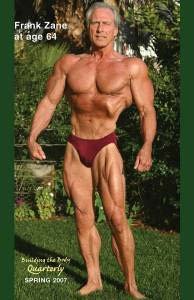
 Click Image To Enlarge.
Frank Zane - Age 64.
The strongest motivation you can have is that because you have to get onstage and you have to look good. It is one of the hardest things in the world there is to do. I did it for 23 years and that was maybe too long. It was long enough in any case. I stopped when I was 41 years old.
[ Q ] I understand you are still training hard and in good shape. What are your current training goals?
Well I still have my goals, pretty much like it was when I was competing and getting into peak condition every year. And I got into great shape this year. My website has some pictures of my current level of development - go to tips of the month.
I also publish my own magazine called "Building the Body". It is a quarterly publication that has no paid advertising - it is just all information. I write most of it myself and have been doing it for about nine years now.
[ Q ] How often do you train nowadays?
I get a lot of my workouts with my clients and when I do it is three-days-in-a-row. If I train three-days-in-a-row I will rest at least one day, usually two. But my favorite way to train is either every other day or three days out of five with weights.
The workout that I am currently doing, which I do most of the time, is day one, chest, shoulders and triceps - the pushing muscles - the next day, legs, the third day I rest, the fourth day I do back, biceps and forearms, and on the fifth day I rest, then I repeat.
When I am training on my own I tend to train that way. When you get older you really can't train as frequently. The whole idea is to train less frequently, but harder. I still train hard but I don't do as many sets. On upper-body days I might do 20 to 24 total sets. On leg days I do about half of that.
[ Q ] Where does cardio feature in your program?
I do more and more of it as I reach peak condition. Usually I reach my peak in the autumn just like when I was competing. As this gets closer I do more. I usually do about an hour total of cardio a week, but as I get in better shape I push that to three or even four-hours-total.
[ Q ] So you follow a series of phases similar to when you competed.
Yes. It is basically a two-phase program - the first three months and the last three months.
[ Q ] When you train with your clients you instruct them at the same time?
Yes, but in my own workouts I usually do only two-sets-per-exercise. So when people come here they are typically what I would call intermediate bodybuilders - they have trained before but still need direction. So it is a great opportunity for them to train with me. They like it because they can see what it is like to train with me.
The pace is a little bit slower because it is based on teaching them good form. Whenever I go a little slower I train heavier. If I train faster I train a little lighter because by training faster with less rest between sets you are not going to be as strong.
[ Q ] Would the heaver training come first in your personal training program - the first phase - and the lighter stuff later?
Not necessarily, but usually it tends to follow that pattern. My goal in the first phase is to up my exercise poundages gradually and my goal in the last phase is to do what it takes to get more definition without losing any muscle mass.
[ Q ] Speaking of becoming defined, how is your diet structured these days?
My diet is always pretty strict. I will be 65 in a couple of weeks so I really don't eat very much. All the research shows that if you want to live longer, you eat less. So I never really eat more than about 2000 calories a day. And I get about one-gram of protein per-pound-of-bodyweight. I weigh usually between 170 to 175 pounds - a little lighter than before.
| PROTEIN CALCULATOR |
I find I can maintain definition better at a lighter bodyweight. Usually I don't get as much carbohydrate - about half to three quarters as many grams as compared to protein per day. Typically if I am training to reach a peak I will keep my carbohydrates low for three days in a row and then on the fourth day increase them to match my protein intake.
[ Q ] How are you feedings structured?
It varies. I don't believe in eating every couple of hours because I don't eat a lot of food. I basically eat a breakfast and an early dinner - two major meals a day, and two snacks.
I have a protein powder I developed so I generally have a protein drink with some glucosamine, chondroitin and MSM in it, twice a day with some fruit. And then my two other meals: one is around three-four o'clock and that is some kind of meat and some kind of vegetable, usually a salad.
At night before I go to bed I may have a snack around eight or nine o'clock. Last night I had a piece of chicken and that was it. Before I go to bed I take some tryptophan and usually a little bit of fruit and that is it.
[ Q ] You said your diet plan varies. Could you explain this further?
What I found works best for me is to cultivate the feeling, the sensation of hunger. I think people eat way too much and if you want to have good definition I don't think you should eat very much. So I wait until I get hungry. And the first time I get hungry I still don't eat.
I stay hungry a little while, before I eat. You are not really losing muscle mass when you are hungry - only when you stop eating for about eight hours do you start losing muscle size. Usually when you first get hungry that is a sign that your body is burning stored body fat.
I like to hang out with that feeling for a while and I encourage people to do it to. If they want to lose weight they have to know what it feels like to be hungry. You don't have to stay hungry. If you want to get lean and lose body fat, stay hungry longer.
[ Q ] But you wouldn't train with weights in that state.
No I don't think you should train when you are hungry. Aerobics yes. It is good to do it then because you will burn body fat, but for weight training you have to have a meal under your belt at least several hours before. It needs to be pretty well on its way to digestion before you train.
[ Q ] Do you think your thoughts on nutrition are somewhat radical given the general consensus seems to suggest that to gain muscle and lose fat we should eat every two-to-three-hours?
I don't go by what other people think. I go by my own experience. I don't even go by theory. I have a master's degree in experimental psychology and can perform experiments and understand, and read research and I don't put any stock in it (theory) whatsoever unless it works for me.
It may be an idea to test but I basically have accumulated 50 years of training experience of things that I know work for me and they are what I resort to. So it doesn't matter what other people say. If it is not my experience, I won't practice it.
[ Q ] So there are no general rules in bodybuilding? What works for you may not work for me?
What I have found is that a lot of things work. There is no one-way to do it. Everything works if you let it. The things you don't want to do are things that are dangerous and that might hurt you. Like I don't believe in going to failure, doing forced reps and so on. I never do that stuff.
The thing is, as you get older you run a greater risk of getting injured. And I certainly have had my share of injuries over the years and have just trained around them. There are a lot of exercises I don't even do anymore because I can't. They hurt. But I have found other ways to work the muscle group and still get great workouts based on special equipment I have modified to work for me. And I don't do dangerous, stupid stuff.
[ Q ] So what is your goal for each set of an exercise?
My goal for each set is to make a lighter weight feel heavier. I move it in a stricter fashion and focus on a slower negative and a controlled, explosive positive. I'm putting more force into it. I don't believe in doing slow positives, I think these are a waste of time. But exerting enough force to take the positive to completion and then fighting the weight back to the starting position for the negative.
The negative should always be a least a little slower than the positive. And I stretch between sets. After every set I immediately stretch for 15 to 20 seconds. And I get a tremendous pump in every workout. My goal in every workout is to get a great pump. And I get a good pump out of every set.
[ Q ] Back when you were competing did you follow the same training protocols?
Well it was different then.
[ Q ] I guess with age come greater insight into what works best for you. But if you knew back then what you know today would you have done anything differently?
I don't know. People ask me that but I really can't give you an answer because I don't know. Maybe. But if it never happened what difference does it make? All I know is what I did worked, and worked well for me. I did a lot of volume training, a lot of sets.
By the way I have a book out that documents that called: Frank Zane: Mind, Body, Spirit, The Personal Training Diaries. It is a summation of 40 years of training condensed into 180 workouts. The book features the typical workouts I actually did with weights, reps, everything.
It is quite an interesting book. It is not like other bodybuilding books. The workouts in this book are in order but some of them are the hardest workouts I did. Some of them are extremely difficult. It is arranged in diary fashion starting from the first day of the year and going to the end.
But if you were to pick this book up and say, "okay, I will now do all of Frank's workouts in one year and I can look like him," that is wrong. That is not what this book is about. I think they would probably kill a normal person if they were to follow them all like that. I just do less volume training now than I did then.
[ Q ] And these people are not Frank Zane. They don't have your recovery abilities and metabolism.
That's right. Everybody is unique. Certain generalisations will work up until a point with everybody but after that you pretty much have to find specific things. That's how I learned about bodybuilding - through my own experiences competing and reaching a certain state, meeting other people and learning from them.
One thing that I never did was to go to someone and ask those people to teach me how to train like a lot of people did with Vince Gironda or Bill Pearl who people would go to and say, "Teach me, take me under your wing." I never did that with anybody. It was always on an even basis.
I trained with Arnold for quite a few years in the 1970s and we were always on an equal basis. We were competitors but we were also friends and everybody was a friend to the other. That was actually our social life - we would hang out together when we weren't training and we would learn from each other.
[ Q ] So the bodybuilders you trained with tended not to have gurus to guide them.
That is right. We learned from each other.
[ Q ] Was there a particular contest you enjoyed winning more than the others?
Out of the three Mr. Olympia's it would have to be the last one. I think in 1979 I was in my best shape of all time considering everything. I had some really good years but I think '79 was my best year as far as combining size and shape. Just having it all together.
[ Q ] Were you at your biggest in '79?
I was pretty big in '79. But I was also very muscular and I was in great shape. There are some very good videos of me posing from the Olympia years on youtube.com. There is a really good one - a black and white video - showing the type of shape I was in at the '79 Olympia.
I was big and ripped too. In 1982 I was bigger but I wasn't as ripped and in 1983 I was smaller but extremely muscular - same thing in '76. In 1978 I was a little leaner but very muscular so I had these different looks in different years.
[ Q ] Contrasting these different looks to what you presented when you beat Arnold on the way to winning the 1968 Mr. Universe in Miami Florida, how would you describe the physique you brought to that stage?
I was in good shape that year and had just won the Mr. America the week before. And the week after I was very muscular when I went down to Miami to compete for that. But I think in those days I was always a big fan of squatting. My legs have always been very well developed. But I think I carried more size in my thighs in the late 60s through to the early '70s.
Later on my upper body grew more and I kept the size of my thighs down to achieve a more proportioned look. My thighs were always a little bit ahead of everything else early on. My calves were a little bit behind. Even now my thighs are very muscular and my calves are actually bigger. They are responding very well to almost no work at all.
[ Q ] How do you train calves?
I do three different exercises for calves. My aim is to get a burn on every set. I train them every five-to-seven-days and they will grow from that.
[ Q ] Going back to the 1968 Mr. Universe. What was the deciding outcome that allowed you to win this show against the emerging Arnold?
I was in shape and he wasn't. It is as simply as that. I was defined and very muscular and had a great posing routine and tan. Arnold was big, white and smooth and he didn't pose that well. He got a lot better subsequently the next year when he first competed in the Mr. Olympia. He was totally transformed. And he just got better after that. But in 68 there wasn't any contest between him and me.
The thing is... the judges for that contest included Chuck Sipes along with other champion bodybuilders. They had nothing at stake. They weren't there to fix anything; they were just honest and that is how I won. I was the clear winner.
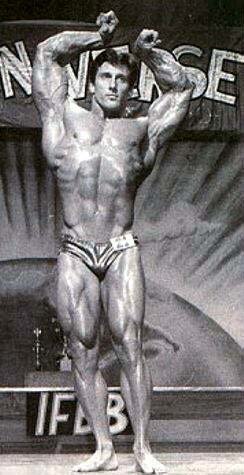 Click Image To Enlarge.
Frank Zane At The 1968 Mr. Universe.
[ Q ] Are we seeing a swinging back to the more proportioned look do you think?
No, I think it's a freak show. It is all about how big you can get and how freaky you can look. You get points for looking freakier. There are only a couple of guys who really seem to have the more aesthetic look. Somebody like Dexter Jackson I think probably has the kind of body that I think should win. But he won't because he is 210 pounds.
[ Q ] With his shape he does appear larger than his weight suggests.
- Creating The Illusion Of Size: Maximizing Width. - By Jim Brewster
- Building A Good Base Frame. - By Topic Of The Week
- Symmetry: Why It Is Important, & How To Achieve It! - By David Robson
- Other Symmetry Articles...
He doesn't look that big standing next to guys like Ronnie Coleman. Dexter is extremely developed and refined. If I were him I would put a little bit more into my posing routine to bring out my lines a bit better. He has a great body. I did it a bit differently because I had to.
People don't really know what certain things mean. For example, round one is called the symmetry round. Nobody really knows what symmetry means. Symmetry just means that your left and your right side are the same. And nobody really has perfect symmetry. What they are talking about is proportion, is everything balanced?
It's not symmetry. It's part of that but its not what it is. People said that I had the world's most symmetrical body. Nothing could be further from the truth because my body is relatively asymmetrical. The thing is I posed it asymmetrically. It's much more interesting to pose you body asymmetrically.
Symmetry:
In other words don't show both sides the same. It's boring when you do that. You get these big guys today and when they pose its done straight on - lat spread, double-bicep, most muscular and on and on. And then they walk around the stage, hit the most muscular, walk to the other end of the stage, hit the front-double-biceps. It's boring.
I don't care if I don't ever see another one of those contests ever again to tell you the truth. It's a freak show and I find it distasteful although I do admire these guys for achieving that. It is a h*ll of a lot of work. I respect that.
But I don't prefer the way they look. I don't think that it has helped bodybuilding. Bodybuilding hasn't become any more popular. It has just gotten tagged with the steroid image, that's all. You look at a bodybuilding today and you say, "steroids." It's automatic.
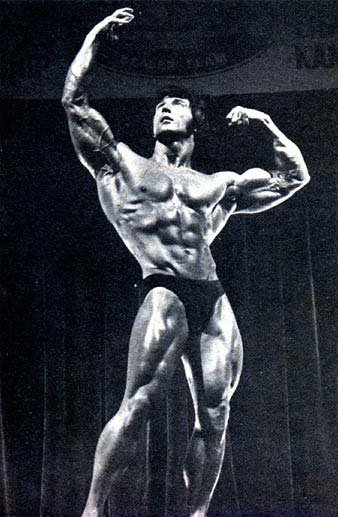 Click Image To Enlarge.
Frank Zane.
[ Q ] Everyone from your era seemed to have several signature poses that were uniquely theirs, which separated them from the other competitors. Why do we not see this today? Could there be posing teachers along with the established training and nutrition gurus?
Yes, but who will teach them? I think the people that are telling them how to pose don't know anything about it. These judges today, the way they tell people to pose and the positions they put them in. They look so awkward.
For example: they tell them to out one foot in front of the other and lock the knee. It is very awkward looking. People who know about posing are not really involved and they are not really interested. Someone like me: I'm not really that interested in it anymore. It has gone so far in the opposite direction I think it is hopeless.
[ Q ] Maybe you can get together with several other competitors from your era and teach people how to pose properly. Run workshops.
Maybe not okay (laughs). Because I don't even care - I care about bodybuilding but not the way it is now. To tell you the truth people who care enough about the way bodybuilding used to be come to me for advice and that is all I care about: that idea. If you want to look like a freak there are plenty of people around who will tell you how to do that.
Every muscle magazine on the market will tell you how to do that except for one thing: they won't tell you what everybody is doing as far as the drugs they are taking. They won't tell you what that is. That is the key ingredient that is left out.
They say, "If you want to look like a freak take these supplements, take MuscleTech. If you do this you will look that way." But that's not true at all. Supplements help, but it is the massive drug abuse that goes on. To tell you the truth I don't blame the bodybuilders. Basically they are just doing what it takes to win. I blame the judges. The judges are the ones that say, "You are the best."
With posing here is my idea, which, of course will fall on deaf ears, but I think this would be a really good idea: make the vacuum pose a mandatory pose. If you want to get guys to start paying more attention to having a small waistline, make the vacuum pose mandatory.
Get them to do it with the abdominal pose. You would use the same position with hands behind the head from the abdominal pose to the vacuum. It would certainly narrow the field because nobody could do it. Actually there is only one guy who could do it and that is Chris Cormier. But nobody else could because of the size of their guts, which are too big.
Another thing that put bodybuilding into the monster realm is when they eliminated the above and below 200 pound class. Everybody said we should all be over 200 pounds. Now there is nobody onstage who is less than 200 pounds.
 Click Image To Enlarge.
Frank Zane.
[ Q ] Problematic in that it encourages the smaller guys to pack on too much size?
Yes that is what it does. Somebody five foot two should weighing about 170 pounds, like Danny Padilla. Remember Danny Padilla?
| RELATED ARTICLE | ||
|
[ Q ] Yes he was phenomenal.
Yes and he should have won the Mr. Olympia in 1981.
[ Q ] Can you give your thoughts on this show?
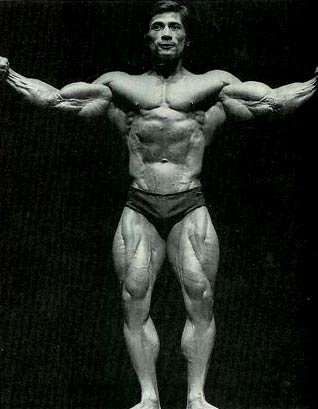
The way it went with Franco winning in 1981 was probably the worst decision anybody ever made in a Mr. Olympia contest. Padilla was incredible and I think he should have won.
 Click Image To Enlarge.
Danny Padilla At The 81' Olympia.
[ Q ] How could they have placed him so low then?
I have no idea. I just saw him before he went there. I didn't even go there because I knew what would happen. I actually should have competed that year instead of 1980. I saw Danny training and Franco training as well as Chris Dickerson. I told Chris, "Chris you are stupid if you go in that contest, you are not going to win." He said, "No, it is my year." I told him he would find out. Sure enough, and Danny Padilla was even lower.
[ Q ] What about Tom Platz who came third. Should he have placed where he did in your opinion?
I don't know. I never thought anything of Platz's body. When I looked at him compete all I saw were thighs walking across the stage. If it was a case of having one good body part making you the winner he would have won, but that is all he had (legs).
He didn't have anything else whereas Danny had everything. And that was the only time in his life he was ever in shape (at the 1981 Mr. Olympia). He was incredible. And here's another thing: if you look at him six feet away he looks amazing. But if you look at him 60 feet away a bigger guy will look equally impressive, because you can't see the detail that far back. And that probably had something to do with it. He gets lost.
 Click Image To Enlarge.
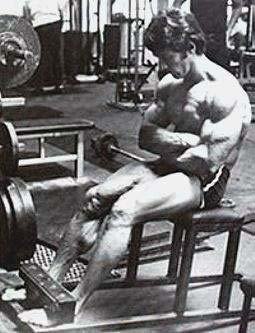
Frank Zane.
[ Q ] What is your opinion on the judging process at the pro level?
The whole thing about bodybuilding is you could always argue that what it really comes down to is it is a matter of opinion and a value judgement. The judges vote for what they like, what they prefer. And what they prefer tends to be what they look like or what they want to look like. You could have entirely different results with different panel's of judge's.
There is no objective standard and that's why it (bodybuilding) is not a sport. That is why, in my book, it never will be one. This talk about bodybuilding getting into the Olympic games is nonsense. It's not a sport. A sport is something you can have objective criteria for who the winner is.
| RELATED ARTICLE | ||
|

Even in activities like gymnastics there are objective criteria. There are still things they look at such as form, how the moves are executed. What do they do in bodybuilding? They don't do that. It is all about how you are developed.
Like round three: the free-posing round. That is supposed to be based on your posing. Well it's not. The best poser doesn't get first place in round three. Then they say it is how you look when you are posing. Then why have a round at all then if that's what it is.
[ Q ] There does often seem to be different judging criteria for the smaller shows verses the larger shows like the Mr. Olympia. Certain trends can be seen from show to show.
Well it is a matter of who is in shape should win I think. You definitely have to have definition to win. If you are smaller and have definition then you should win over a guy who is bigger with less definition. But if you are a bigger guy that has definition and proportion then you are pretty well a shoe-in providing the judges like you.
And a lot of times somebody great will come on the scene and blow everybody away but still not win because they have not been seen that often. They have to come back a few times and pay their dues.
[ Q ] You had a lot of involvement with Joe Weider during your competitive years?
Well Weider was pretty much the only game in town when he was involved in bodybuilding.
[ Q ] Would you have considered yourself a Weider athlete?
I wouldn't say that. Basically I contributed to the Weider magazines and wrote articles and took photos and stuff in exchange for advertising. That was pretty much the deal.
[ Q ] Did you ever have a contract with Joe Weider?
I never had a contract and never got any money from Joe. I never even asked him for money. He had no problem giving me ad space in his magazines, though, and he still does.
[ Q ] Did Joe Weider oversee your training at any point?
No. I will tell you one thing he was good at though and that was posing. He helped me to develop a lot of the poses that I used. As far as the master trainer and all that, I don't think that was the case at all.
I think that he had a keen eye for a physique and for posing. He was always there at posing sessions. And the best thing you could have done before a contest was to have a photo session with Joe because he would always be there telling you to do little things to make the pose look better. And that was probably the best thing I had gotten from Joe. He knew all these little things about posing just from watching. He really loved the sport and he lived vicariously through it. I think that it has really gone downhill since he's left.
[ Q ] Did many of your fellow competitors get such advice from Joe?
I know what I did, not what anybody else did. Arnold pretty much did the same thing also. Basically when you are in your best shape you want to get a lot of photo sessions in. Joe always encouraged me to take a lot of photos and I did. I could have even taken more but when you are training for a show that is all you want to do, that and getting into the sun.
Do your own little thing rather than go to the studio and do a photo session. But that is really the best thing you can do because if you don't do the photos you really don't get any recognition or publicity.
[ Q ] Did Joe help your career in any other ways?
Just contributing to the magazine, getting good photos. For example, he wouldn't use bad photos of people. He would tell me that if it weren't a good photo he would not use it. Which was great because it helped your image. But I think that was pretty much it. He had the vehicle (the magazines) and it was the biggest circulation. Although you didn't get paid for it, it did help to make your reputation so it all worked out in everybody's favor.
[ Q ] So Joe would be more versed in the artistic side of the sport?
I think basically he is a businessman who was knowledgeable about what a top physique should look like. I think Joe was a size freak. He loved guys like Arnold and Sergio.
The thing that he used to tell me all the time was (Frank does his best Joe Weider impression): "Oh come on Frank you gotta get bigger. Come on eat some more. Just use the Weider cheating principal more okay. You need to get bigger." You know that really wasn't the right advice to give me because I didn't need to get bigger. But that is all he wanted.
[ Q ] How can you reconcile the fact that you won three Mr. Olympia titles up against some pretty big guys at the time? Surely Weider's publications in some way influenced the judging at the time.
Well Joe had nothing to do with it. I think that he pretty much steered clear of associating with the judging process, which was a smart thing to do. People get influenced as to who they will vote for and what they like indirectly by what's in the magazines and what tends to be in vogue. Human perception is not very straightforward.
The way people perceive things is not the way you think they would. We basically perceive through our belief system, which gets built up through various ways. So in the sense that what is in the magazines influences peoples ideas of what's good I think yes, that may have some kind of an effect on who is selected. But as far as saying who should win the contests he (Joe Weider) had nothing to do with that. I don't think Ben Weider did either. I think they left it up to the judges.
[ Q ] So the judges may have been influenced by virtue of the athletes emphasised in Joe Weider's magazines?
You know it has always been like that. Bodybuilding has always been a size-dominated sport. The saying is: "A good big man is better than a good small man." That was the standard attitude toward the whole thing.
[ Q ] 'Good' being the operative word. We saw some questionable decisions at the 1980 and 1981 Olympia's.
I agree. If you look at Grimm's Fairy Tales there is the tale about the emperor's new clothes. The emperor is parading in the street with nothing on and everybody is raving about what incredible clothes he has except for this young child who can actually see that he is nude. And that is pretty much the way people perceive things.
They see things according to their belief systems or what they are fed. It is about what is at stake. So it is all in what you like too. So Jay Cutler wins it this year? I think that he has a great physique, especially his legs for example. I could find flaws though. I would not want that kind of body. He is just a big, huge blocky guy. He is not even tall, just way too big. But that is the epitome of development as things stand today.
[ Q ] Would you say that Ronnie has a better waistline compared with Jay? He seems to have more of an X-frame type physique.
Ronnie has a huge gut, although one year it wasn't so big. The thing is too: if you squat with 700 pounds for ten reps it is going to make your waistline bigger.
[ Q ] What would be your guidelines for squatting?
I don't think your should overdo it. If you do it will make your waistline bigger.
[ Q ] Would you perhaps have someone cut back on squats as the contest approaches?
It is hard to say because we would be looking for generalisations because every situation is quite specific in my book. I just think that in Coleman's case that is just one of the things that contributed to his large waistline. It could also be the eating of incredibly large amounts of food. Another thing could be the combination of chemicals and pharmaceuticals he ingests, although I have no proof of that.
[ Q ] So the massive growth we are seeing today is due not necessarily to the gene pool getting bigger but the fact people are willing to take more risks?
Yes, I think so.
[ Q ] It does seem hard to pinpoint any one thing when discussing a particular athlete's development.
You get into the realm of gossip and that is not fair to these guys because it looks as if. But we really have no proof. We don't have any photos or video of guys doing certain things so what can I say? But it sure looks like it.
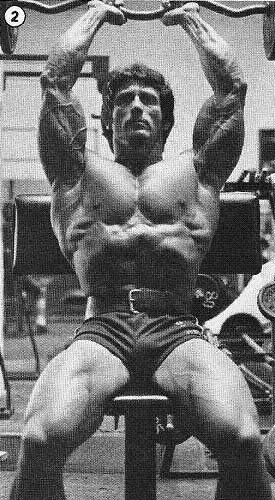 Click Image To Enlarge.
Frank Zane.
[ Q ] Well it has been great talking to you Frank. Thank you for your time.
Thank you for the interview David.
Visit Frank's Website: www.frankzane.com