

Want to improve your cycling performance, either on its own or for a triathlon? Step one is simple: Put in your time on the bike. There's no way around it. Cyclists simply have to improve their aerobic and anaerobic systems by following a strict endurance-training program. I'll spare you a lengthy discussion of the SAID Principle—that is, specific adaptation to imposed demand—but suffice it to say, to get better at cycling, you have to cycle.
So does the story end there? Only if you want to hit your head against the same performance ceiling over and over again. As an increasing number of recreational and competitive cyclists are discovering, training for strength allows you to use your existing muscle more efficiently, tap into power you didn't have before, and perform better in the crucial late stages of your races and time trials.
This style of work is known as concurrent training, but the version backed by the latest science isn't the same old lightweight rep-assault you may have been doing for years. Change the way you approach your workouts, and you'll create a whole new idea of what you can achieve on the bike!
"As an increasing number of recreational and competitive cyclists are discovering, training for strength allows you to use your existing muscle more efficiently, tap into power you didn't have before, and perform better in the crucial late stages of your races and time trials."
Build Endurance on the Bike, Strength in the Gym
As someone who has experience in both strength training and endurance training, I'm not going to insult you with a stereotype of "the endurance athlete" versus "the strength athlete," as if the two are entirely different species. Both are athletes, and they're also people, which means they encompass every body type, personality, training style, and lifestyle.
However, just like any other type of athlete, cyclists who get serious about their craft are prone to following the prevailing training style they see modeled around them. And when it comes to strength training, that model has been this:
"I'm an endurance athlete, therefore I should stay in the endurance rep range: 10 reps and above per set, with light weights and short rest periods. After all, I don't want to add weight in the form of muscle or induce too much leg fatigue."
Sound familiar? Even if that's not you, you've no doubt heard someone use this line of reasoning to describe their approach to training. Let me be the first to say that this approach is no longer valid. It's time to outgrow it the way you outgrew toe clips and steel frames.
Ask any bodybuilder—you're on Bodybuilding.com, after all—and they'll tell you that the best way to add muscle is with moderate weights, high reps, and short breaks. In other words, exactly the same way endurance athletes have been taught to train to avoid building muscle.
It's time for a change. Here's what you need to know:
- You can significantly increase your strength without adding large amounts of muscle.
- Increasing your strength can improve your endurance, power production, and resilience to injury.
- The best way to build strength is by training for absolute strength. This means heavier weights, low repetitions, and longer rests.
This is the recipe for building powerful muscles that will help you perform better: Train for endurance on the bike, and train for strength with free weights in the gym. Here's the how and why.
Rep Ranges For Athletes
For Hypertrophy 8-12 reps per set and higher
- Lighter weights, shorter rest periods
- Greater sensation of burn and/or pump, often by working to failure
- Common among bodybuilders
- Common (mistakenly) among endurance athletes trying to avoid excess muscle growth
For Strength 1-5 reps per set
- Longer rest periods, heavier weights
- No lifting to failure or for burn/pump
- Common among Olympic lifters and powerlifters
- Best for endurance athletes seeking to build strength without adding muscle
How does strength help endurance?
The strength-building mechanisms that help cycling performance are largely neurological. This means they have to come from teaching your body to better use the muscle it has, rather than from adding lots of new muscle.
This has the potential to benefit you in a number of ways. For instance, endurance training typically relies largely on the recruitment of slow-twitch muscle fibers. These fibers have great stamina as it is, but researchers have concluded that strength training improves the maximum strength of these fibers, which further increases the time it takes to work them to exhaustion. This allows you to reserve your fast-twitch fibers for later in a race or time trial.[1]
Heavy strength training develops fast-twitch fibers far more effectively than light high-rep training. This is where things really get interesting. A 16-week experiment performed with top-level cyclists found an increase in type IIA fast-twitch muscle fibers relative to more easily exhausted type IIX muscle fibers following combining heavy strength training and endurance training.2 Type IIA are more fatigue-resistant than type-IIX, yet still capable of producing high levels of strength and power. They're the ones that can give you an extra gear when everyone around you is exhausted.
Additionally, combined strength and endurance training has been shown to increase concentrations of fast energy-yielding substrates—e.g., phosphocreatine and glycogen—and lower concentrations of lactate at the end of a 30-minute bout of cycling at 72 percent of VO2-max:3 In other words, more energy and less discomfort.
Lastly, strength training improves how quickly you can produce force, what is known as the rate of force development. Bump this up, and you'll reduce the time you need to reach certain velocities, as well as decrease the intensity required to perform your endurance work.1
"Bump this up, and you'll reduce the time you need to reach certain velocities, as well as decrease the intensity required to perform your endurance work."
What about fatigue?
This is a fair concern. Whether because of the prevalence of intense bodybuilding-style workouts in gyms, or just because strength training looks tough, endurance athletes are rightfully concerned about heavy weight training impairing their performance. Research has shown, however, that it's all about the approach you take.
Back in 1999, researchers at the University of Waterloo in Ontario found that adding maximal strength training to a cyclist's endurance-training program had no negative physiological effects on endurance parameters, such as maximum oxygen consumption or lactate threshold.[3] On the contrary, it has been shown to lead to an improvement in cycling economy, particularly in less-trained cyclists.[4] Cycling economy is the oxygen consumption required to maintain a submaximal cycling intensity.
Ask any strength coach who paid attention during their certification exams, and they'll remember at least the Tweet-length version of that idea: Stronger muscles are more efficient muscles. The slightly longer version: As maximum strength increases, the amount of activated muscle fiber required to produce the same submaximal force decreases.[5] You'll do the same work, but with less effort.
While some research attempts to cast doubt on strength training's benefits for cyclists, these studies' methodologies are often to blame: the volume is too low, the program is too short, or not enough time is left for recovery. All of these issues can be addressed with smart programming.
Program Design Recommendations
Put all of these studies together, and a picture emerges of a cyclist who trains strategically for strength. He or she takes longer to exhaust, and has lower levels of lactate during intense stretches of work. This cyclist can also produce more force more quickly when the need arises. If that sounds like the recipe for a faster, more satisfying race or time trial, you're right.
So when is this person training? Good question. You have a couple of options.
Winter/Off-Season
This is the most common time for cyclists to devote time to strength, and with good reason. The "Journal of Electromyography and Kinesiology" found that devoting five weeks to maximal strength training (3-5 sets of 3-5 reps, 3 times per week) helped cyclists maintain their pedaling cadence over the course of two hours.[6]
During the Cycling Season
The flaw with some lackluster studies into concurrent training is that the strength component is simply added to an endurance program, without making any changes in the latter.[7] This is a recipe for exhaustion and impaired performance. Consider taking a cue from a review study published in the "Journal of Strength and Conditioning Research" in 2009, which concluded that replacing a portion of a cyclist's endurance training with maximal resistance training is likely to yield better time-trial performance and increase maximal power.[8]
The takeaway: You can have it all—but not all at the same time!
In my experience, most cyclists can benefit from maximal strength training 1-3 times per week, depending on the time of year. The program should focus on improving strength and power output, and consist of free-weight and bodyweight exercises. These will have more athletic transferability to cycling than using exercise machines will.
{{caption}}
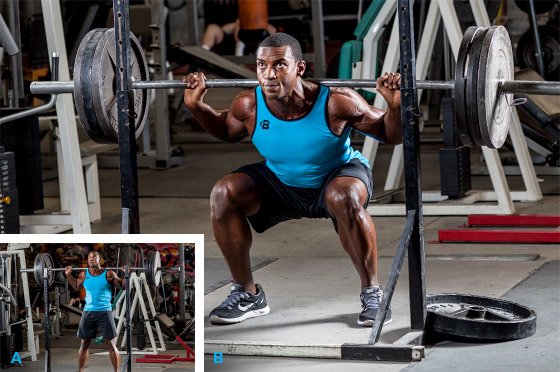
Barbell Back Squat
Focus on multijoint movements and avoid isolation-type exercises. This isn't the time to try to "bring up" your calves! Stick mainly to sets of no more than 5 repetitions on big-ticket movements like the squat, with 3-minute rest breaks between sets. During these, you can either rest or perform mobility work or noncompeting strength work—such as ab work after lunges. Perform the concentric phase (the up phase) of heavy lifts as fast as possible, even if the weight moves slowly. Do not go for "the burn" or to failure on any movement. Feel strong and in control at the end of every set.
Here's an example of what such a strength session could look like. Bear in mind, this doesn't have to be your workout, but it's an example of a full-body strength routine that would give an endurance athlete a lot of bang for their buck.



BodyFit
$6.99/month- 2,500+ expert-created single workouts
- 3,500+ how-to exercise videos
- Detailed workout instruction
- Step-by-step workout tips
- Training at gym or at home
- Access to Workout Plans
- Access to Bodyfit App
- Store Discounts
Already have a Bodybuilding.com account with BodyFit? Sign In

What comes with BodyFit?

- Instructional Videos
Don't risk doing a workout improperly! Avoid injury and keep your form in check with in-depth instructional videos.
- How-to Images
View our enormous library of workout photos and see exactly how each exercise should be done before you give it a shot.
- Step-by-Step Instructions
Quickly read through our step-by-step directions to ensure you're doing each workout correctly the first time, every time.
For optimal results, replace a portion of your endurance-training volume with a strength-training session like this. You can strength train in place of easy endurance-training days, or after hard endurance workouts. If performing a strength session after a hard endurance session, perform immediately afterward, or separate the sessions by at least six hours.
If you're struggling to recover between workouts, you're probably doing too much. Cut back on exertion, make sure you're eating and resting enough, and give your body the space it needs. Building strength requires listening to your body, but once you get the hang of it, the rewards are significant!
References
- Rønnestad BR, Mujika I. Optimizing strength training for running and cycling endurance performance: A review. Scand J Med Sci Sports. 2013 Aug 5.
- Aagaard P, et al. Effects of resistance training on endurance capacity and muscle fiber composition in young top-level cyclists. Scand J Med Sci Sports. 2011 Dec;21(6):e298-307.
- Goreham, C, et al. High-resistance training and muscle metabolism during prolonged exercise. Am J Physiol. 1999 Mar;276(3 Pt 1):E489-96.
- Sunde, A, et al. Maximal strength training improves cycling economy in competitive cyclists. J Strength Cond Res. 2010 Aug;24(8):2157-65.
- Ploutz LL, et al. Effect of resistance training on muscle use during exercise. J Appl Physiol (1985). 1994 Apr;76(4):1675 81.
- Hausswirth C, et al. Endurance and strength training effects on physiological and muscular parameters during prolonged cycling. J Electromyogr Kinesiol. 2010 Apr;20(2):330-9.
- Levin GT, et al. Effect of concurrent resistance and endurance training on physiologic and performance parameters of well-trained endurance cyclists. J Strength Cond Res. 2009 Nov;23(8):2280-6.
- Yamamoto LM, et al. The effects of resistance training on road cycling performance among highly trained cyclists: a systematic review. J Strength Cond Res. 2010 Feb;24(2):560-6.