
1. Plan Ahead And Execute
Believe it or not, the same personal organization and time management that helps you succeed in school is also important in bodybuilding. Because most of us are not professional bodybuilders and therefore have schoolwork, jobs, and extracurricular activities to worry about, the ability to plan and execute is the key to maintaining a consistent diet and workout plan.
The worst approach is to train "when I'm free" and eat healthy "when I can" because that type of attitude is too vague and doesn't hold oneself accountable.
Instead, plan your day ahead of time—know when and how you will train and what you will eat throughout the day. This may involve skipping out on leisure activities or preparing and packing food for the road, but the progress will be worth it. And also leave room for the unexpected by always knowing that workouts and diets will get interrupted by everyday life. How quickly and effectively you get back on track is very important.
For example, I used to plan my workouts around my classes in college, with rest days scheduled for my most hectic days. I would also wake up before classes to pack salads, sandwiches, and snacks to eat throughout the day, sometimes carrying around 3 full meals in my gym bag. It was a hassle at first, but after a week or two, it became second nature.
2. Train Properly
The gym is a place to train and train properly. That seems like an obvious and unnecessary statement, but I often see people, especially younger individuals, using the gym improperly. Some come to check out the women in aerobics classes, others come to socialize with their friends, and still others come simply to show off and display their strength and power.
While the first two groups are an annoyance to gym goers everywhere, falling into the third category can lead to serious injury. Honestly, no one really cares how much you can lift unless you can heave record-level weights because gym patrons are there to execute their own training.
Therefore, you should not focus so much on throwing around ridiculous weights but on lifting the heaviest weights that still allow you to maintain good form. Good form will not only allow you to avoid injuries, it will lead to gains and allow your muscles to develop proportionally.
For example, my approach to the bench press is to use a heavy weight that I can lift 6 to 8 times while keeping my grip a bit wider than shoulder width, my back flat on the bench, and my feet flat on the floor. Once I start arching my back, shifting my feet too much, or bouncing the bar off my chest, I know the weight is too heavy.
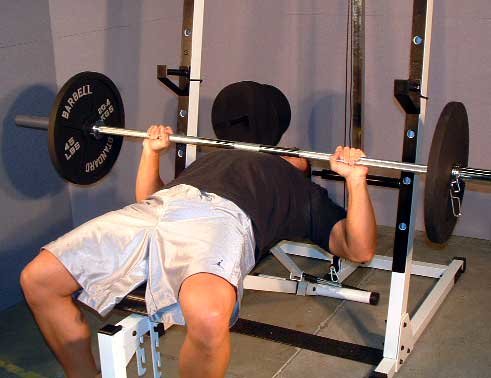
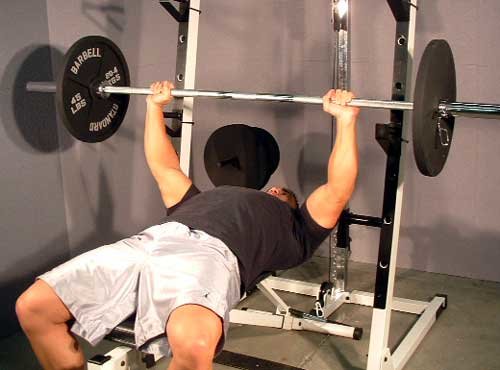
 Click Image To Enlarge.
Flat Barbell Bench Press
3. Train Proportionally
The bench press and different curl stations always seem to be occupied, while many squat racks and leg stations are idle. Bodybuilders naturally love to train very visible muscle groups such as chest and arms, so exercises that target these areas are the most popular. Don't fall into this trap because you will quickly become disproportionate and asymmetrical.
If you plan to compete in bodybuilding competitions, you will receive very low marks for this type of figure. Be sure to train your lower body in addition to your upper body, and don't overlook less popular muscles such as forearms, obliques, and calves. These muscles are often the difference between a good physique and a great physique. Lastly, be sure to self-assess as well as having a third party assess your development every few months.
4. Remember To Rest
Lifting weights does not cause your muscles to grow; the recovery period is what leads to gains. Too many beginners think that the more you train, the more you will grow, and this is simply wrong. The opposite is actually true, and rest is a vital component in any bodybuilder's regimen that should both be scheduled and randomly allotted based on soreness and fatigue.
When you train a muscle or muscle group, the resistance causes fibers to tear slightly. Afterwards, the body essentially repairs and rebuilds these damaged muscle fibers through protein synthesis with various available amino acids.
Each rebuilding phase results in a slightly larger and slightly stronger muscle. These phases require proper nutrients and time, so if you constantly train a certain muscle group or don't get adequate rest or sleep, recovery is stunted.
I personally aim for about 3 days rest for major muscle groups such as chest, back, and quads. Smaller groups such as abdominals are given about 2 days rest.
If you are a beginner, though, soreness will be markedly higher, so be sure to rest and recover even more to be on the safe side.
5. Because More Isn't Always Better
Like life in general, too much of a good thing can turn bad. The unfavorable consequences of too much training were discussed above, and the same rules apply to protein.
The bodybuilding community is known to stress (and potentially overstress) the importance of protein consumption. While it is absolutely true that adequate protein is necessary for successful protein synthesis and muscle growth, there is such a thing as too much protein.
When involved in a training program, you should consume between 1 and 1.5 grams of protein per pound of body weight. Where you are should be determined by your overall goal, so if you're looking to cut down, stay towards 1 gram per pound, and if you're aiming to bulk up, consumption should be on the high end.
Too much protein will simply go unused by the body and be stored as muscle glycogen, then fat. So if you are eating a lean protein source at every meal in addition to snacking on products such as dairy, you probably don't need multiple protein shakes throughout the day.
6. Keep Things New And Fresh
If you are just starting resistance training or bodybuilding, those first few workouts will leave target muscles absolutely fatigued. You will walk funny, perform everyday actions gingerly, and feel pain with the slightest of movements. This is good, however, as it is a signal that you are well on your way to making gains.
You want to be able to experience this 'good' pain (although not to the same extreme as when you first started) after every session, so I am a big proponent of varying workouts and diverse training techniques. The human body is naturally inclined to acclimate and adapt in order to avoid stress.
By doing the same exercises day in and day out, you are giving your body time to get used to the routine, which will result in lower and lower effectiveness. This is often known as a plateau, and it is an enemy of all bodybuilders.
So when you get to a point when certain exercises are too easy and you are not sore afterwards, it is time to increase the weight, vary reps, add drop sets or forced reps, or pick new exercises all together.
Each time I train chest, for instance, I try to pick a whole new group of exercises to target that muscle group. One session will be flat bench, incline dumbbell flyes, cable cross-overs, and close-grip push-ups. The next session will be incline bench, decline dumbbell flyes, dips, and wide-grip push-ups.
7. Supplements Are Tools, Not Miracles
Supplements are used to reinforce and complement a well-rounded diet and exercise program. If you train adequately and follow a clean diet, supplements can help you develop muscle, eliminate fat, generate energy, and recover.
For example, protein powders are a fast, easy, and cost-efficient way to meet your daily protein intake because it is often impractical to carry around cans of tuna or pieces of chicken. Supplements DO NOT, however, replace hard work and dedication.
Too many people have the gross misconception that because they take a certain pill or powder, they can slack off at the gym or raid the refrigerator. This type of mentality can greatly sabotage your goals because the progress lost by skipping workouts and the extra calories consumed by overeating far outweighs the benefits of supplementation.
For example, if you think that you can eat more because you are on a fat burner, consider this—one dose of most common fat burners allows you to expend about 150 extra calories a day, the equivalent of one and half cans of soda.
8. Do Your Research
The teenage body is markedly different from the adult body, and these differences must be considered when supplementing. Mainly, teenagers are still undergoing hormonal and psychological changes. Add to this the fact that the common teenage bodybuilder is a lot less informed about supplements than the average adult bodybuilder and the message is clear—be cautious and do your homework.
Do NOT simply take a supplement because your buddy, a famous bodybuilder, or the guy on the late night infomercial does. Instead, do some research. Consult a variety of sources such as medical studies, reputable magazines, and trusted individuals to see exactly what you're getting into.
Be sure to figure out what the supplement does, how it does it, the recommended dosage, potential side effects, and the ingredients, among other things. If you plan to take a variety of supplements, be sure to find out how these various substances will interact with one another.
For example, I have found through research and personal experience that some casein protein combined with an L-Glutamine supplement at night helps me recover more effectively and feel renewed for my morning workouts. So the more you know, the more effective your supplementation will be.
9. Do It For Yourself
The last piece of advice I want to impart on teenage bodybuilders and all other readers is probably the most important and overarching piece. The motivation and drive to body build should come from yourself. In other words, the diet, the training, and the sacrifices (and there will be many) should be because you want to improve yourself and push your body to its limits.
As trite as this may be, you should not start bodybuilding to impress or please others. While this may very well happen as a result of your efforts, they should not be your primary motivation.
I say this because there will be many days when you find it near impossible to get out of bed or perform that last rep. The cute girl from your algebra class won't be there to help you get through it. Success will only result if you truly enjoy what you are doing and what will result.